
Dorothy Leigh Sayers did much to help make detective fiction respectable
Dorothy L Sayers was, alongside Agatha Christie, Margery Allingham and Ngaio Marsh, one of the leading figures of the ‘Golden Age of detective fiction’ in the 1920 and 1930s.
Dorothy Leigh Sayers was born at Oxford on June 13 1893, the only child of the Rev Henry Sayers, who was in turn the son of the Rev Robert Sayers from Co Tipperary.
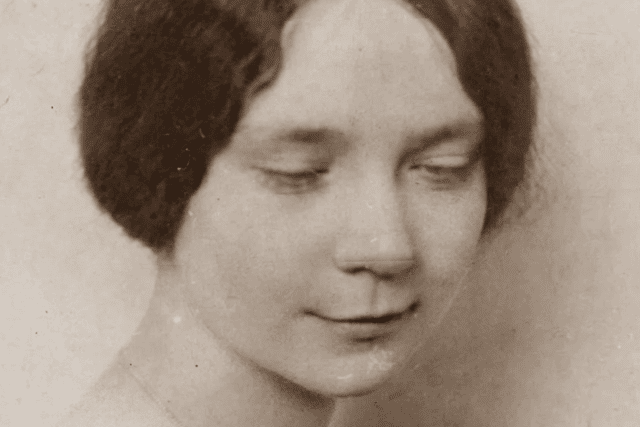

At the time of her birth, her father was headmaster of Christ Church Cathedral School and chaplain of Christ College, Oxford. In 1897 her father became rector of Bluntisham-cum-Earith, a remote parish in the Fens of East Anglia.
Home-educated, she could read by the age of four. Being an only child and leading a solitary existence, she made full use of her father's extensive library.
Her father began teaching her Latin before she was seven. She had lessons in French and German from governesses.
At the age of 15 she entered the Godolphin School, Salisbury. Being a High Church Anglican, she found its Low Church ethos uncongenial.
Winning a scholarship to Somerville College, Oxford, she earned the equivalent of a First in her course in Medieval French in 1915. However, the university still refused to award degrees to women. When Oxford changed its rules in 1920, Sayers became one of the first women in the university’s long history to receive a degree.
Although teaching did not greatly appeal to her, to earn a living she taught modern languages at Hull High School for Girls. In 1917 she secured a post with the publisher and bookseller Basil Blackwell in Oxford.
Between 1919 and 1922 she taught in Normandy and London before becoming a copywriter at S H Benson, then the UK’s largest advertising agency. There she devised highly successful campaigns for Guinness and Colman’s mustard. Although often credited with coining the slogan ‘My Goodness, My Guinness’, the slogan only made its appearance in 1935, six years after she left the firm.
In 1923 she published her first novel, ‘Whose Body’, which introduced Lord Peter Wimsey, the amateur sleuth who featured in 10 more novels and in collections of short stories.
Lord Peter is the younger brother of the 16th Duke of Denver, eventually succeeding him to become the 17th Duke.
Educated at Eton and Balliol, graduating with a First in history, he was also athletic and an outstanding cricketer. His other interests extended to collecting incunabula, bell-ringing and playing Bach.
Aristocratic, wealthy, slightly eccentric and with impeccable manners, Wimsey is ferociously clever, though he normally managed to conceal the fact.
Assisted by his valet and former batman in the Great War, Mervyn Bunter; by his good friend and later brother-in-law, police detective Charles Parker; and, by Harriet Vane, who becomes his wife, he solves crime as a hobby.
There has been a great deal of futile speculation about who was the model for Lord Peter but he may well have been her creation without too much resort to Oxford contemporaries of her acquaintance.
In ‘How I Came to Invent the Character of Lord Peter Wimsey’, Sayers amusingly explained: ‘Lord Peter's large income... I deliberately gave him... After all it cost me nothing and at the time I was particularly hard up and it gave me pleasure to spend his fortune for him. When I was dissatisfied with my single unfurnished room I took a luxurious flat for him in Piccadilly. When my cheap rug got a hole in it, I ordered him an Aubusson carpet. When I had no money to pay my bus fare I presented him with a Damlier double-six, upholstered in a style of sober magnificence, and when I felt dull I let him drive it. I can heartily recommend this inexpensive way of furnishing to all who are discontented with their incomes. It relieves the mind and does no harm to anybody’.
Ngaio Marsh accused Sayers of having ‘fallen in love’ with Lord Peter and she may well have been right.
On the other hand, Harriet Vane, a cerebral, Oxford-educated mystery writer who was Lord Peter’s intellectual equal, may have been essentially a self-portrait.
Unsurprisingly, some of Sayers’ novels are drawn from life. ‘Murder must Advertise’ (1933) draws on her experience at S H Benson’s.
‘The Nine Tailors’ (1934) is set in the Fens. The Rev Theodore Venables, the clergyman in the novel, is a portrait of her father and his rectory is based on her childhood home.
‘Gaudy Night’ (1935) is widely regarded as her finest Wimsey novel and is set in Harriet Vane's old Oxford college (and in reality Sayers’ alma mater).
There is an attempted murder but Lord Peter identifies the culprit in time to prevent further harm. At the end of the book Lord Peter proposes to Harriet (in Latin) and is accepted (also in Latin).
From the mid‐1930s Sayers wrote plays, mostly on religious themes, which were performed in English cathedrals and broadcast by the BBC.
Her innovative radio dramatisation of the life of Jesus, ‘The Man Born to be King’ (1941-42), was denounced as blasphemous because Sayers insisted on using colloquial speech. She believed the Authorised Version was ‘over-familiar to churchgoers and incomprehensible to everyone else’. It reached a huge audience during the darkest days of the Second World War and was rapidly recognised as an important work.
Reading Dante in the original Italian during the Blitz, she concluded he was ‘simply the most incomparable story-teller who ever set pen to paper’. Her major preoccupation became translating the three books of the ‘Divine Comedy’ for Penguin Classics.
She completed ‘Hell’ and ‘Purgatory’ before her death but the largely completed final volume, ‘Paradise’, was finished by her friend Barbara Reynolds. In 1989 Reynolds opined that because of Sayers's translations, Dante has been read by ‘more English-speaking readers in the last 40 years than he had in the preceding six and a quarter centuries’.
She died unexpectedly on December 17 1957 at her home in Witham in Essex.
While best known for her Wimsey novels, she considered her academic and religious works – especially her translation of Dante’s ‘Divine Comedy’ – to be her greatest achievements.
However, P D James has observed that Sayers ‘did as much as any writer in the genre to develop the detective story from an ingenious but lifeless puzzle into an intellectually respectable branch of fiction with serious claims to be judged as a novel’.