
From HRH Princess Anne to football legend Pelé: The colourful journey of Belfast artist Keith Drury, from a garage studio to global recognition
Love Your Local: Known for his colourful, detail-rich 3D artworks, Keith Drury reveals how faith, community, family and a late autism diagnosis helped shape a unique artistic vision that continues to connect with audiences across Northern Ireland and beyond
People often ask me how I became an artist. The truth is, art has been part of my life for as long as I can remember.
I grew up in Belfast and, before becoming a full-time artist, I trained for the Presbyterian ministry and spent many years serving at May Street Presbyterian Church in the city centre. That chapter of my life was about people and community. We used the church in creative ways, from jazz nights and community events to safe nightclub-style evenings for teenagers. Looking back, I recognise the same instinct has always been there — creating spaces people can enter, enjoy and feel part of.
Art was there from early on too. My father bought me my first paint set and brushes after I told him, during a visit to the Ulster Museum, that I thought I could do better than some of the work on display.

Later, a Belfast gallery owner at Magee Gallery on the Ormeau Road took a chance on me, lending me paintings to study and encouraging me to create my own versions. That experience gave me confidence and helped me believe I could become an artist.
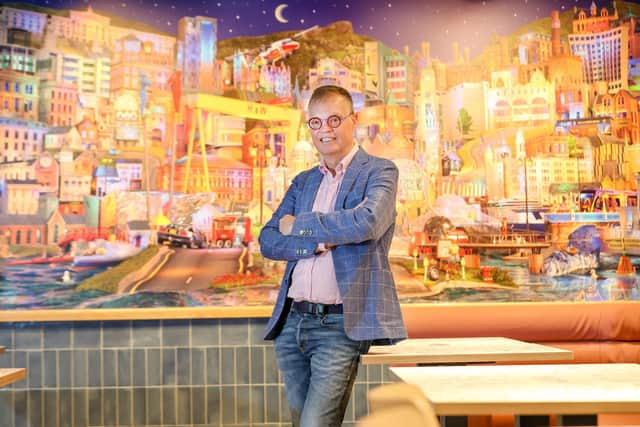
Keith Drury Art became a business in 2013, but my ambition was never simply about selling paintings – it was always to create something distinctive.. Today I create 3D artworks focused on Belfast and other recognisable places, reimagined in a brighter, more colourful way and full of hidden detail.
I describe my work as “life, but brighter. Real, but lifted.” It is recognisable but not literal, filled with small figures, buildings and moments that reward closer inspection.
What makes my work different is the mix of technology and traditional artistic instinct. I taught myself 3D software, particularly Maya, and use digital modelling to build entire worlds rather than simply images. This gives me depth, narrative and atmosphere, while still relying on a painter’s eye for colour and composition.
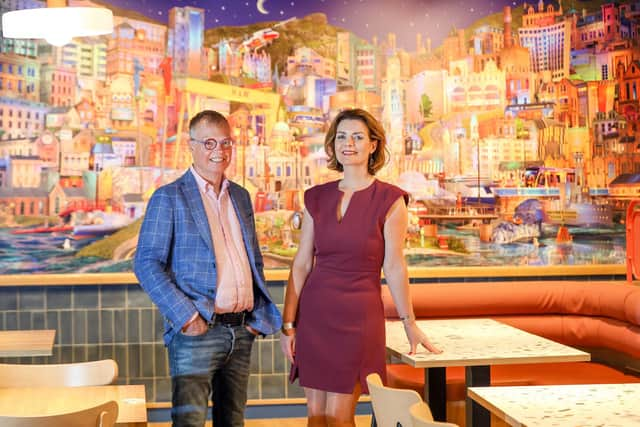
There is also a personal layer. My wife Deborah appears in my artworks as a girl holding a balloon — a recurring detail that turns each piece into something more intimate, almost like a hidden thread running through the work.
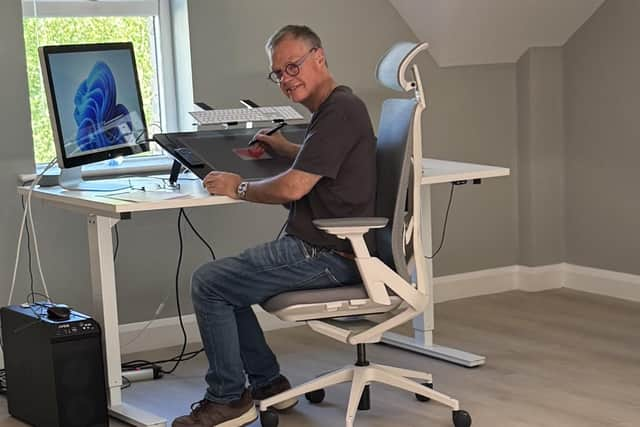
A typical day is a mix of creativity, business and problem-solving. I can spend long periods absorbed in a single piece. Since receiving a late-life autism diagnosis, I understand my hyperfocus better. It can be intense, but it is also what allows me to build the worlds that define my work.
Alongside the creative side — researching places, building structures, adding detail and characters — there is also the business side. Deborah now works full-time in the company and we run it together, managing commissions, galleries, customers and planning.
No two days are the same, but most are driven by the aim of creating work that makes people stop, look closer and feel something. I often work late at night when things are quiet and I can fully focus.
One of the biggest highs has been seeing my work reach wider audiences, including winning a Europe-wide portrait competition on Irish history and heritage. That oil painting still hangs in Belfast City Hall.
Another highlight was having an artwork presented to HRH Princess Anne. I also had the privilege of personally presenting an early painting to Pelé in Dublin.
Other milestones include international collectors, gallery representation and charitable projects. I worked with The Odyssey at the SSE Arena on “Hospice Hockey”, raising significant funds for the Northern Ireland Hospice, and created a piece marking 80 years of Mencap in Northern Ireland, exhibited at Stormont.
But the real high is simpler — watching someone stand in front of a piece and slowly discover the stories within it.
The early years were challenging. When the business started in 2013, I worked from a garage and a bedroom, and the first year of accounts was difficult. My accountant once joked that if I couldn’t pay in cash, I could pay in art.
There were also personal challenges. My autism diagnosis brought clarity to long-standing experiences such as sensory overwhelm, hyperfocus and difficulty with change. It didn’t change me, but it helped explain me.
The lows were often about uncertainty — financial pressure, creative strain and not always understanding my responses to the world.
I’m proud that my work is instantly recognisable and has become its own visual language. I’m also proud that the business has grown from modest beginnings into a recognised creative brand in Northern Ireland.
On a personal level, I’m proud that Deborah and I have built this together. The business is as much about partnership and trust as it is about art. Deborah is central to everything we do.
I’m also proud that what once felt like difference has become part of the explanation for the work.
If I could change anything, I would try to understand myself sooner. The autism diagnosis gave language to experiences I had lived with for years. It helped us understand the thinking behind the work more clearly.
From a business perspective, I might also have trusted the value of my work earlier. Like many artists, I had to learn how to build a sustainable practice around creativity. But the journey shaped the work — the garage, the bedroom and the setbacks all became part of the story.
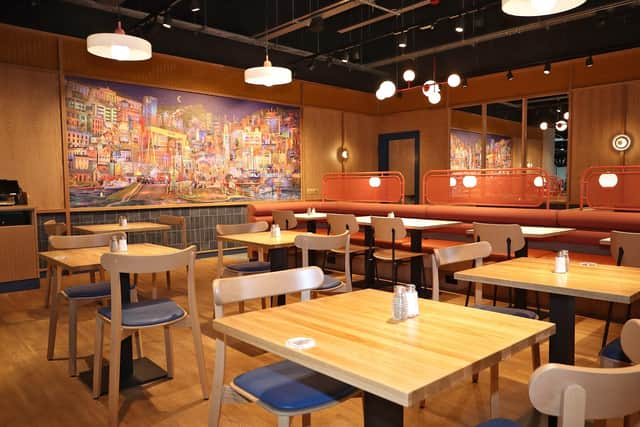
My most recent news is the unveiling of Best of Belfast, a commissioned mural by SSP Group, now displayed at Belfast International Airport’s departures lounge. It places my work in front of millions of travellers and marks one of the most visible projects of my career. For Deborah and me, it represents both business achievement and recognition.
Looking ahead, I want to work with more companies and venues to create bespoke artworks that go beyond decoration. The right piece can tell a story, capture identity and create a sense of place. Whether in a hotel, airport or public space, art can turn a building into an experience.
We are also looking forward to another corporate partnership in Belfast later this year.
As Oscar Wilde said, “Some things are too important to be taken seriously. Art is one of those things.”
For me, art is about atmosphere, memory and feeling. My autism diagnosis has become part of how I understand my work. It didn’t change who I am, but it helped explain the intensity, focus and detail behind each piece.
Ultimately, I hope people who see my work feel something — recognition, curiosity, or a sense of seeing the world a little differently.