
'This is the right decision for our business': Belfast yard leads Navantia UK’s move to renewable energy across Britain
The Belfast-based shipbuilding group has moved to 100% renewable electricity across its UK sites, cutting emissions and supporting community-owned energy in the Western Isles
Navantia UK has switched all of its UK shipbuilding yards, including its Belfast site, to 100% certified renewable electricity sourced from a community-owned wind farm in the Hebrides.
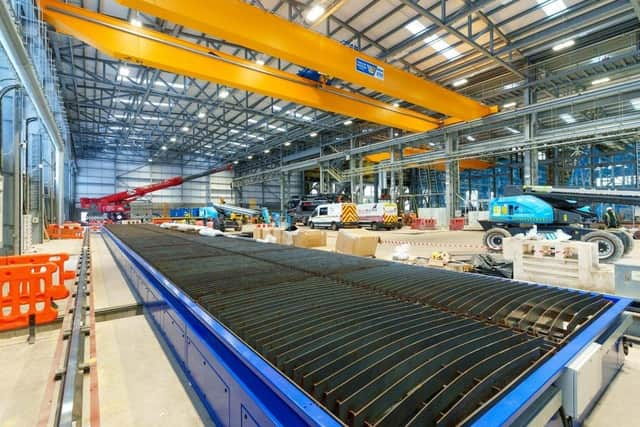

The company has confirmed that its Arnish, Methil and Appledore yards are now powered entirely by renewable electricity supplied by ENGIE and generated in partnership with the Point and Sandwick Trust on the Isle of Lewis.
The supply is linked to Beinn Ghrideag, the UK’s largest community-owned wind farm, located just over two miles from Navantia UK’s Arnish yard near Stornoway. With the latest agreement in place, every Navantia UK site across the UK, including Belfast, is now operating on certified renewable electricity backed by Renewable Energy Guarantees of Origin (REGO) certification.
The move will reduce the combined carbon emissions of the three yards by 28%, marking a significant step towards Navantia UK’s ambition of achieving Scope 1 and Scope 2 carbon neutrality by 2040.
Beyond the environmental benefits, the agreement is also designed to deliver direct economic value to local communities. The Point and Sandwick Trust is a community-owned charity that reinvests all profits from Beinn Ghrideag into the Western Isles, supporting local infrastructure, employment, education, environmental projects and initiatives to tackle fuel poverty.
By sourcing electricity through this arrangement, Navantia UK is effectively channeling energy spend back into communities surrounding its Arnish yard, an area identified within the Scottish Index of Multiple Deprivation.
The company said the decision reflects its wider commitment to sustainable industrial development across the regions in which it operates, combining investment in advanced manufacturing with social and environmental impact.
Navantia UK chief executive Donato Martínez said the move represents both a practical and symbolic step in the company’s transition.
“This is the right decision for our business, for the environment and for the communities where we operate,” he said. “As we continue to invest in our UK yards and transform them into some of the most modern shipbuilding and fabrication facilities in Europe, we want the way we power them to reflect the values that underpin that investment.
“What makes this agreement particularly special is its local impact. The renewable electricity powering our Arnish yard is generated just a few miles away by a community-owned wind farm, meaning that the benefits of our energy use are helping to support jobs, facilities and opportunities across the Western Isles.
“Navantia UK is committed to building a more sustainable future, not only through the ships and infrastructure we deliver, but through the way we operate every day. This agreement is another important step on that journey.”
Point and Sandwick Trust founder and director Dr Calum MacDonald said the deal demonstrates the potential of community energy on a national scale.
“We can take great pride that our community-owned turbines are not just supplying green energy to Arnish, but also to Navantia yards across Britain,” he said. “The scale of our output and our ability to win such contracts in a highly competitive market shows that community energy can deliver and compete on the big stage.
“I hope it encourages other communities across the UK to raise their ambitions so we can release the full potential of community-owned green power.”
UK Energy Minister Michael Shanks said the agreement reflects a wider shift in how industry is powering growth.
“Businesses like Navantia UK are turning to clean, homegrown power not just because it’s better for the climate, but because it lowers their bills and drives growth,” he said. “This is what the clean power mission looks like in practice: British industry powered by Hebridean wind, with benefits flowing back to the communities that generate that power.”
The Point and Sandwick Trust already supplies other organisations across Scotland and continues to expand its customer base as demand for community-owned renewable energy grows.