
Soil Nutrient Health Scheme research ‘maps the way ahead’
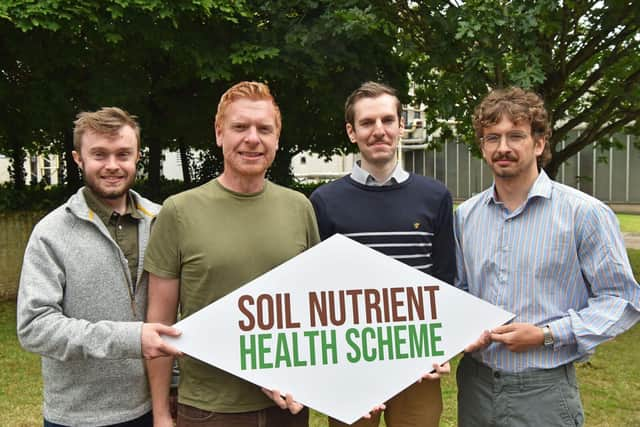
Researchers working on the Soil Nutrient Health Scheme have confirmed that the first broad scale research work has just been published. The collaboration between AFBI and Ulster University has focussed on identifying key areas for diffuse nutrient loss at fine scale across the NI landscape, as a guide to landowners in avoiding losses of valuable nutrients to streams and rivers.
The loss of nutrients in runoff to hydrologically sensitive areas (HSA), from land to watercourses during rainfall events, provides a large proportion of the loads moving downstream to our lakes and coastal areas annually.
Until now, areas susceptible to runoff were very difficult to identify on the ground and normally only visible during heavy rainfall and where vegetation cover is low.
The complex landscape combined with highly variable soil types in Northern Ireland (NI) add to the challenge. Actions to reduce losses from these areas, whether through land use management or installation of measures to trap and retain nutrients on land, are essential in breaking this land-water link and reducing nutrient, and particularly phosphorus, inputs to the aquatic system.

This will be particularly important as it is embedded as part of the strategy to reduce nutrient pressures on Lough Neagh and improve water quality more generally in NI.
Within the DAERA-funded Soil Nutrient Health Scheme research programme a specially commissioned LiDAR (Light Detection and ranging) survey, together with soil mapping and advanced geospatial modelling techniques, the state-of-the-art approach has been applied across the 6,927 km2 area of Zones 1 and 2 of the Soil Nutrient Health Scheme.
In-field runoff HSAs covering 249 km2 of the highest risk were defined across over 400,000 fields and will ultimately be provided for all 700,000 agricultural fields in NI. All farmers in these areas can now access the maps within the SNHS online map viewer provided through their Government Gateway accounts.
Pieter-Jan Schön Head of Environment and Marine Science Division at AFBI said: “Research activities as part of the Soil Nutrient Health Scheme will ensure a strong scientific foundation to the information we provide to participating farmers across Northern Ireland.

"The runoff risk maps are a starting point that can be used by farmers and their advisors, to target appropriate measures and management on those specific areas of their farms. Ultimately this will help retain nutrients on the land where they can be used for crop growth, while reducing losses and the resultant impact on our rivers and lakes”.
Dr Rachel Cassidy, AFBI-lead on the project commented: “This research marks a major breakthrough in the high resolution mapping of key areas for mitigation in the agricultural landscape to help farmers take action in the right places”.
Prof Phil Jordan at Ulster University added: “This collaborative work provides an important new tool for agri-environmental management in Northern Ireland and made possible by developments in new technology and data analysis”.
The published research article can be read Open Access in the international Journal of Environmental Management at https://doi.org/10.1016/j.jenvman.2024.122110 More information: https://www.afbini.gov.uk/articles/soil-nutrient-health-scheme