
Belfast sisters Frances Kane and Mary Delaney share their experience of being diagnosed with coronary heart disease in their twenties
Two North Belfast sisters are sharing their experience of coronary heart disease in their twenties to highlight the gender inequalities that exist in the diagnosis of the condition in women.
Frances Kane and her sister Mary Delaney, whose father had a heart attack in his 40s, were both initially ruled out as suffering from heart disease due to their gender and young age.

However, when Frances was 27 and studying for her PhD she began experiencing breathlessness, chest and arm pain, which she initially thought were just “niggles, or something muscular.”
When she could no longer walk up the stairs without having to stop, she decided it was time to see her GP, who said the chest and arm pain were likely caused by allergies, so she was sent home with antihistamines.
On a repeat visit to the GP, Frances was told once more that she was too young to have anything wrong with her heart and instead received a lung function test, the results of which were normal.
However, Frances knew her symptoms were related to something more serious, so a few months later, she went to the emergency department.
“I went up and down the stairs in the hospital as many times as I could to bring on the pain so I could show the doctors and nurses what I meant.”
After being reviewed at the emergency department, she was referred to a cardiologist and sent for a treadmill ECG test. The test showed a minor abnormality so Frances was told she would be sent for a coronary angiogram.
“I was told that I would receive a coronary angiogram to rule out coronary heart disease and a heart attack but that was unlikely as I was a young woman."
The coronary angiogram showed a blockage in Frances’ artery.
"I was told that my artery was 70 per cent blocked and that I was on my way to a massive heart attack. That was very hard to hear when I was so young. I felt shocked. I then felt very sorry for myself. I went home and cried on the sofa and asked myself: why did this happen to me? The doctors always referred to my age and gender as a young woman to dismiss my concerns that my problem was heart related. My persistence when I knew myself that something wasn’t right, probably saved my life”.
When Frances was diagnosed with coronary artery disease, her sister Mary was offered a stress echocardiogram. Although the results showed no abnormalities at the time, three years after her sister’s diagnosis, at the age of 26, Mary was also diagnosed with coronary artery disease.
Mary was told by the doctor that she was a “ticking time bomb.”
She had been treated for high blood pressure since she was 22 years old, but she was generally in good health.
“I was active, as an A&E nurse I was always on my feet. I had symptoms for three weeks before I received a diagnosis. I had shortness of breath, chest pain on exertion but I dismissed the symptoms until I felt really unwell. Had it been a male patient in his 60s or 70s telling me of these symptoms, I would have known right away not to ignore it.”
Mary was at work when she told her colleagues how unwell she felt so she was referred to the consultant cardiologist.
“When the consultant saw that a young female had been referred, they challenged the referral; the cardiologist queried why a 26-year-old female was being referred for review by cardiology. I wasn’t taken seriously. Because of my sister Frances’ diagnosis, the cardiologist agreed to see me”.
Mary was sent for a treadmill test which showed ECG changes on exertion. She then proceeded to have an angiogram which showed 90 per cent stenosis in her coronary artery, similar to her sister Frances.
She had a stent fitted from the point of diagnosis.
“It was described as a ticking timebomb. If I hadn’t had the quick escalation due to Frances’ diagnosis, I would have been on my way to a massive heart attack”.
Coronary heart disease (CHD) is one of the leading causes of death for women in Northern Ireland – killing twice as many women each year as breast cancer
However, research has revealed that women are less likely than their male counterparts to know the symptoms of this devastating disease and less likely to get optimal treatment.
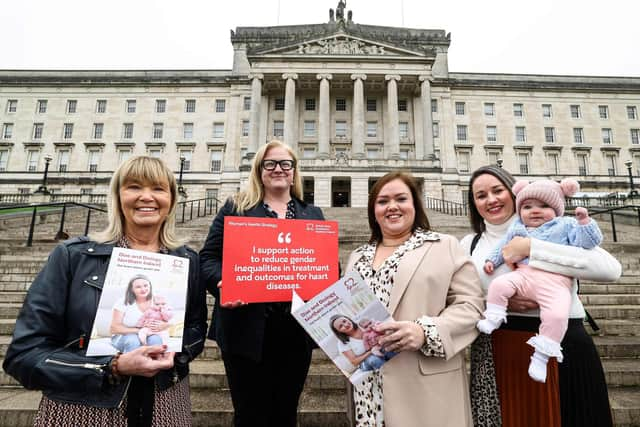
The British Heart Foundation Northern Ireland (BHF NI) has published a report on the heart attack gender gap and is calling on the NI Executive to deliver a Women’s Health Action plan that prioritises cardiovascular health and tackles these inequalities across the cardiac pathway.
BHF NI estimates that there are currently around 26,000 women in Northern Ireland living with coronary heart disease . However, women with heart disease are disadvantaged at each stage of their patient journey. A growing global body of research over the years has revealed sex inequalities across the cardiac care pathway.
Health & Care lead for BHF NI and cardiac nurse Karen McCammon said: “Women who experience a heart attack are more likely than men to be misdiagnosed or receive a delayed diagnosis and are less likely than men to receive guideline-indicated treatment. As a result, women have higher mortality rates than men following a heart attack.”
Karen added: “Equipping women in Northern Ireland with clear information to empower them to quickly and confidently recognise the onset of heart attack symptoms could mitigate delays in seeking medical attention and reduce mortality and morbidity.
“Working alongside key stakeholders in health, we want to change the public perception of women and heart disease. Our aim is to start a conversation today so that, in the future, more women’s lives are saved, and women make a better recovery from heart disease.”