
Princess of Wales tries her hand at using 'flax brake' as Kate and William visit linen farm near Cookstown, Co Tyrone, Northern Ireland
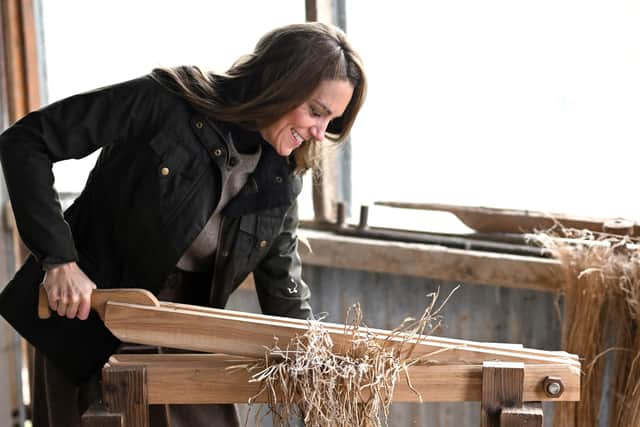
The Princess of Wales has thrown herself with gusto into operating an old-fashioned “flax brake” during a visit to a County Tyrone farm.
The farm, run by husband and wife team Helen Keys and Charlie Mallon, aims to rebuild a sustainable flax-to-linen supply chain in Northern Ireland.
Helen and Charlie have been restoring heritage machinery from 1941 to produce natural fibre products “from field to fabric”.
She was previously awarded an MBE for her work in part for work in this area.

Although they travelled in a large royal motorcade of black SUVs and motorcycle outriders, the Prince and Princess of Wales pulled quietly into the unassuming Tyrone farmyard in a black Range Rover.
Without any ceremony the royal couple stepped out and, Kate confidently leading the way with an outstretched hand to cheerfully greet linen farmers, Charlie and Helen and his mother Margaret (93).
The highlight for the press was probably when Charlie demonstrated to the couple an old fashioned "flax brake" - a wooden blade in a frame which is used to repeatedly crush the flax.
Invited to try her hand, Kate enthusiastically gave it a go.

Asked later how she performed, Charlie replied: "She did very well."
He joked that he was much better able to cope with the machine as he had much bigger hands.
"It is quite physical work. Your arm would definitely get sore after an hour or so - you would definitely know about it."
Dressed in relaxed country style, the couple were led across several fields by the couple as they arrived, chatting as they went.
They then arrived at a field full of flax, with bundles of flax artfully positioned to greet them.
Following on from his father's interest in heritage, William expressed a curiosity about how and why the industry originally disappeared and the nature of the crop.
But he was matched virtually question for question by Kate, who was equally interested.
They were then led back to the barn where the flax is processed, which houses restored heritage machinery dating back to 1941, which is used for "breaking and scutching".
The entire production process was laid out, from preparing the raw linen, spinning and weaving, with a wide variety of impressive retailed linen products on show as the end product.
These ranged from a leather-like purse, to dolls hair of all colours, and a long rack of stylish linen clothing, displayed by husband and wife team Joel and Amy Anderson of Kindred Ireland.
Other experts the couple met included weaver Mario Sierra from Mourne Textiles and Tiernan Stuart, an inventor of a mini spinning machine.
Speaking after the royal couple left, Helen said: "They were really interested in the farming side of things."
The Prince was really interested in the many opportunities of what can be done with the crop.
The couple had lots of questions around the entire process, she said.
"They were also interested in the practical aspects of how to scale the process up and what that would look like and the current gaps in the process."
Helen said their whole team worked hard to prepare for the visit and that they were really excited by the opportunity it presents for them.
"It was just lovely to have them here."
She added: "There has been a little bit of ‘hidying’ as we call it - tidying - but we are who we are.
"We thought it was important just to be ourselves as well."
Asked if they were in any way awed by having the royal couple on the farm, she laughed: "Ask us in half an hour - what just happened"?
Charlie is a blacksmith by trade who has worked in London and Dublin.
He later began experimenting with bronze sculptures and wanted to package them in Irish linen. However when he went to source some he found he had to go to the Netherlands or China.
And that began his interest in flax.
He now farms enough to give about one tonne a year, which he says "is more profitable than milking cows".
Their vision would be for many flax farms across the land, but the weakness in the process is the lack of spinning facilities.
Several weavers were present on the farm who are looking at old fashioned and modern solutions to the problem.
"The industry didn't work in the past so we don't want to go back to poor conditions in factories," Helen added.