
Retro: Dromara iron ore mine plan not ‘a wartime stunt’ (September 1940)


In September 1940 it was reported by the News Letter that steps were being taken to re-open the iron ore mine near Dromara, Co Down, where almost 70 years ago miners were working with, it was claimed, “good prospects of success”.
Ignoring condemnatory reports of government experts and geologists, the promoters of the new venture – Mr J I Chapman, of Messrs Chapman and Company, structural engineers, Sydenham Road, Belfast, and Mr A E Dodd, of Dromara – had sunk a shaft alongside the original workings, and were pushing ahead with exploration work. Samples have already been sent to two of the biggest steel companies in Great Britain - one in Scotland and the other in England. The reports of their analysts were shown to a party of pressmen who inspected the mine in September 1940, including the News Letter’s correspondent.
Here is what they had say: “The Scots company found an ore content of 51.19 per cent. This quality,” the report stated, “is very promising indeed, and it would be interesting to know what quantity you would have for disposal and what shipping port you could load at.”
The English company reported a content of 51.52 per cent, and commented “This sample represents rich ore remarkably low in sulphur and phosphorous,” it declared.
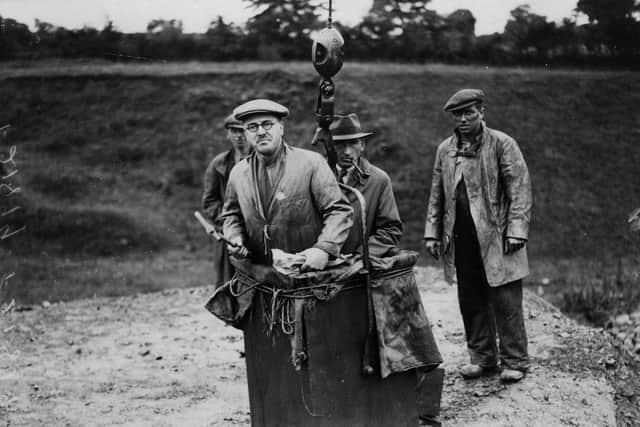
SIX MEN ENGAGED
Six men were employed in the initial stages, but the promoters were satisfied that if their ambitions were realised, they would be able to give considerably more work.
“Ample reservoirs of labour are available in Banbridge and Rathfriland. I cannot the moment,” Mr. Chapman told the visitors, “give any definite indication of what production will be eventually, but I am convinced that we have unlimited supplies of good ore, and I would say that the prospects are rosy. We are satisfied with what have done so far.”
The visitors included Mr J E Bailey, MP, in whose constituency the mine is situated, Dr Brian Maginess, MP, for Iveagh and Mr H A Maginess.
Both Mr Bailey and Dr Maginess had asked questions at Stormont regarding the possibility of reopening operations, but they said that the reply had always been that the ore was of a poor quality. They were interested in the new development “both on national grounds, and as a source of new employment in the district”.
3,000 TONS OF ORE
Describing to a News Letter reporter how he came to begin investigations, Mr Chapman said: “I was acquainted with the past history of operations in the district. The mine was originally worked between 1872 and 1875, but it had to be closed down owing to the high royalties demanded by the landlord, and to difficulties of transport.
“At that time about three thousand tons of ore were mined. It had to be taken by traction engine to Dundrum, but I believe that the county council refused to bear the cost of damage to the roads. About forty years ago a syndicate was formed to work the mine, but again the royalties were too high. Since then the mine has lain idle, and when came to explore the old shaft we found some of the shovels that had been used by the workers.”
Mr Chapman said that it was about two years ago that he and Mr Dodd conceived the idea, and at the beginning of 1940 they had secured on reasonable terms the lease of ten thousand acres from the Ministry of Finance, the owners of the mineral rights. Excavations had been made on the site of the original shaft and in other parts of the adjoining field.
SEAM UNCOVERED
“Finally,” he said, “we sank a new shaft 45 feet deep alongside the old working. We have uncovered a seam five feet thick and seven feet deep, but we do not know the actual depth - it may be 700 feet deep.
“Yet it has been stated in a government report that the seam was only three to five inches thick, and that the ore was very low grade.”
Mr Chapman emphasised that the project was purely a business proposition, and that they were not now asking the government for any assistance
He had got into touch with the ministry in order to see if the government would assist them to develop quickly, he said; but he had been informed that the ministry could do nothing.
“If we obtained good ore and plenty of it, the ministry would try to get the ministry of interested,” he said.
He continued: “I, personally, got into touch with the Ministry of Supply, and their expert was to have visited the mine some weeks ago; but I was informed that he was engaged on more important work, and that it would be three weeks before he could come.”
One final point that Mr Chapman pressed home was that the work was not intended merely as “a wartime stunt” but as “a permanent peacetime industry”.
He remarked: “Great Britain has imported seven million tons of ore in 1937. At present, supplies of ore are of vital importance, but there is also big demand for ore in peacetime. The samples had shown a higher ore content than those of some mines he had visited in Cumberland.”
ROAMER’S SNIPPETS ON DROMARA
Reflecting on this history of Dromara a number of days after the press day at the mine The Roamer wrote: “What with new methods of retting flax and searches for iron ore the village of Dromara is in the news. Let us hope that these activities which have brought if publicity, will bring it a measure of fame and prosperity. It is a forgotten village. The main streams of traffic pass it by, one going by Dromore, the other by Ballynahinch. It lies in a sleepy hollow below the brown shoulder of Slieve Croob, and near it the infant Lagan tumbles over its boulder filled course. The Dromara district was once in the possession of the County Down family of Magennis, but after 1641 it came into the possession of Sir Moyses Hill, founder in Ireland of the Downshire family, and the village was at one time called Annsborough, after a member of that family. Sir Moyses married an Anne Grogan as his second wife, his son, Arthur, who was created Constable of Hillsborough Fort in 1660 and married Anne, daughter of Richard Bolton, Lord Chancellor of Ireland. Arthur’s son, Moyses, marred his cousin Anne, daughter of Francis Hill of Hill Hall.”