
65th anniversary of the death of Harry Ferguson
On the 25th October, 2025 it will be 65 years since the death of one of Northern Ireland’s and indeed the world’s greatest ever innovators, Henry George Ferguson or Harry Ferguson as he was more commonly known. Harry Ferguson passed away at his home at Abbotswood near Stow-on-the-Wold, Gloucester, England, United Kingdom on Tuesday 25th October, 1960. His death was the result of a barbiturate overdose, but an inquest into his death was unable to say if it was suicide or accidental.
Harry Ferguson was born into a farming family on Tuesday 4th November, 1884 at Growell near Dromore in County Down. He might have been small in stature, but he was an intellectual giant. His small physical size was not suited to heavy farm labour and is why in 1902 he jumped at the opportunity to go and work for his older brother Joseph Bell Ferguson at his motor vehicle business in Belfast. His inventive streak like so many Ulster-Scots started to show becoming the first Briton to build and fly his own monoplane that took to the sky on the 31st December, 1909 at Hillsborough County Down.
After narrowly surviving a serious plane crash on the 10th October, 1910 at Milligan Strand, County Londonderry that destroyed his plane he built another but his interest started to drift away from aviation in 1913 by which time he had formed his own company to sell cars, motorcycles and tractors.
A new interest began to play a more and more important part in his life and that was the modernisation of the farm tractor and plough. Tractors at the time were designed to replace a horse to pull a plough or harrows and Harry Ferguson thought there must be a better way to attach a plough to the tractor and in doing improve its control.
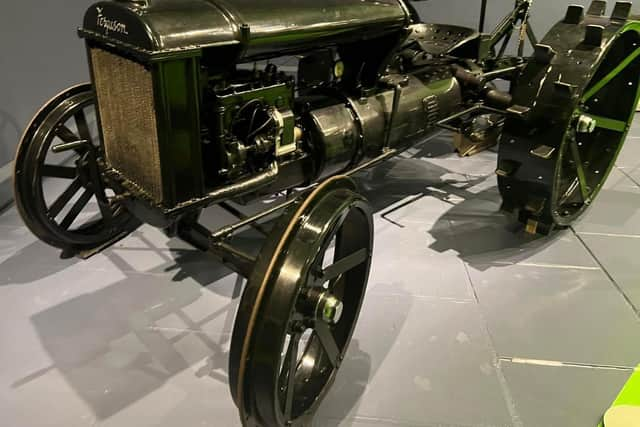

By 1917 he had started production of his first plough directly attached to a tractor called the Ferguson Belfast Plough.
As research and development continued he developed the duplex or two point hitch in 1919 to connect a plough to the Fordson tractor but this only suited ploughs and not the wider range of implements he and his chief engineer William Sands was working on. In 1925 he filed his Ferguson Master Patent that celebrates its centenary this year which is the actual invention of the modern tractor with quickly interchangeable implements and automatic depth control.
1928 would see his Patent filed for three point converging linkage, a big improvement on the duplex hitch, allowing a wider range of different implements to be attached.
From 1931 to 1933 he and his engineers would build the Ferguson Belfast Black Prototype tractor at Belfast to demonstrate ideas first envisioned in the Ferguson Master Patent in the hope to get the tractor mass produced. The Ferguson System with three point converging hydraulic linkage as fitted to the Ferguson Belfast Black Prototype tractor would after almost 2 and a half years finally be perfected in 1935 in the fields of Country Tyrone. The Ferguson System celebrates its ninetieth anniversary this year. Universally adopted as an international standard today is fitted to the vast majority of tractors.
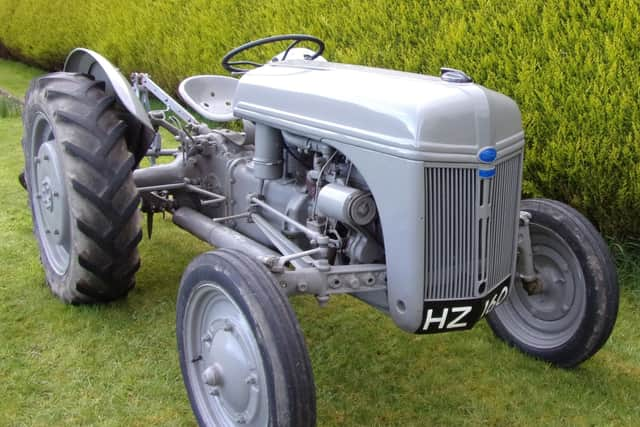
The world’s first production Ferguson System tractor, the Ferguson-Brown Type A would follow in 1936. Sadly it never truly achieved the mass production Harry Ferguson desired and by the time of making the Gentleman’s Agreement with Henry Ford in the USA in late 1938 little over 700 tractors had been built.
The Gentleman’s Agreement between Harry Ferguson and Henry Ford resulted in the revolutionary little grey Ford-Ferguson a ground breaking tractor introduced in 1939 and which by the time production ended in 1947 over 306,000 had been built. Available at the lowest possible price this made them affordable for even the poorest farmer. The Ford Motor Company after ending the agreement with Ferguson would start building a tractor called the Ford 8N that was based on the Ford-Ferguson without Harry Ferguson’s permission. Harry Ferguson owned the intellectual property rights to the tractor and not Ford who only built the tractor. A legal case in which Ferguson sued Ford over the building of the Ford 8N would be settled in 1952 with Ford agreeing to stop production of the tractor and paying Harry Ferguson 9.25 Million Dollars.
Testifying for day after day in the 4 year case, personally submitting thousands of pages of documents to the court, the legal battle took a heavy toll on Harry Ferguson’s health, being unable to sleep. A year after victory in the legal case he decided to sell his Ferguson tractor company to Massey Harris in 1953, the company becoming Massey Ferguson in late 1957. Massey Ferguson today is one the world’s largest and best known tractor and machinery brands.
In later years Harry Ferguson worked on four wheel drive systems with some success in the Ferguson Formula. He also built several prototype vehicles, but never had the same success as with the tractor.
He would make the headlines in February, 1957 when he was shot in the leg at Jamaica while on holiday after fighting off an armed burglar with a walking stick.
Harry Ferguson achieved so much in his life with a legacy respected throughout the world and today he is rightfully recognised as the father of the modern tractor with inventions that helped feed the world.
Sadly 65 years after his passing, Northern Ireland still does not have a Harry Ferguson Museum of Innovation to properly tell his amazing life story but the campaign continues to do so.
Stevan Patterson Castlederg, Co. Tyrone.