
‘An appalling state of affairs through ruined crops and flooded homes’ (October 1946)

An assurance that the Ulster government was making every effort to eliminate the flooding of agricultural land in Co Fermanagh by the water of Lough Erne was given in a letter which the Prime Minister, Sir Basil Brooke, had sent to the president of the Ulster Farmers’ Union (Mr A G Algeo, JP), reported the News Letter during at the end of October 1946.
The Northern Ireland Premier, with the Minister of Agriculture (the Reverend Robert Moore) and the Minister of Finance (Major J M Sinclair) had received a deputation from the union on the matter on October 7.
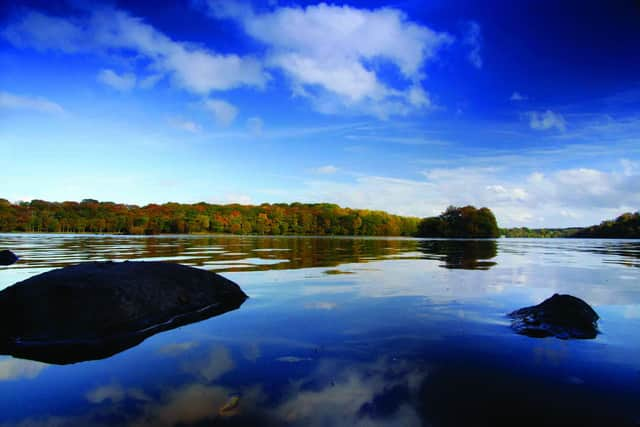

In a statement issued, the union stated that a census of damage during the past few years and the result of this season's wet harvest weather showed “an appalling state of affairs through ruined crops and flooded homes”.
The Prime Minister writing in reply to the Ulster Farmers’ Union stated: “The whole question of drainage conditions in the Lough Erne area has been under discussion between technical officers of the government of Northern Ireland and technical officers of the Eire government and the Eire Electricity Supply Board.
“Certain statutory difficulties still remain to be disposed of and every effort is being made to press forward towards a solution.
“In the meantime, I feel I must point out that I am advised that the mere lowering of the levels, unless carried out in conjunction with improvements in the channel connecting the two loughs, would be unlikely to afford any appreciable relief. In point of fact, the Belleek sluice gates have been kept fully open recently, but the abnormally wet conditions have rendered relief through that method Inadequate to cope with the problem.
“I am sure you and your colleagues are aware of the difficulties which lie in the way of a practical solution, but it may be of help if the outlined.”
The Premier's letter continued: “The drainage works, which were completed over 50 years ago, were designed to maintain the levels of the two loughs at certain specified levels fixed by statute – 153 feet above ordnance datum for the upper lough and 152.66 feet above ordnance datum for the lower lough
“The slightly lower level for the lower lough was designed to provide the hydraulic gradient considered necessary in the channel connecting the two loughs.
“These drainage works have in practice failed to achieve fully the purpose for which they were designed.
“The main reason for this lies in the fact that the capacity of the channel between the two loughs and of the channel between the lower lough and Belleek has proved insufficient to discharge the flood waters as quickly as they run off the catchment area during periods of prolonged and heavy rainfall.
“From this it follows that during continuous wet spells the water levels of both loughs are almost inevitably bound to rise above the levels fixed by statute.”
The responsibility for the drainage of the Lough Erne district had been entrusted to the Lough Erne Drainage Board, the premier noted, “who were under obligation to maintain the statutory levels to which reference has been made”.
He added: “For some years the Drainage Board operated the sluice gates irregularly by reducing the levels to approximately three feet below those fixed by statute.
“This contravention of the law rendered the Drainage Board liable to legal action by any person who could prove that his interests had been damaged by the creation of a level below that authorised by statute.”
An action of this kind in the Courts against the Board had been successful, and was followed in 1940 by the resignation of the board.
“Thereafter a temporary arrangement was made under which the control and operation of the sluice gates are exercised by the respective chief engineers of the governments of Northern Ireland and of Eire.
“The operation of the sluice gates is still subject to the maintenance of the specified statutory levels, but the representations made by you and Mr Tisdale on this aspect of the problem are being fully borne in mind in the course of the discussions with the Eire Electricity Supply Board.”
The Ulster Premier concluded: “The government are fully alive to the urgent need for remedial work s to be undertaken at the earliest possible date and every effort is being made to press the matter to a successful conclusion.”
Irish Regiments abroad - Conditions in Austria
At the end of October 1946 the News Letter office in Belfast had received a further despatch from Major Eric Montgomery, Army Public Relations Officer, Northern Ireland District, who was in Austria on his tour 6th Irish Regiments abroad.
The despatch read: “For concentrated scenic beauty I think Austria surpasses any other country I have ever visited. There is a rugged grandeur about her Alpine mountains, and a secluded homeliness about her valleys which make a deep and lasting impression.
“The Irish Battalions have fallen in love with the country, and little wonder, either, for it offers more attractions to the soldier than any other station I know of.
“Apart from the scenic beauty there is bathing: in a summer climate , such as we seldom experience at home. In the winter there is ski-ing and skating.
“Above all, the people are friendly, for Austria is a liberated, not a defeated , country, and our troops are liked and made welcome wherever they go.
“It would, however, be wrong to picture the life of the soldiers in Austria as one long pleasant holi day. They have their work to do, and their duties arc often hard and monotonous.
“A better way to describe their life would be to say they work hard and play hard. There are probably men with grievances there , as there are in any community; but on the whole the Army is very happy and contented.”
The despatch continued: “Having found this to be the case with the 2nd Battalion Royal Inniskilling Fusiliers at Portschach, I was not surprised to find a similar state of affairs at Volkermarkt, the home of the 1st Battalion Royal Irish Fusiliers.
“The Commanding Office is Lieutenant-Colonel G A French, OBE. He is a Wexford man, and his 27 years' service has all been spent with the “Faughs”.
“In length of service he is just senior to his Quartermaster, Captain W Shephard, MBE, of Dawson Street, Armagh, and they have been together for almost all of their Army life.
“One of the many good features of soldiering in Austria is that the men can have their wives along with them. I rather expected to find that half the Battalion had taken advantage of this, and was surprised to learn that so far only the Officers and NCOs had done so.
“There are, I think, two reasons for this. One is that quite a few of the Fusiliers are too young to have had time to marry yet, and the other is that it is necessary for a husband to undertake to remain in the Army for twelve months before permission can be obtained for his wife to join him.
“As many of the men are taking their release soon, this rules them out.”
Major Eric Montgomery's despatch from Austria concluded: “The “Faughs” have found a solution to the problem of varying the Army menu to suit their own tastes. They have set up a Battalion bakery, which is run by Seregant G McBratney, of Alexander Gardens, Portadown. They also run their own “farm”, which is stocked with pigs, turkeys, geese and hens, and is looked after by Fusilier R McLoughlin, of Ainsworth Avenue, Belfast.”