
Rail law update prompts fresh debate on NI-GB ‘divergence’ post-Brexit
A Conservative peer likened the EU’s approach to legislation to the way ‘drug addicts take drugs’.
Peers have accepted an update to railways law in Northern Ireland, despite fears it will disrupt the supply chain of parts and trains across the Irish Sea.
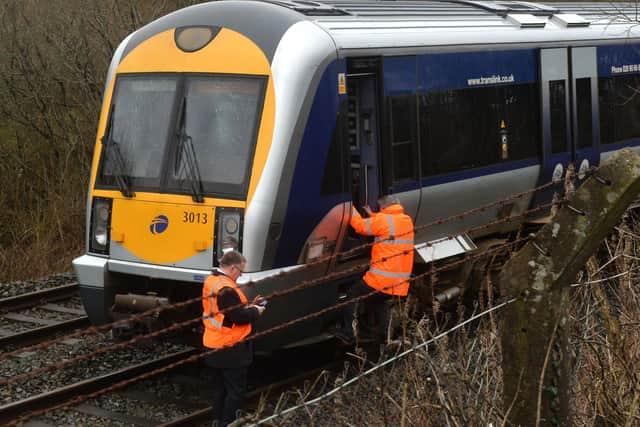

Rail minister Lord Hendy of Richmond Hill said the regulations, tabled as a result of the Windsor Framework, were designed to make sure “trains, railway infrastructure, and railway equipment can operate safely and effectively” across the connected railway networks on the island of Ireland.
Separate legislation sets out the “interoperability” rules in Great Britain, which Baroness Hoey, an opponent of the Windsor Framework, warned will create a “divergence” between two parts of the United Kingdom.
Lady Hoey, a former Labour MP who sits in the Lords as an independent non-affiliated peer, moved a symbolic “regret motion” in opposition to the proposal.
It was voted down by 63 votes to 20, majority 43, and peers agreed to accept the law change.
In her motion, she complained that the regulations “were not subject to a public consultation on the proposed divergence in rail regulations”.
Lady Hoey told the Lords that without a consultation, people in Northern Ireland were “effectively told ‘we have no choice’, and what sort of way is that to run any government, to run our country, to rule any part of the United Kingdom?”
According to the Department for Transport, the regulations put into domestic law a 2016 EU directive which already applies in Northern Ireland.
Referring to the 27-member bloc, which the UK voted to leave in 2016, Lady Hoey said: “The law is being changed by some people and some institution that we have no say in.”
Conservative former minister Lord Lilley, backing the regret motion, said: “I want to make it clear how offensive regulations of this sort are to all unionists, whether they live in Northern Ireland or Great Britain.”
He criticised a bid by the Government to pursue so-called “dynamic alignment” with the EU at a UK-wide level.
“Dynamic alignment will require us to accept all regulations passed by the EU since we left,” Lord Lilley said, as he claimed “a tsunami” of EU law was headed for the statute books.
He said the EU has “so much legislation” because “it’s what they do, just as drug addicts take drugs”.
And the DUP’s Lord McCrea of Magherafelt and Cookstown described the regulations as containing an “indignity” which was “greatly compounded by the decision of our Government not to hold a public consultation on this legislation”.
He accused EU members of mounting “efforts” to “disrupt the national unity and territorial integrity of the United Kingdom”.
Lord Hendy said the Government did not launch a public consultation on the proposals because the regulations implement arrangements which the UK had already signed up to, including through the Windsor Framework and a deal known as COTIF (the convention concerning international carriage by rail).
“The Government carefully considered this issue,” the minister said.
But he warned there was “limited scope to take a different policy approach”.
Lord Hendy said the Westminster Government did approach “organisations most directly affected by the legislation”, including the Belfast-based Department for Infrastructure, public transport organisation Translink and the Office of Rail and Road (ORR) watchdog.
Earlier this year, Traditional Unionist Voice party leader and North Antrim MP Jim Allister wrote to the House of Lords Secondary Legislation Scrutiny Committee, telling the panel that “Northern Irish rail relies heavily on the highly developed Great British rail supply chain for maintenance, infrastructure and technical expertise”.
He opposed a requirement for suppliers to the railway sector in Northern Ireland to generate an EU Declaration of Conformity.
Mr Allister described this as “deeply controversial”, and added: “This has the effect of fracturing the UK internal market so that goods produced in Great Britain cannot be sold in the UK internal market without effectively submitting to EU requirements as if Northern Ireland was no longer part of the UK internal market.”
Lord Hendy said there was “more practical benefit in Northern Ireland having closer interoperability with Ireland’s railways than Great Britain”.
This was because of “inherent differences” either side of the Irish Sea, he said.
One major difference is that the gap between rails, known as track gauge, is wider on the island of Ireland (5ft 3ins) than it is in Great Britain (4ft 8.5ins).
The Republic of Ireland, which is in the EU, and Northern Ireland are also connected by rail, with direct services across the border between Dublin and Belfast.