
Retro: Visit of world famous Irish tenor Mr John McCormack to Belfast (1930)


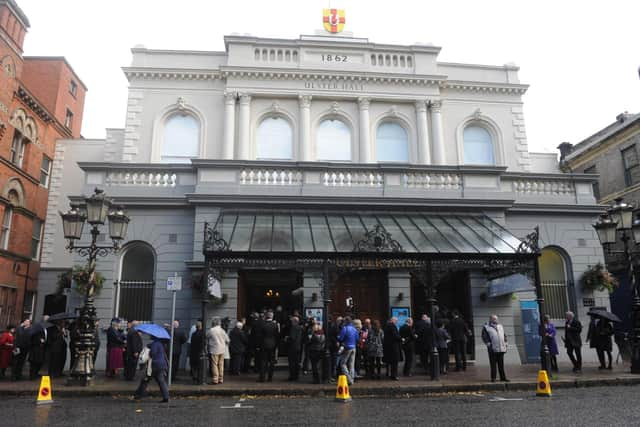
The distinguished Irish tenor, Mr John McCormack, achieved a notable triumph at the international celebrity concert which was held in the Ulster Hall, Belfast, during this week in October 1930, reported the News Letter.
The hall was simply packed with an enthusiastic audience, and numerous encores were demanded and generously given, noted the News Letter.
In his four groups of songs Mr McCormack showed the wide variety of his repertoire, “singing with ease and fluency in German, French, and Italian”, but he”was naturally at his best in the songs of his homeland”, the interpretation of which he was “unrivalled”.
The News Letter's correspondent wrote: “A quarter of a century or thereabouts, Mr McCormack was virtually unknown to fame, but he was 'discovered' at the Dublin Feis Ceoil in the tenor competition, when Signor [Luigi] Denza, the adjudicator, declared that the youthful singer, with the golden quality of tone, had a voice in a million.
“From thence onward his rise to eminence in the world of music was phenomenal, and in opera, in oratorio, and on the concert platform he has richly fulfilled the promise of his youth.
“It is, however, in the singing of the simple melodies of Ireland, that Mr McCormack shines with the greatest lustre.
“To the interpretation of these he brings a sincerity of purpose and temperamental gifts which reveal the tenderness and charm of Irish minstrelsy in the highest form of his art.
“In declamation he also carries conviction, while occasionally he condescends to sing a humorous song, a lightsome change from the more serious items in his programme.
“The beauty of his voice still delights his hearers, but last night there were traces of cold, now and again, and the tone has lost some of the golden quality which enthralled the audiences of past years”.
ARTISTIC INTERPRETATIONS
For his opening numbers, Mr McCormack chose an old German ballad, 'Entlaubet ist der Walde' (1536) and 'Alma del core', from Caldara's 'La Constanza', which he sang in the original Italian.
It was noted: “Both are love songs and they were rendered with tenderness and restraint. The top notes were beautiful in their subdued quality, and wonderful breath control was shown in the long phrases and in sustaining the curve and line of the music.”
In all his songs Mr McCormack displayed this accomplishment, while in tone gradation, “from the softest note to open-throated volume”, he was the master of his voice.
“A cordial encore brought its reward to the audience,” remarked the correspondent.
The second group of songs was varied in style and mood.
The correspondent wrote: “Special mention might be made of Sir Hamilton Harty's 'Cradle Song', in which the sadness of the words was realised in tone-colour and intensity of expression. Bantock's song of a widow bird was another item in a minor strain delicately rendered, and the series was concluded by a vivid interpretation, with a splendid climax, of 'There' by Sir Hubert Parry. A double encore followed, when 'The Prince came a-wooing' and 'Just for today', were sung, the latter being one of the most appealing songs of the evening.”
The gems of Irish song were reserved for the third group, and in these Mr McCorrnack appeared at his best.
They comprised a trio of folk songs in which Ireland is so rich, and “compared with them the ordinary modern songs fade into insignificance”.
The correspondent remarked: “They were contrasted in mood, although the melancholy tinge which shadows much of Irish poetry could be traced in each. 'Una Ban' (Fair Una), arranged by Mr Carl Hardebeck, a Belfast musician, was perhaps the most appealing of the group. “It was rendered with touching tenderness, leading to a dramatic climax.
The 'Song of the Fairy King' was another charming number, in which the sighs and entreaties of the royal lover were reflected in the voice of the singer. There was a rhythmic swing in 'I'd roam the world over', a love song full of promise and sentiment, with its little pathetic note in the final cadence so beautifully expressed by Mr McCormack in whispered tone.
The delighted audience gave the artist another ovation, and he had to respond to three clamant encores.
The final group included a song composed by Mr Schnieder, the accompanist. It was entitled 'Far Apart', and was sung on this occasion for the first time in public.
Mr McCormack's rendering gave distinction to “this little gem of song”, and both artists had to bow their acknowledgements, to an enthusiastic encore. A song 'The Fairy Tree' by Vincent O'Brien, was another outstanding number.
A BRILLIANT PIANIST
Two groups of pianoforte solos were played by Miss Vitza Vronsky, a talented young musician. Her first selections comprised compositions by Bach arranged by Busoni, and a Capriccio by Scarlatti.
The News Letter's correspondent noted: “She showed remarkable command over the keyboard, her splendid technique easily overcoming the florid difficulties and flashing passages of the 'Toccato and Fugue in D Minor' by Bach.
“It was a brilliant performance and worthy of the ovation she got. Miss Vronsky scored another triumph in her playing of Valse Oubliee by Liszt, and paraphrases of 'Lon Juan' (Mozart) Liszt-Busoni, and she had to respond to a double encore.”
The concert arrangements were carried out by Messrs W H Smyth and Company, Queen's Arcade, Belfast.