
‘The Disastrous Campaign in the Crimea’ and sudden death of the Czar (January 1855)

By the beginning of 1855 it had become apparent that the war in the Crimea had gone disastrously wrong.
In its edition of January 22, 1855, the News Letter headlined an editorial comment – ‘The Disastrous Campaign in the Crimea.’
Allied armies had become bogged down at Sebastopol and reports of death from disease and deprivation had increased.
The News Letter said: “The terrible truth is no longer to be concealed or evaded, that the British contingent of the army notwithstanding its recent reinforcements, is absolutely on the point of annihilation - the partly physical, and partly moral, annihilation which renders any striking achievement impossible. The French army, it is true, is nearly as strong as ever but what can it do, yoked as it is to a moribund ally – suffering, as it does, the torture invented by the tyrant Mesentius, that of a living body bound hand and foot with a corpse. No wonder that the history of the campaign since the memorable, but fatal, battle of Inkerman, is a blank, as regards the great purpose for which the expedition was intended.”

The News Letter said it would not join other journals such as The Times of London in blaming Lord Raglan for the failures. The paper pointed out that ordinary soldiers did not blame Raglan.
“We suspect that the outcry against Lord Raglan will turn out to be as originally suspected – the last resort of ministerial lickspittles to shift upon innocent shoulders the crime of their patrons.
“No! We believe the war department of the government, snug in their enjoyment of the delicios of Downing Street, are alone to blame in this terrible crisis. Lord Raglan himself is sacrificed with his army. The fearfully bad management of his superiors in London has precluded him from taking those advantages which are of the essence of his duty. Can he budge over a seven miles waste of mudland and filth to give his men meat and clothing? Can he arrest the spread of dysentery and catarrh by an order of the day? Can he take Sebastopol with a ghastly army which, as the Times assures us, out of 52,000 men, did not, a few days ago, number 2,000 sound, strong, healthy individuals in its ranks.”
The newspaper also produced a letter from a soldier in the Crimea to his family at home in which conditions were detailed. The letter referred to soldiers being “almost starved. Fancy the ration, one pound of meat (salt beef) in five days, and no coffee, and only two allowances of sugar; we had biscuit which was almost the only thing that saved the men from starvation. I spent Christmas night in the advanced trenches and they gave us no ration of meat”.
At this stage of the Crimean conflict the name of a Miss Nightingale had been appeared regularly in the columns of the News Letter in connection with reports about conditions at the disease infested hospitals in Scutari.
An attack by Richard Cobden, an economic reformer, upon the government’s mismanagement of the war was backed enthusiastically by the News Letter but the paper did not share Cobden's opposition to the war.
“What more easy than to get rid of evil ministers? Or does he contend that, because ministers are evil, the war is evil also. Everything has occurred to disgust us with the government, but nothing has occurred to disgust us with the great cause for which we are contending.”
Hopes raised at news of sudden death of Czar Nicholas
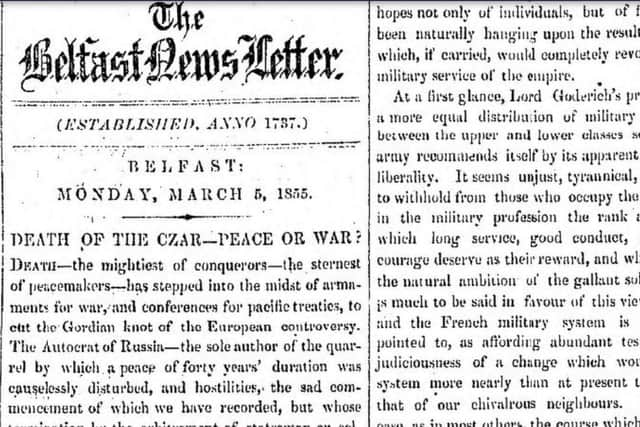
On Monday March 5, 1855, the News Letter announced the sudden death of the Russian Czar, Nicholas, which raised hopes that there might be a change of direction in the war in the Crimea.
The News Letter headlined its story - Death of the Czar - Peace or War? The News Letter pinned the blame for the outbreak of the war on the “Russian autocrat”.
It said the Czar had been the victim of the “sudden visitation of the Almighty shortly after the midnight chimes on Thursday night had ceased to vibrate through the palace-walls”.
The News Letter continued: “The Czar is dead. How many million tongues throughout Europe, catching the import of the message as it flew along the teelegraphic wire from city to city, have since echoed the words in tones of solemn awe, as if the reason could hardly trust itself to believe the rumour, or the lip to give expression to the feeling it excited. Let us not too closely analyse that feeling, but rather conclude that if it is not one of sorrowful surprise, and if the satisfaction predominated over regret, it not because the heart of Europe rejoices over the death of the man who has fallen by a higher degree than the judgement of his fellow men but because the event inspires hope - almost the certainty - that the war which he caused has died with him, and that the sunshine of peace will revisit the nations with the coming gales of spring.”
It was, however, to prove a false dawn.
The News Letter said the news might have remained a rumour but for confirmation in Parliament from Lord Palmerston and telegraphic reports from Berlin which revealed that the Czarewitch, the Grand Duke Alexander, had assumed the throne in St Petersburg. Telegraphic reports indicated that Czar Nicholas had contracted influenza from which he subsequently died.
The News Letter which for many months had carried reports detailing the failures of the British military establishment in the Crimea, reflected on the changes required to turn the tide of defeat.
The Belfast newspaper compared the British military system with that of France and came down in favour of the introduction of premotion based on genuine merit rather than the “ultra democratic system which has long prevailed in France”.
It added: “Before the French plan could be adopted in these countries, we should require to undergo a series of political and social revolutions similar to those which have afflicted our neighbours since the close of the last century, and out of which the French have been so slow in reaping any permanent advantages of greater value than the natural progress of the age would have bestowed in the interim.”
The French army depended upon conscription which meant that the “educated gentleman” was as often found among the rank and file as among the higher grades of the profession. Conscription had “forced the younger branches of families of all classes into military service”.
The News Letter concluded: “It is evident, therefore, that the French example is not one to be copied by the military authorities of our own country; for he would be a hardy minister who would offer the privates and non-commissioned officers of our army an equal share of honours and emoluments with the class whom Lord Goderich impertinently terms ‘gents’ at the cost of national conscription.”
The practice of purchasing commissions in the services which had long been a feature in Britain, the News Letter said, was “most likely to degenerate into jobbery and extortion”. It was a “gross injustice” to families which could not afford to purchase commissions
Reports continued to flow into the News Letter offices on Bridge Street, Belfast, detailing the appalling conditions in the Crimea and at Balaclava in particular. It was a dreadful campaign for soldiers, their horses and ponies which were used to transport all manner of supplies over roads which were little better than mud tracks. One report revealed that 900 horses had been landed for the allies at Varna but “they die off by dozens every night”. The Turks were said to have found an unusual way of keeping a check on their animals. Horses which died had their ears removed by their handlers as evidence of death.
Dysentery and other diseases exacted a heavy toll of British soldiers.
At Magdalena, the News Letter reported, where the 18th Regiment (Royal Irish) was positioned to repel attackers. Both sides had been conserving resources for a “tremendous final struggle”.