
The Ulster Railway begins operations and steams into Biblical controversy (August 1839)

The Ulster Railway began operations on August 12, 1839 with its first journey between Belfast and Lisburn being reported in the News Letter the following day.
The newspaper reported that passengers were allowed to enter the carriages after several experimental trips, all of which had been performed with “the most gratifying success”.
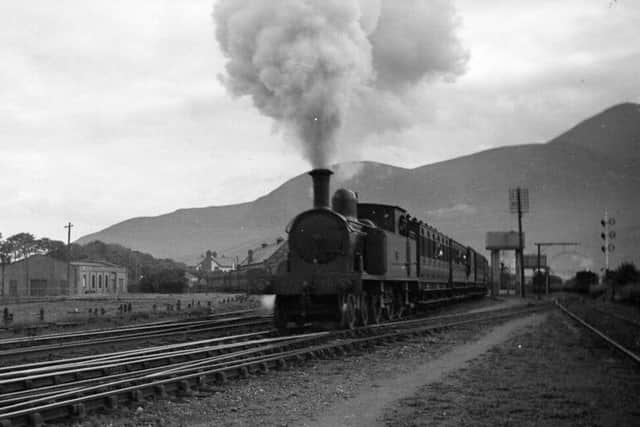

The News Letter reported that the average time for each trip was between 15 and 19 minutes but could have been faster “had it been desired”. But the proprietors opted for caution to avoid accidents.
The News Letter continued: “Yesterday morning, at seven o'clock, the line was formally opened, and the train continued to ply up and down each alternate hour during the day until 8 o'clock in the evening, as had been previously arranged.
“The crowds assembled in the neighbourhood of the railway were immense, and universal enthusiasm prevailed at the success with which this truly national undertaking has been hitherto prosecuted.
“The number of passengers during the day amounted to upwards of three thousand while hundreds were disappointed in obtaining places.
“This is a flattering commencement, and we hope that it is only a prophetic omen of the reward to which the company may reasonably look forward, when the line shall have been still further extended.”
Under an editorial column heading - Irish Railways - News Letter editor James McKnight on March 1, 1839 had outlined the papers policy on the new mode of transport. Mr Knight said: “We know no more effectual way of promoting the substantial improvement of Ireland than by opening up lines of communication between the leading seaport towns and the interior, for were this once accomplished capital would flow in, employment would be created, and the physical capabilities of the country would be brought into beneficial action, instead of being left as at present dormant, and consequently useless.
“Until roads were cut out, and free communications were established, the greater portion of the Highlands of Scotland was a barren waste, while the inhabitants were generally sunk into a condition of social barbarism, amenable to no laws but those of feudal clanship, and inured to no enjoyments superior to those of hunters in an American forest.”
The News Letter said the advent of roads had helped to overcome the uncongenial nature of the environment of the Highlands and had been made to yield to industrious perseverance. Ireland with its superior soil, “and the multiplied natural resources” would be proportionally striking.
The News Letter also added its support to the campaign to pressure Parliament into taking steps designed to prevent the railways from becoming “dangerous monopolies”.
McKnight added: “In England this salutary precaution has not been taken, and the public are beginning to feel the consequences.”
The directors of some railway companies in England had abused their monopoly positions and had shown little concern about the requirements of passengers.
Within a few weeks of its opening the Ulster Railway had steamed into trouble. A never on Sunday row erupted in the columns of the News Letter.
The edition of September 20, 1839 carried a long letter from the Reverend James Morgan the influential minister at Alexander Mackay's Presbyterian church at Fisherwick Place in Belfast Morgan, in an open letter addressed to the proprietors of the Ulster Railway, warned that they had broken God's law by infringing the Sabbath.
“If our views of its divine authority be correct, you are chargeable with nothing less than a violation of an express law of God. This is my own deliberate conviction,” wrote Morgan.
He continued in similar vein: “I believe you might as lawfully employ a man to break the eighth commandment, and give him the authority to steal, as employ him to break the fourth commandment and send him forth, under your sanction, to follow his calling. Are you not afraid to change the times and laws which God himself has appointed and claimed? The Sabbath is not yours, it is God's; you have not authority, to spend it as you will, you must spend it as he has commanded; if you change it, it is at the expense of violating that law of which its author has said, 'heaven and earth shall pass away, but my word shall not pass away'.”
Morgan said the violation of the Sabbath was regarded by Jehovah as a national sin, “and he has ever threatened and visited it with national judgments”.
He said Sabbath observance and national prosperity were closely allied.
Death of Ireland's most renowned Methodist missionaries
Earlier in the year - in May 1839 to be exact - death claimed one of Ireland's most renowned Methodist missionaries, namely Gideon Ouseley who had brought the Protestant religion to the Gaelic speaking regions of Ireland.
Ouseley died in his 78th year and was described by the News Letter on May 17th as “a zealous, self denying minister. Throughout the United Kingdom and during nearly half a century he was ceaselessly engaged in his Master's work in Ireland especially in its towns and village fairs and markets regardless of personal ease, fearless of danger, and uninfluenced by the prudence of cowardly professions he persuasively called on men to repent and to believe in the gospel”.
Ouseley and a number of other Irish speaking Protestant missionaries had incurred the wrath of the Irish Roman Catholic hierarchy because comparatively few priests could speak Gaelic.
The Protestant churches had largely failed to extend the Reformation message to Gaelic speaking Ireland but by the last decades of the 18th and the first three of the 19th centuries a conscious attempt was made by the missionaries and various Bible societies to convert the native Irish.
The development of Maynooth College from 1824 and the politicisation campaign of the Catholic Association during Daniel O'Connell's period produced significant changes. The Irish Catholic church after the veto controversy in 1813 also moved away from the English and into the Roman orbit.
There was a fundamental clash in both religion and political outlook between the Protestant and Roman Catholic churches. The main Protestant churches were also in ferment; the Presbyterians torn between New and Old Light advocates while the Church of Ireland faced pressure from O'Connell over its established status.
The advent of Protestant evangelicalism coincided with Ultramontanism, meaning beyond the mountains in Rome, within the Catholic church, Inevitably the clash pushed Protestants and Catholics in Ireland further apart. The second Reformation sparked by the evangelical movement and the rise of Bible societies met resentment from resurgent Roman Catholicism.
Controversy plagues plans for Belfast's piped water supply
Controversy also surrounded the attempts to extend Belfast's piped water supply. A surveyor was hired to prepare a detailed report for the Spring Water Commissioners.
On April 12th John McNeill's report appeared in the News Letter. He estimated that the population of the town would by 1841 have grown from 53,287 in 1831 to 73,287. He estimated that each person required 10 gallons per day which meant a total requirement in 1841 of 734,870 gallons per day or 509 gallons per minute. The level of demand in 1939 was 112 gallons each minute.
Clearly the growth of the town would impose severe strains on what was then a relatively primitive water supply system. A number schemes had been put forward including one drawing water from Whitewell which McNeill favoured.
News Letter maintains its circulation despite another rival
Circulation figures, published in the News Letter in May showed that the paper continued to maintain its lead over its rivals.
Another new publication - the Christian, Patriot - had emerged to challenge for a position in the market.
Between January and March 1839 the News Letter's average circulation per edition was 1269 copies; the Ulster Times of Isaac Butt had overtaken the Whig selling 923 against 717; the Commercial Chronicle managed a circulation of 692, the newcomer Christian Patriot a healthy 807 and the Reformer, which had been launched by the Whig, a comparatively modest 307. In the country the Newry Examiner led the Telegraph by 807 to 410; the Down Recorder headed its rival Down Chronicle by 730 to 383 while in Londonderry the Sentinel sold 1,077 against 961 for the Standard and the Journal's 692.
The publication of the circulation figures apparently brought a challenge from Francis Finlay in the Whig.
On May 21 McKnight published his calculation of circulation for the main Belfast papers for a 12 months period. These showed that the News Letter had an average sale of 1,125 against the Whig's 900, the Ulster Times' 884 and the Chronicle's 666.
McKnight concluded: “Thus it is proved that whatever view of these returns is taken the News Letter uniformly maintains its position at we head of the press of Ulster in point oi circulation.”
The controversy demonstrates the impact of the increased competition a this time.
Newspapers had begun to fight for sales, advertising and then their very survival.