
Legal claim that security forces can be held liable for blaming McGurk’s Bar atrocity on IRA bomb to be struck out
A legal claim that British security forces can be held liable for falsely blaming the McGurk’s Bar atrocity on an IRA bomb is to be struck out, the High Court ruled today.
The widow of one of those killed in the attack more than 50 years ago sued the police and Ministry of Defence (MoD) over an alleged policy of disinformation about the perpetrators.

But a judge held today that her action based on allegations of deception is defective and unsustainable.
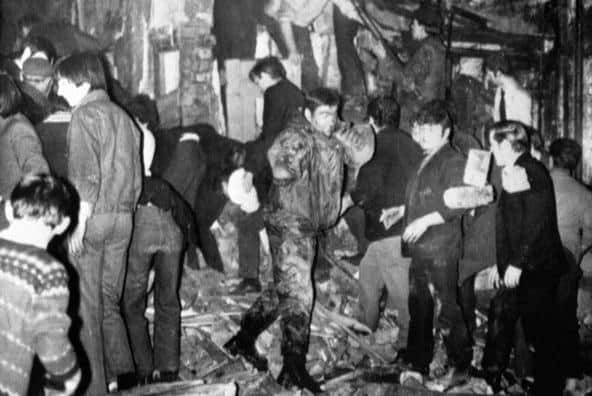
Fifteen people were murdered when McGurk’s Bar in north Belfast was blown up by the Ulster Volunteer Force in December 1971.
Following the explosion it was wrongly suggested that it may have been an accidental IRA “own goal”.
A claim for damages was brought by Bridgid Moss, whose husband Edward Kane died in the blast.
Her lawyers alleged that a government unit known as the Information Research Department (IRD) operated in Northern Ireland at the time to place anti-IRA material in the press.
It was contended that one of its objectives was to deter people from storing the republican organisation’s munitions by creating a belief that they were unstable and exploded prematurely.
The disinformation policy was aimed at alienating the IRA from the civil population, the court heard.
A national newspaper article published in the immediate aftermath of the McGurk’s Bar bombing referred to an Army intelligence theory that it was an IRA device which accidentally detonated while in transit for use elsewhere.
Subsequent disinformation suggested the bomb had been carried by one of the customers in the bar.
Ms Moss’s legal team attempted to establish that the Chief Constable, MoD and Home Office could all be held liable for the tort, or civil wrong, or deceit. The statement of claim alleged
: The defendants knowingly placed false information in the public domain by briefing local politicians and journalists with false information that the bomb was likely to have been an IRA device.
: The defendants intended the plaintiff, as a member of the Catholic community in Belfast, to be deceived and/or influenced by the deception.
: The defendants were reckless about any stigma she would suffer over the bombing, and caused her a complex Post-Traumatic Stress Disorder.
Counsel for the police and MoD denied that the IRD was operating in Northern Ireland prior to December 1971.
It was asserted that the unit’s role included producing material to counter propaganda produced by republican and loyalist organisations, providing decision makers, influencers and members of the public with a balanced and accurate account of the facts.
Disputing the case against them, the defendants emphatically rejected making attempts to falsely to blame any of the patrons of McGurk’s Bar for the explosion.
An application was mounted to have the case struck out on the basis that it disclosed no reasonable cause of action.
Counsel representing the defendants insisted there was no proof of performing any act required under the tort of deceit.
Citing case law established over more than a century, Master Bell granted the application after identifying insufficient facts to support Ms Moss’s case.
“I must therefore conclude that the plaintiff’s pleading is defective in that it does not properly plead one of the crucial elements of the tort of deceit,” he held.
The action is therefore unarguable and unsustainable and must be struck out.”
Master Bell added: “The defendants’ call to have the plaintiff prove the defendants’ intention or recklessness and to identify a specific act which she performed in reliance upon their misrepresentation has essentially gone unanswered.”
Following the ruling Ms Moss’s solicitor indicated that an appeal will be mounted.
Speaking outside court, Setanta Marley of KRW Law said: "We welcome this first-time judicial assessment on this precedent setting action on the tort of deceit.
“The Plaintiff alleges that the state deliberately misled her and the other McGurks families by blaming those who were killed in the bombing.
“The case will now be appealed to a high court judge for the latest stage of the families’ long running quest for justice."