
Noah inquest: I did not expect police to search as far down the drain tunnel as they did and Noah might not have been found otherwise, says rescue expert. 'Everything was done that could be done'
It would not have been surprising if police had stopped their search of a storm drain well short of where Noah Donohue was finally found, a rescuer has told his inquest.
Noah was 14 when his naked body was found in a storm drain tunnel in north Belfast in June 2020, six days after leaving home on his bike to meet two friends in the Cavehill area of the city. A post-mortem found the cause of death was drowning.
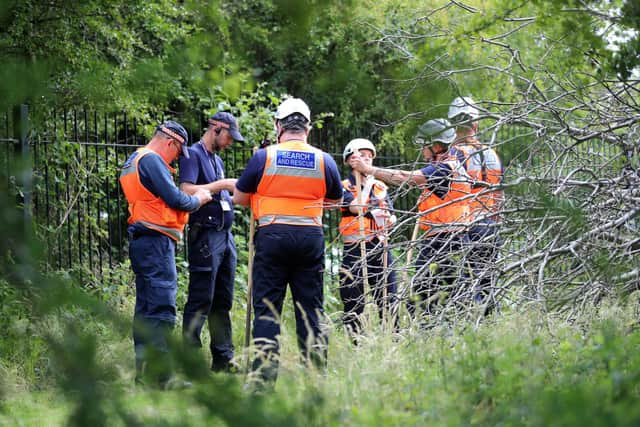

The jury inquest at Belfast Coroner's Court is now in its fifth week.
Sean McCarry, the regional commander for the Community Rescue Service (CRS), was questioned on Wednesday by barristers including Peter Coll KC for the inquiry, Nessa Murnaghan KC for the Department of Infrastructure, and Donal Lunny KC for the PSNI. In response to a question from the latter about the speed and outcome of the police search, Mr McCarry said that in his opinion “everything that was done that could be done”.
Mr McCarry described the 1,000m distance where Noah was eventually found as “a long way down the drain” but the searchers had hoped the schoolboy would be found alive.
When asked at the inquest, which is in its fifth week, if he thought Noah’s body would have been found so far down the tunnel, he replied “definitely not” and it was “far beyond” what he would have expected.
Mr McCarry said he was “extremely grateful” that Noah’s body was brought back to his family who are looking for an explanation of the circumstances of his death.
He said: “I would not have been surprised if police had stopped the search at 200m, at 300m, at 400m and we could be sitting today not knowing where Noah was.”
His team alerted the police to the culvert on waste ground behind some local houses as it was “easy to get into”, as the searchers spotted the grille on top “was unlocked and could be easily opened”.
The volunteers suggested the culvert should be searched as they felt that a slim adult could pass through it. He said it needed to be searched by a confined space-trained and equipped team.
A trained CRS volunteer, who was fitted with a harness and attached to a line, went in to the culvert as far as they could. They went a short distance before having to withdraw for safety reasons.
The CRS team also carried out a “call and wait” process, in which they shouted down the tunnel and then paused to see if there was a response.
Mr McCarry said a “massive effort” was made to find Noah, adding: “If I make a single mistake here that could be the difference between life and death – that is on the forefront of my mind, and the people and the police I work with (and) it is in the forefront of their mind.”
He described finding Noah as the “priority”, adding: “If I felt there was anything else that should have been done – I would have been raising that.”
At least 100 community search and rescue volunteers were called out to the Cavehill area, which had been the initial focus of the search for Noah. Updated information made the search for the missing youngster “fluid”, the court heard.
It included a call to deploy searchers in the North Queen Street area where a phone was found. Police then contacted Mr McCarry in the early evening to say Noah's bicycle was found in Northwood Road.
Mr McCarry said the search team of volunteers is often called out to Cavehill and are familiar with its dense terrain, which he said included passable areas but “the rest is sometimes like the jungle”.
Mr McCarry explained the stages of a search. He said that there was an ‘Initial Visual Check’, then an efficient search, then a thorough search, all three of which could happen at the same time.
Due to the importance of survivability for the missing person, “we are pushing through those areas as fast as we can”.
He explained that if the searchers can get over an obstacle such as a fence, they assume the missing person can too.
Mr McCarry also explained how difficult it was to search in wasteland and a park behind the houses on Northwood Road where Noah’s bike was found, due to a stream, fencing and heavy overgrowth. When they saw the culvert “I could not have said at that time definitely Noah had gone down the drain”.
He said that “we wanted to find him alive” but could not ignore the fact of the drain, and “we brought to the attention of police immediately” even though they could not find evidence he had gone down there.
While he “never wanted at any time to think that Noel was in the drain”, Mr McCarry said: “I am not saying it wasn't part of my thought process, it was.”
They had a volunteer begin to search the opening to the drain with a line and safety harness but stopped as the gradient became dangerous, for police experts to search. “It’s an extremely dangerous environment,” he said. “You will lose someone else’s life if something goes wrong.”
Mr McCarry said that urban searches were actually the most difficult because not only is overgrowth and parkland and streets having to be searched, but so are “garden sheds, coal bunkers, bins”.
Asked about the speed and outcome of the police search, Mr McCarry said: “Do I believe everything that was done that could be done? As far as I can see, yes.”
He is back in Belfast Laganside court today for questioning from Brenda Campbell KC, who is representing Noah’s mother, Fiona.
Last week Ms Campbell questioned Inspector Menary, who is retired from the police but previously managed the PSNI hazardous environment search team.
She asked him: “I’m going to suggest that your search neither started nor proceeded with any sense of urgency. I anticipate you disagree with that?”
Mr Menary said: “Correct.”
Under questioning from Mr Coll yesterday, Mr McCarry recounted how he was contacted before 4am on Monday June 22 2020, hours after Noah was reported missing by Ms Donohoe on Sunday night.
“I was sound asleep when I got the call,” he said. “It was before four o’clock, because I left home shortly after four.” It took him about an hour to travel down from the north coast.
Mr McCarry explained how the search was initially focused on Cavehill, because that is where Noah was thought to be heading. He said that in the initial stages of a search “speed equals survivability”.
He said that even when Noah’s phone was found that did not mean that the focus of the search changed. It was a “developing situation, some of team refocused to the North Queen Street area” where the device was found.
Mr McCarry said they were trying to put at least 100 volunteers on Cavehill, which is 460 acres. “If it was 500 we would have used every one of them, but unfortunately we don't have that kind of numbers.”
He said a team of trained volunteers were deployed to the Northwood Road area after being alerted that Noah's bicycle had been discovered.
The area was searched and a culvert was found on waste ground located at the back of some houses.
Mr McCarry said the searchers spotted that the grill on the top of it “was unlocked and could be easily opened”.
The volunteers suggested the culvert should be searched as they felt that an adult could pass through it.
He said he made contact and stated it was “easy to get into” the culvert and it needed searching by a confined space trained and equipped team.
He added: “From early on we were aware of this as a potential ingress point as it was possible for one our technicians who was of slim build to pass between the bars.”