
Terror symbols and flags: PSNI issues 27 pages of instructions to officers on removing them from public display
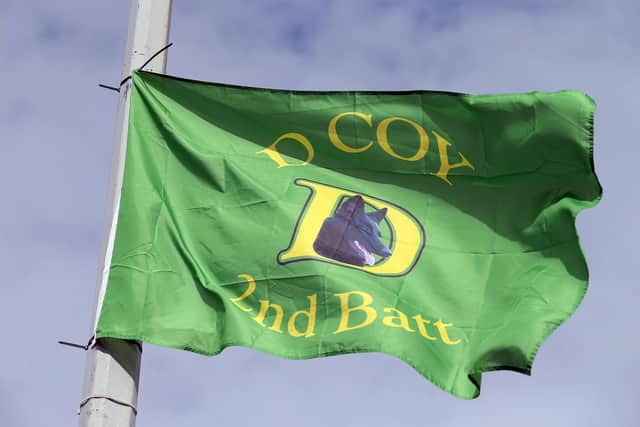
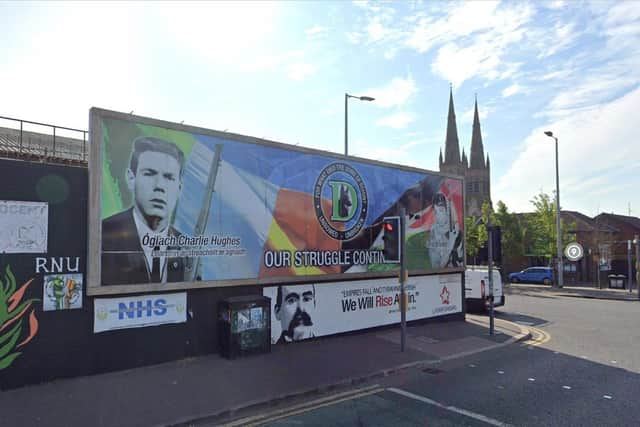
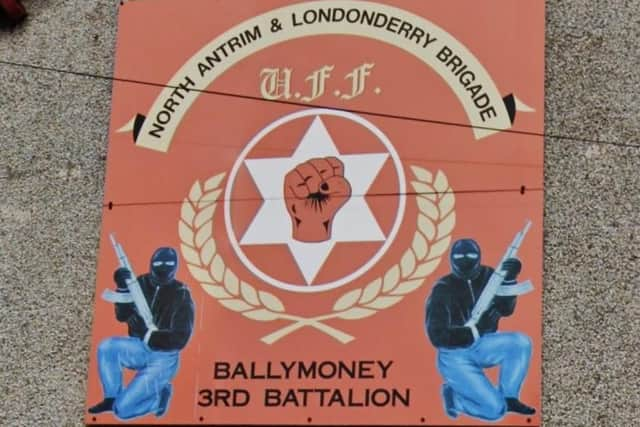
The PSNI leadership says they want officers to be clear about what to do when they encounter paramilitary displays, so have issued them with a 27-page-long set of instructions.
The document – called a Service Instruction – states that "where the display of any material constitutes an offence the PSNI has an obligation to act," adding that "not making a decision, doing nothing, or failing to act is not an option".
It then says police should only remove material (such as flags, for example) if it "is placed in such a way that it can be removed quickly and easily at no risk to attending police".
It adds: "The primary responsibility for removing material will always reside with the material’s owner, or the owner of the street furniture or property upon which it is displayed."

It suggests officers should contact the property owner, such as the Department for Infrastructure, to secure removal.
This agency can then call on the PSNI for support – but "any offer of support will be contingent on police assessment of its feasibility, necessity, proportionality and legality".
Where the owner cannot be contacted, or they are unwilling to remove the material, "police should again consider involvement in the removal of material".
Meanwhile "negotiation and mediation" to remove the material remains an option too.
Elsewhere, the document suggests that if nobody has complained about a terrorist display, action may be at officers’ discretion, saying: "In the absence of a complaint, an objective assessment is required to determine if executive action is required."
The document further states that "engagement with local stakeholders should form an ongoing and central aspect of all stages of the decision-making process, to gain insight into local perspectives, explain police’s actions and rationale, and encourage partnership working", before adding: "All decisions (including decisions not to act) should be fully recorded, along with their rationale."
Prior to any action, officers are also invited to consider the European Convention on Human Rights (particularly the clauses on freedom of expression), the police Code of Ethics, and the Core Policing Principles as set out in Section 31A of the Police (Northern Ireland) Act 2000, which states that police officers "shall carry out their functions with the aim of securing the support of the local community".
‘WE ARE MAKING THIS CLEAR TO OFFICERS’:
The Service Instruction, which does not mention any terror groups by name, is dated January 16.
It has come to light now thanks to remarks made last week at the Policing Board by deputy chief constable Bobby Singleton.
He was asked by Peter Osborne, a former Alliance councillor, now an independent member of the board, about the display of "racist" material 10 months ago (he did not specify what or where).
Mr Singleton responded by appearing to talk about paramilitary displays, saying the new Service Instruction "is to try and make sure that officers are clear in terms of what our expectations are of them in particular circumstances, how we want them to respond".
He added that "there has been significant public and stakeholder criticism in the past of the service's response, or perceived lack of response", and "criticism from people when they say that we're not acting consistently". He also said that "the instruction is very clear: that we expect our officers to remove that [material] where they can do it, and they can do it safely".
The PSNI have long had powers to take action over displays which show support for proscribed terrorist groups (under the Terrorism Act 2000), or which are threatening and intended, or likely, to arouse fear (under the Public Order (Northern Ireland) Order 1987).
But, as the News Letter reported in November, just seven people were charged with supporting terrorism across the whole of Northern Ireland over the preceding 10 years.
‘WILL PSNI PAINT OVER MURALS NOW?’
The News Letter asked the PSNI a series of questions, including whether officers will now remove wall murals to the UVF and IRA, and whether they will remove the names of paramilitaries from GAA clubs, grounds and trophies.
The force was also asked why it has tolerated illegal paramilitary displays across Northern Ireland ever since its inception.
It responded with a statement, saying: "This service instruction, published in January 2026 and based on the National Decision-Making Model, provides practical guidance to police officers and staff on how the PSNI should respond to, report and investigate incidents involving displays in public spaces.
"Its development follows a number of hate incidents in 2023 when anti-immigration signage was placed in a number of towns and housing areas in Northern Ireland."
It then quoted Chief Superintendent Gillian Kearney as saying: “As a police service, we are dedicated to safeguarding people and property while taking action against any offenders of hate crime incidents.
“There has always been guidance available to our officers on the steps that can legally be taken in regard to complaints on public displays.
"This has now been developed into a service instruction which outlines clearly when to act and how to respond.
“The primary responsibility for removing material remains with the material’s owner, or the owner of the street furniture or property where it’s displayed.
"However, where any offences have been committed, the circumstances will be investigated within statutory functions, and in accordance with law and Human Rights obligations.
“Our officers, who are well supported by this information, will engage and work with local community representatives and partner agencies in relation to any complaints about displays in public spaces.”
Later, the PSNI also added: “As per the Service Instruction, every incident will be looked at on a case by case basis.”