
‘Destruction’ at Ice Age site is probed
An investigation has been launched following alleged “destruction” at a protected Ice Age site which experts say would be "impossible to restore" if damaged.
Tonnes of sand and gravel appear to have been scooped from the rare geological site carved out by glaciers between 13,000 and 17,000 years ago. Now a charity and planning expert are urging authorities to take a very firm line against any actions which are deemed to be illegal.
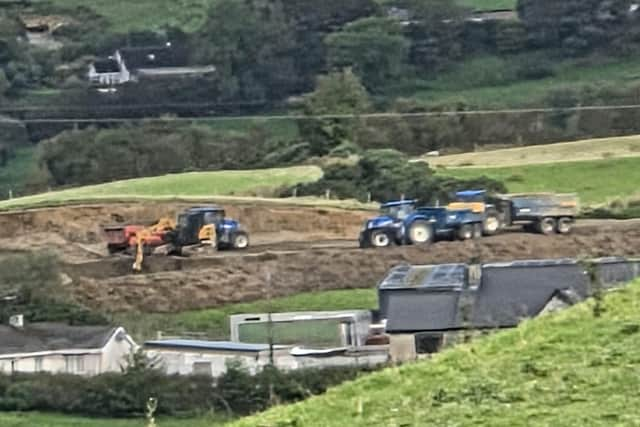

Environmental group Friends of the Earth Northern Ireland sounded the alarm on the alleged unauthorised mineral extraction at the site in rural Co Tyrone.
The charity’s director, James Orr, claimed the government “isn’t doing its job”.
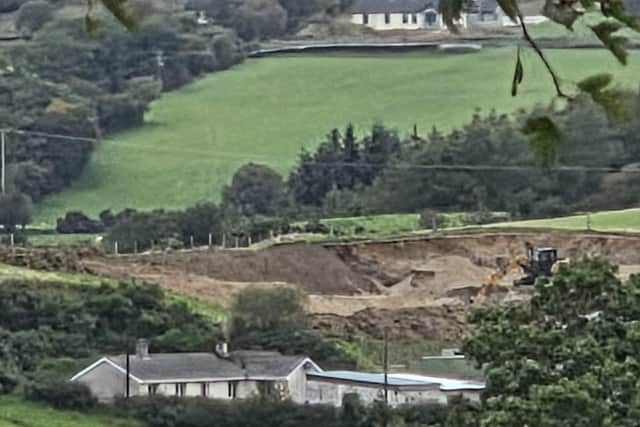
While authorities have issued a ‘temporary stop’ on the site while they investigate, former government planning officer, Dean Blackwood, says if any criminality is uncovered: “Northern Ireland Environment Agency needs to vigorously pursue prosecution of those placing personal greed ahead of the public interest in preserving our irreplaceable protected sites.”
Pictures taken at Lisnaragh Area of Special Scientific Interest (ASSI) in September show diggers, tractors and trailers scooping up earth in what appears to be a freshly dug sand pit near the village of Donemana.
It comes in the wake of ongoing ecological disaster at Northern Ireland's most famous ASSI, Lough Neagh, which has been devastated by high levels of water pollution since 2023.
James Orr says the way authorities deal with those responsible for any alleged damage to Lisnaragh will be “a test case”.
He added: “If we can't protect a designated ASSI then we can't protect anywhere. Despite us having so few of these special places left they are under constant threat.”
Lisnaragh was designated an ASSI in 2009 because of features including a ‘moraine ridge’ of sand, gravel and mud which is effectively raised rocks, soil and sediment that was carried and left behind by a moving glacier in the last major ice age.
Queen’s University geoscientist Dr Andrew Newton says a moraine “is much more than a pile of sand, gravel and mud” because its shape, position in the landscape and the sediment it contains “preserves evidence… about the timing and processes of retreat of the last Irish Ice Sheet”.
“Having looked at the photographs, the excavation appears to be substantial rather than simply a minor disturbance of the surface.”
Dr Newton warned that “once the original sediments have been excavated, removed, or mixed, their arrangement and geological context cannot simply be recreated”.
“You can put the sand and gravel back, but you cannot put the geological record back. It is a bit like taking a five-tier wedding cake, smashing it to pieces, and then claiming it has been restored because you have piled the sponge and icing back into roughly the same shape. The ingredients may be there, but the original structure is not. In geology, that structure is where much of the scientific information lies.
Planning expert, Dean Blackwood said: “The destruction at Lisnaragh is compounded by the fact that the lands are statutorily designated as an ASSI and those responsible may well have acted criminally in contravention of the Environment (NI) Order 2002.”
Any landowner, including government bodies, must apply to NIEA for consent to carry out any activity on an ASSI. It is the statutory body responsible for managing and protecting ASSIs.
According to the Department for Agriculture, Environment and Rural Affairs, which oversees NIEA, environment agency officers “arranged an urgent site visit and attended the location on September 15, 2026 to assess the reported activity”.
They said NIEA is ”working closely with Derry City and Strabane District Council (DCSDC), as the relevant Planning Authority” and that DCSDC has taken “planning enforcement action” while investigations continue.
“NIEA is currently assessing the extent of any environmental damage and considering whether offences may have occurred under environmental legislation,” they continued.
“As these investigations remain ongoing, it would not be appropriate for NIEA to comment further on potential enforcement action or outcomes at this stage.
"However, NIEA would want to assure the public that DAERA is committed to protecting Northern Ireland’s Areas of Special Scientific Interest.”
A spokesperson for DCSDC said its “Planning Enforcement team is investigating alleged unauthorised mineral extraction in the Donemana area”.