
Irish election: counting continues after exit poll finding that suggested an even three-way split between the three main parties
The protracted process of sorting and counting votes in Ireland’s General Election has begun, after an exit poll put the three main parties virtually neck and neck.
Sinn Fein held 21.1% of first-preference votes, narrowly ahead of current coalition partners Fine Gael and Fianna Fail at 21% and 19.5% respectively, according to the Ipsos B&A Exit Poll commissioned by RTE, The Irish Times, TG4 and Trinity College Dublin.

It puts the two largest parties in the current coalition, Fine Gael and Fianna Fail, on a combined 40.5%.
The poll, if it is correct, suggests that those three main parties are down somewhat on the 2020 general election, when they won more than two-thirds of the first preference vote, at almost 68% support. The exit poll suggests a combined total of around 62% and thus a larger share for smaller parties or independents.
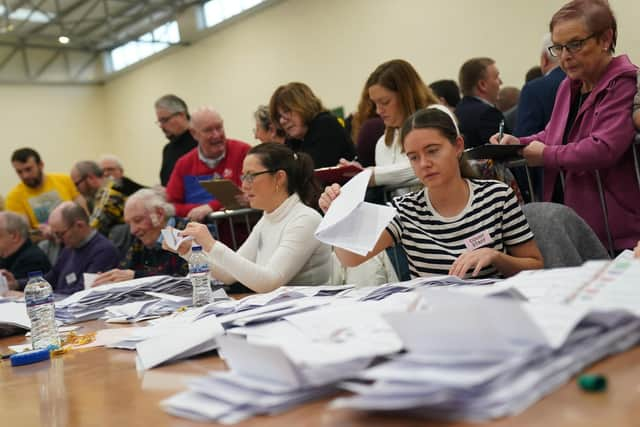
The boxes holding the ballots were opened at 9am at count centres across the country.
They must first be sorted before counting formally begins, in a process which could last days because of Ireland’s complex system of proportional representation with a single transferable vote (PR-STV), where candidates are ranked by preference.
It means the voting slips need to be counted several times, an undertaking which can last days.
However, a sense of the accuracy of the exit poll will begin to emerge as tally counters observe the sorting of the votes.
The final results will immediately kick-start government formation speculation, amid the suggestion of the exit poll that more than three parties may be needed to form a majority.
While the exit poll is indicative of the support base for the political parties, the final results will be determined by transfer votes, a key part of PR-STV.
The exit poll’s examination of voters’ second preferences put Fianna Fail and Fine Gael at 20% each, with Sinn Fein at 17%.
The inconclusive results mean that all eyes will now turn to the potential search for coalition partners.
Elsewhere, the exit poll showed: Social Democrats (5.8%), Labour (5%), Greens (4%), Aontu (3.6%), People Before Profit-Solidarity (3.1%), and Independent Ireland (2.2%). Independents and other candidates were on 14.6%.
Fine Gael’s director of elections has said the party is “happy” with the exit poll results that put the party on 21%, up 0.1% on the first preference vote it got in 2020.
“I think it’ll be a long few days, and it could be a long time after that… but I think it’s a positive poll, from our perspective,” Fine Gael’s Olwyn Enright said.
Friday night’s election exit poll indicated that Fianna Fail leader Micheal Martin had 35% support to become the next Taoiseach, while 34% preferred Sinn Fein leader Mary Lou McDonald and 27% opted for Fine Gael leader Simon Harris.
Ms Enright, an Offaly county councillor, said she was “surprised at that”.
“This is really not what our candidates were saying on the ground,” she told RTE’s Morning Ireland.
She said that a huge focus was put on the party’s new candidates because 63 out of the 80 were not outgoing TDs.
“That was where this election was going to be won and lost, really, it was very much a ground war.”
It is important to elect a stable government in Ireland following the election, a former Fianna Fail finance minister has said.
Michael McGrath, the incoming EU Commissioner for Democracy, Justice and Rule of Law, said “a number of different parties and groups will have to be involved”.
Speaking to the PA news agency at the Nemo Rangers count centre in Cork, he said: “I hope it is a stable government that has the prospect of lasting the five years because of the challenges we are facing in Ireland and throughout the European Union.
“Let’s allow the picture to emerge over the days ahead.”
The former minister predicted there will be variations between the exit poll and the final result.
Attending in support of his brother, Seamus McGrath, who is contests his former seat in Cork South Central, he added: “I’m here to do what he did for me for about 25 years.
“It is a different feeling but I’m enjoying being part of the democratic process.
Referencing his new role in Europe, Mr McGrath added: “We’re very fortunate in Ireland to have free and fair elections – it is not something we should take for granted.”
Sinn Fein’s Matt Carthy has said that “the nightmare scenario” would be Fianna Fail and Fine Gael returning to government in Ireland.
He told RTE’s Morning Ireland that if Sinn Fein emerge as the largest party it would be a “phenomenal result”, adding the exit poll putting support for Mary Lou McDonald as the next taoiseach at 34% was a “huge vindication” for her.
Asked who his party would talk to about forming a government, Mr Carthy said: “We will see how the numbers land. We will try and do everything in our power to create a government that doesn’t include Fianna Fail and Fine Gael.”
“I have to say the nightmare scenario as far as I’m concerned – as somebody who has an 18 and a 17 (year-olds) and younger kids at home – the nightmare scenario is Fianna Fail and Fine Gael returning to government, regardless of what the third leg of the stool is.”
He added: “I think we might be in for a few surprises yet over the weekend. All I can say is we went into these elections with many people predicting our demise, it now appears that we may be the largest political party.”
Aontu leader Peadar Toibin said there is a chance the party will return with a parliamentary team.
The Meath West candidate, who was the party’s only TD in the last election, said state funding was one objective for the party.
“It looks like we’re going to reach the threshold for state funding, which will mean that we’ll be able to employ a strong team of eight, nine staff, which will obviously improve our output.
“It will probably add 10 years onto my life as well,” Mr Toibin told RTE’s Morning Ireland.
Fianna Fail deputy leader Jack Chambers replied: “I just think it’s interesting to hear from Peadar that he’s talking more about staff than he is seats.
“We’re about to see votes counted across the country and he’s more interested in having staff around him than he is people elected to the Dail, which is quite unusual.”
People Before Profit’s Richard Boyd Barrett said that Aontu had never ruled out going into government with Fianna Fail.
“He ruled out Fine Gael, but he was not ruling out going in with Fianna Fail. And you know, that’s what Aontu is, they want to bring us back to the 1950s version of Fianna Fail.”
The results of the exit poll suggest the arithmetic to form a majority may prove tricky, as the country’s several smaller parties and many independents potentially jockey for a place in government, possibly in a coalition made up of four parties.
The leaders of Fianna Fail and Fine Gael have consistently ruled out entering into a coalition with Sinn Fein, citing substantial differences on policy. As such, Sinn Fein faces a much more challenging route to forming a government.
However, long-held and seemingly insurmountable political differences have eroded as recently as 2020, when the general election also delivered an inconclusive result.
Then, Fine Gael and Fianna Fail, two parties forged from opposing sides of Ireland’s Civil War of the 1920s, agreed to set aside almost a century of animosity and share power for the outgoing coalition, after similar pledges against forming coalitions had been made before the final results.
The Greens joined the coalition as a junior partner.
In that election, Sinn Fein won the popular vote but a failure to run enough candidates meant it did not secure sufficient seats in the Dail to give it a realistic chance of forming a government.
This time around, party leader Mary Lou McDonald fielded many more candidates, in a vow not to repeat past mistakes, as she urged voters to elect a government of change without Fine Gael or Fianna Fail.
There are a total of 174 seats in the country’s parliament to be filled, more than ever before.
As the Ceann Comhairle, the speaker of the house, is automatically returned, 173 seats will be filled in the counting process.
More than 3.6 million people were registered to vote in the election to choose their representatives across 43 constituencies, in a campaign that has focused on the country’s housing crisis, the response to a dramatic increase in immigration, and economic management for the cost of living, as well as potential future trade shocks.
Before the exit poll, Green Party leader Roderic O’Gorman said his government partners will be looking for an “easier life” in a future government, and warned that this could result in “right-wing independents” or “small populist parties” padding out the numbers.