
Pat Bradley: Electoral chief who oversaw polls through The Troubles and beyond sadly passes away

The man who steered Northern Ireland’s elections through some of its darkest and most defining moments, and went on to advise governments and international organisations around the globe, has died in his native Londonderry.
Patrick “Pat” Bradley, former Chief Electoral Officer for Northern Ireland, passed away on Thursday (September 18), in Altnagelvin Hospital following a short illness. He was 89.
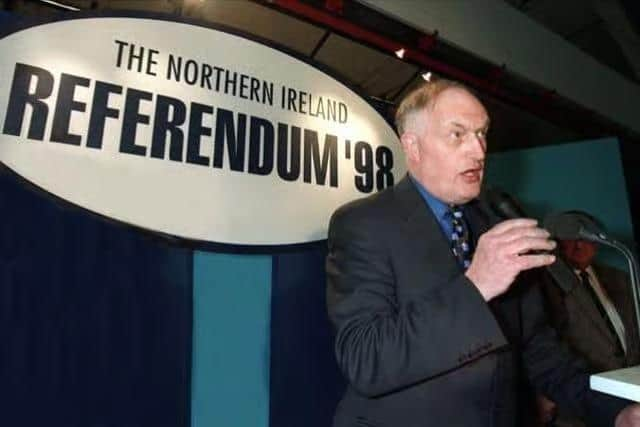

Born in 1935 on Ewing Street, Bradley was educated at Brow of the Hill Primary School and St Columb’s College. After early jobs as a laboratory technician with DuPont and later with the Local Enterprise Development Unit (LEDU), he applied for the role of Deputy Electoral Officer in 1973. With no prior experience and minimal training, he was suddenly tasked with running elections across western Northern Ireland at the height of The Troubles.
He quickly discovered an electoral system under severe strain: short-staffed, lacking proper offices, and with basic equipment stored miles away in a rusting shed in Bushmills. Just weeks into the job, he was plunged into the snap Westminster election of February 1974 – the first of many polls he would organise under extraordinary pressure.
Bradley became Chief Electoral Officer in 1980, overseeing every election in Northern Ireland for the next two decades. His tenure spanned landmark moments in the region’s history, from the election of hunger striker Bobby Sands in 1981 to the Forum elections of 1996 and, most memorably, the Good Friday Agreement referendum in 1998. It was Bradley who stepped before the cameras to declare the result – “Yes, 71.12%” – a phrase that entered history as a defining marker on Northern Ireland’s road to peace.
His calm stewardship of democracy under threat made him a sought-after international advisor. The UN, EU and UK Foreign Office called on him to guide elections in fragile states and emerging democracies, particularly after the fall of the Soviet Union. Over his career he worked in 30 countries across five continents, from South Africa to Saudi Arabia, Kosovo to Hong Kong. He faced danger abroad as well as at home—surviving a 200lb bomb attempt in Londonderry, coming under fire in East Timor, and holding meetings with leaders such as Nelson Mandela.
In recognition of his service, Bradley was awarded an MBE in 1986 and a CBE in 1999. In 2022 he published his memoir, Ballots, Bombs and Bullets (Colmcille Press), reflecting on a career that spanned both the fragility and resilience of democracy.
He is survived by his wife Mary, children Aileen, Dermot and Steve, and his granddaughter Zara. A proud son of Derry, Bradley often spoke of his deep ties to the city, which he carried with him throughout his life and career.
His funeral will take place on Saturday, September 27, at 10am in St Columba’s Church, Long Tower. His remains will repose at the family home, 25 Talbot Park, on Thursday and Friday, September 25 and 26.