
Shooting stars to light up night skies with up to 100 meteors every hour across the UK
Lovers of the stars are set for a treat across the UK as a display of celestial fireworks is expected to light up the night skies as the Earth passes through a cloud of cometary dust, producing up to 100 meteors every hour.
If skies are clear, the Perseid meteor shower should be visible across the UK from around sunset on the night of August 12 until the early hours of August 13.
The event is associated with the dusty debris left by Comet Swift-Tuttle, which orbits the sun once every 133 years.
The meteoroids from the comet, mostly no bigger than a grain of sand, burn up as they hit the Earth’s atmosphere at 36 miles per second, to produce a shooting stream of light in the sky.
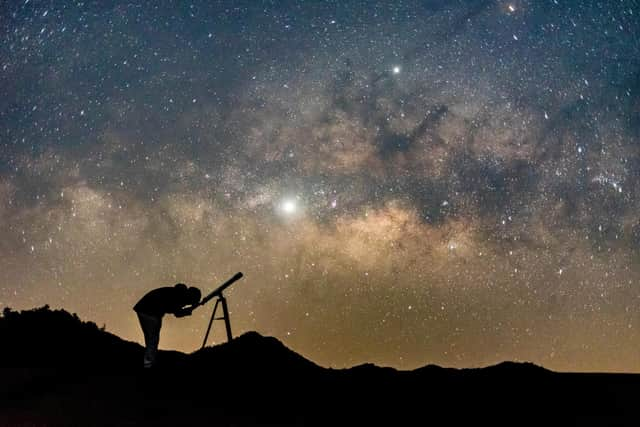

Peak temperatures can reach anywhere from 1,648C to 5,537C as they hit the atmosphere.
The meteors are called Perseids because they seem to dart out of the constellation Perseus.
A spokesperson for the Irish Astronomical Association told keen observers to avoid well-lit and built-up areas and try to find unobstructed views.
"To see the most meteors, you need to be well away from bright artificial lights, especially later in the night when you can enjoy real darkness after the Moon gets low and sets.
"The best direction to look is about 40 - 50 degrees on either side of Perseus, and at a similar height above the horizon, as long as that's in a dark part of the sky. That's about half of a right-angle, as a rough guide.
"They are best seen with the naked eye - even binoculars have much too small a field of view, as you never know where the next one will appear! Use a lounger or a reclining chair for comfort, and allow at least 10 minutes for your eyes to adjust to the dark before you can see any but the brightest ones.
"You can try to get photos with a phone camera, but it's a matter of luck - the meteor will be gone before you can press the shutter! So just prop the camera up pointing at the sky, in night mode, and set it to take a series of exposures each as long as possible, and hope for the best - but you'll be lucky to image even one. The best advice is - just look, and enjoy the free show.
"You'll also see them on the nights before an after maximum - in fact from now until about 16 August, but the rates decline significantly on either side of maximum.
"If you are in a dark sky site on the nights of either 11-12 or 12-13 August, you might see about 60 - 80 per hour late in the night, and especially in the dark period before first twilight."