
'The veteran community in Northern Ireland welcome today’s outcome': Northern Ireland veterans commissioner

Veterans will welcome the acquittal for Soldier F, Northern Ireland veterans commissioner David Johnstone has said.
The former paratrooper – who can’t be named due to legal reasons – was found not guilty of murdering two people, as well as the attempted murder of five others on Bloody Sunday in Londonderry in 1972.
After Judge Patrick Lynch announced his verdicts on Thursday, Mr Johnstone said the conclusion of the trial had “brought into sharp focus the deep pain and division that events from over 50 years ago continue to cause.”
He added that families “continue to experience pain” after losing loved ones – not just in 1972 – but throughout the Troubles.
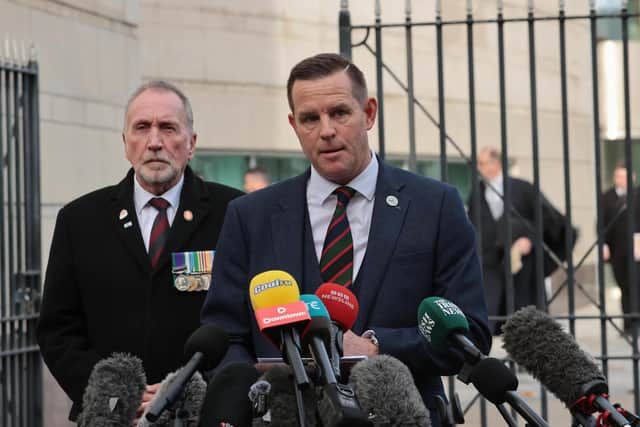

Regarding the outcome, Mr Johnstone stated: “The veteran community in Northern Ireland welcome today’s outcome. Based on precedent and similar legacy court cases, it has become increasingly clear that the admissibility of certain types of evidence, particularly those based on decades old recollections, remains deeply problematic in any fair legal process.
“Soldier F has faced legal scrutiny in various forms for more than a quarter of a century, and it is my hope that today’s ruling by Judge Lynch, brings that long and arduous process to a close. I would also like to take this opportunity to thank those veterans who have attended throughout this trial to show their support for Soldier F.”
He did however warn that “society in Northern Ireland must find a way to deal with legacy issues in a fair and balanced way” and that “many veterans are rightly concerned that too often legal processes are used to twist the truth, rewrite history and shift focus away from the reality that terrorists, on both sides, were responsible for the conflict and that there was never any justification for their actions.”
In concluding, Mr Johnstone stressed: “As Veterans Commissioner, I will continue to advocate for a legacy process that ensures fairness for all and that does not facilitate the wholesale demonisation of those who served, the vast majority of whom did so with restraint and professionalism, with the sole motivation to protect all sections of our community during the turbulent years of our Troubles.”
Meanwhile, Paul Young, national spokesman for the Northern Ireland Veterans Movement, said veterans would be “heartened by this verdict today” and was interrupted as he addressed the media.
“I will just leave because I’m obviously not going to get a word in here,” he said. “Soldiers across the United Kingdom will be happy with this, and I hope that there is no more soldiers brought to the courts here with evidence that has actually no way of going through.”