
Ben Lowry: Kamala Harris is getting some good poll numbers but I still think the core data favours Donald Trump
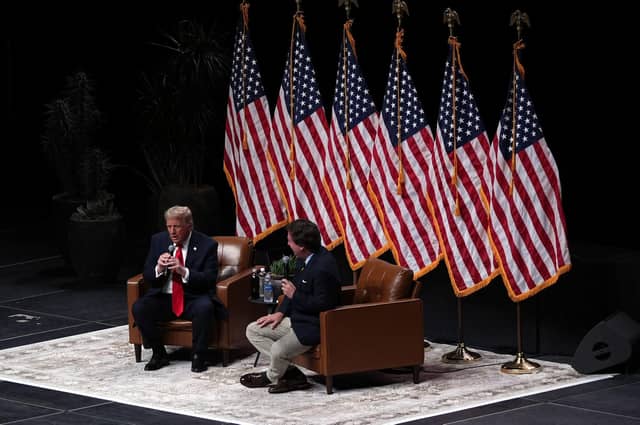

If there is a statistic to bear in mind in tomorrow’s US presidential election, consider this one.
Asked if they like the former president Donald Trump, 64% of Americans in a recent poll cited by CNN said no. But 21% of those respondents who dislike him will vote for him anyway.
Now add those two figures together: 21% of 64% is 13.4% of the total number of people polled. If you add that to the 36% of Americans who do like Mr Trump, then you get to almost 49.5% of the total number sampled – which is roughly the share of the overall US vote he is forecast to get. Around a quarter of Trump voters don’t in fact like him. I noticed this coolness towards Mr Trump among many of his voters in a micro poll I did in North Carolina in 2016.
Left-leaning critics of Mr Trump often assume that by constantly highlighting his dislikeable traits they will win some of these reluctant Trump voters, but such voters are – or so it seems – too wary of the politics of liberal Democratic Party politicians such as his opponent, the US vice president Kamala Harris, to switch to her.

We understand this in Northern Ireland. Plenty of nationalists and unionists in the province have voted for candidates of whom they are not fond to send a message to the other community.
The survey finding I cite above is one of a blizzard of statistics, some of which contradict other findings. Yet since he was elected president over Hillary Clinton, Donald Trump has performed better in elections than his consistently low favourability ratings. More than half of Americans dislike his traits of boastfulness, lies, fantasies, and verbal abuse. But reservations about Mrs Harris are being exploited here in America by TV adverts and pro Trump videos that show the Mexican border being overrun, or refer to her past support for extremist movements such as Black Lives Matter and Defund the Police.
Long before Joe Biden was deposed as the Democratic Party candidate for president this summer polls showed that any other moderate Democrat politician would easily defeat Mr Trump in the Oval Office race – someone such as the former US senator for Maine George Mitchell, who oversaw the 1998 Belfast Agreement talks. Mrs Harris, however, is seen as too radical and as having been prematurely promoted due to race and gender.
A fortnight ago I wrote about my own informal method for assessing all the opinion polls, and why Kamala Harris was not far ahead enough in them (‘Why I think Donald Trump is marginal favourite to win,’ October 19). My updated summary of the latest 20 polls as of yesterday has her 1.0% ahead of him in the overall popular vote, an even smaller lead than then.
The American election is not decided by a nationwide tally of the overall vote but rather by its electoral college, explained in my Saturday column of October 26. There have now been two elections in which the Democratic candidate has won the vote but lost the college, most dramatically in 2016 when Hillary Clinton won a mammoth three million more votes than Mr Trump but lost the college (a footnote on that: Mrs Clinton, whatever her political failures, never challenged that patently legitimate Trump victory. He in contrast has repeatedly contested Joe Biden’s legitimate and even more decisive 2020 win – an unprecedented postwar undermining of the impressive US democratic system by one of its own presidents).
So if Mrs Harris does indeed win the popular vote by a mere 1% she would be expected to lose badly in the electoral college, which currently favours Republican Party candidates, due to the way votes are distributed across the 50 US states.
You will have seen polls from the so-called swing states that show the race too close to call. I write this from one of them, Arizona (click here for my report from Trump and Harris rallies here), and last week was in another, Nevada (click here for my report). But I am wary of such polls. There is better polling infrastructure for surveying the entire US, and more experience of doing so, than there is in individual states, which can move being between being marginal and safe for one party.
In 2008 I was in the then swing state of Ohio, which Barack Obama won easily but which is now firmly Republican. In 2016 I was in the swing state Florida, which Donald Trump won narrowly but is now seen as a cert for him. So I continue to look at the national vote data for the two candidates and work backwards from that to the electoral college, on the basis that any national swing is likely to be reflected pro rata in the individual states.
Does this mean her defeat assured, due to a combination of a too-slender national lead, the way Mr Trump has been under-estimated in the two elections in which he has previously stood, and the fact that the electoral college probably favours him? Not quite.
There are two plausible routes to victory for her. The first is that the polls no longer under-estimate Mr Trump because the so-called shy vote (people who are reluctant to admit voting for such a controversial man) is gone. There is less stigma to voting for someone who has become mainstream to many Americans. In 2008, when I was in the US, I wondered if Mr Obama’s republican rival John McCain would benefit from shy white voters who would not admit to pollsters their reluctance to back Mr Obama, a black man. But that year there was no shy vote – the polls were spot on. Using my method of averaging the last 20 pre election opinion polls, Mr Obama was 7.2% ahead. And on the day he won the US popular vote ... by 7.2%.
Also, pollsters, who amend their data to try to ensure that it is reflective of the likely voting public, might now be over-compensating for under-estimating Mr Trump in 2016 and 20.
Her second route to victory is if the electoral college no longer works in favour of the Republican Party, in which case even a slender victory margin in the overall vote will see her win the college too.
That brings me to a respected pollster’s finding this weekend that has shocked pundits, showing Mrs Harris ahead of Mr Trump in Iowa, a state he has been expected to win with ease. The poll has her so far ahead of Mr Trump among women as to upend assumptions as to what will happen in other states, and so in the electoral college.
The gender divide is now colossal. Mr Trump is said to be gaining ground even among Latino men, who have traditionally been mostly pro Democrat, and African American men, who have been overwhelmingly so, while losing support among white women. But the political push against abortion is so unpopular, particularly with female voters, that even solid Republican states such as Kansas are overwhelmingly opposing anti termination initiatives. Concern about abortion is seen as a key reason why the Democrats did better in the 2022 congressional elections than they had polled.
This massive support for Mrs Harris among women could yet shatter the recent trend in the electoral college, in which Democrats have to get far more votes than Republicans, and see her win the overall race to the White House.
I still think that the core data is better for Mr Trump than for her.
• Ben Lowry (@Benlowry2) is News Letter editor