
Ben Lowry: I fear that vulnerable and isolated people will be at real risk of coercion under the assisted suicide law
In the article below I talk about farm tax inheritance and some of the confusion around the planned new law.
Such inheritance problems would be avoided entirely if farmers, or indeed non farmers, left all their assets to their offspring or heirs long before death.

If you bequeath your assets to your beneficiaries more than seven years before you die you pay no tax at all.
There are some qualifications to that rule – you cannot, for example, benefit from the rule if you bequeath your house while you are still alive and then continue to live in it, unless you are paying market rent to your beneficiary. But the rule is an easy way for anyone who wants to avoid inheritance tax to do so.
Why then don’t all parents do that? The answer to that question helps to explain why there are serious concerns about the so-called ‘assisted dying’ legislation. I agree with critics that it would be more accurate to call it ‘assisted suicide’.
Parents do not give all of their assets to their children for a wide range of obvious reasons. That they cannot know how long they will live is one. But they cannot entirely trust their children either.
Do I mean that parents cannot be sure of the fact that their children love them? No. I mean that parents all round the world might be entirely sure that their children love them deeply but cannot be sure that their kids will act in ways that are best for them (the parents) or indeed for themselves (the children).After all, we all grow up. I suspect most people aged 50+ wince at major life decisions they made when they were 30+. We can all make serious mistakes in our lives that we only come to see and to understand later in life, when w look back on events. Parents know very well that a dearly loved child might, for example, enter into an unsuitable, perhaps even disastrous, marriage.
In that case, the parent who has given down their assets so that their children avoid inheritance tax or care-home fees might live to regret that it much if they survive long enough to see the child squander the said money.
My observation is an obvious one. And it brings me to one of the big problems with assisted suicide. If a parent cannot be entirely sure that a beloved child will do the right thing by them, then an aunt or uncle or other vulnerable person will often be even less certain that their nephew or niece or other next of kin will do the right thing for them.
Imagine, for example, a lonely and kindly person who is very elderly and frail, slowly losing their faculties, who is intending to leave their assets to people who are not their children, then having to rely on those beneficiaries to do what is best for them, the legator.
I do not doubt that the overwhelming bulk of beneficiaries in those circumstances would do the right thing by the older person for whom they are next of kin. But even if most people will behave with complete integrity, many others will not. They might try, if they have any legal ability to do so, to hasten the death of the older person. They might need money for some urgent reason, and then – in the face of potentially massive care home fees – convince themselves that they are putting the elderly person out their discomfort and sparing them the misery or indignity of such care.
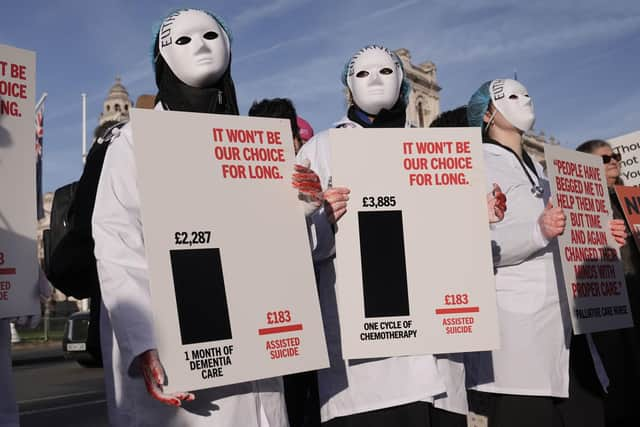
Even if this does not happen, a kindly elderly person might convince themselves that they are a burden who should hasten their death when they would prefer to live on. I am not saying that this bill that Parliament passed yesterday, bringing assisted suicide closer, would enable next of kin to end the life of the person for whom they have been entrusted to care. The bill is far from having been passed into law, and could yet be changed radically before that happens. But I am saying that we are heading into very murky territory where all sorts of bad things could happen. I am also alarmed at how assisted dying has expanded massively in scope in countries such as Belgium and Canada.
The advocates of assisted suicide claim that it is not suicide, but I think that a doctor bringing forward a death with the apparent consent of the patient is indeed helping a suicide.
There will be certain situations in which there is no doubt at all that the patient is determined to bring forward their death. But I always remember something my dad, a cancer doctor, said in a debate on euthanasia in Belfast a decade ago: that he had had many, many terminally ill patients and almost all of them wanted to keep living longer, even if their quality of life was very poor. Some did want to die, but very few.