
Ben Lowry: Politicians like the Rev Martin Smyth served the community despite the grave threat to their life
We report on page six the funeral of the Reverend Martin Smyth in north Belfast.
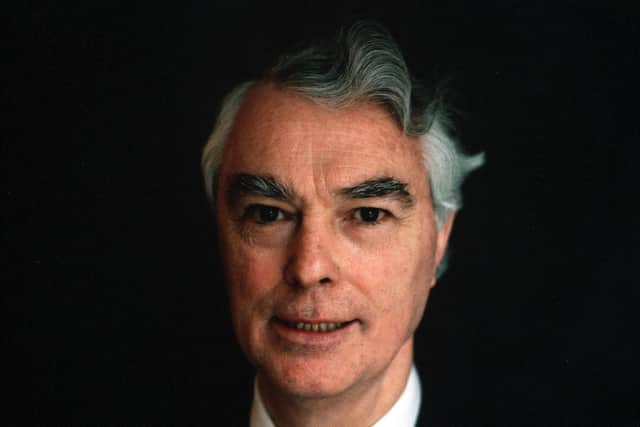

I was among the mourners at Alexandra Presbyterian Church on the York Road, within walking distance of the city centre (1.4 miles away).
I was there to represent the newspaper, having met or interviewed Rev Smyth only rarely (I was unable to pass my condolences to his daughters, Rosemary and Heather, yesterday before the family left the church for the private committal). But while Rev Smyth was in some respects a quiet politician who shunned the limelight, I am well aware of his career, having become interested in politics not long after he was elected to Westminster in 1982.
A lot changed politically between then and now, not least in his former constituency, South Belfast. I know the seat well because my grandparents lived there and later did so myself. It was such a safe unionist seat in the 1980s that when Rev Smyth resigned his seat in protest alongside other unionist MPs over the disastrous 1985 Anglo Agreement, he won the resulting by-election over the former Alliance lord mayor, the late David Cook, with a whopping 71% vote share. South Belfast does not exist as a constituency in its old form but when it last did, in 2019, the combined unionist vote had collapsed to a trifling 27.4% – unionists had gone from almost two-thirds of voters to barely a quarter.
It was striking to see the full range of unionism at the funeral service yesterday, from the liberal Ulster Unionist MLA Robbie Butler to the firmly unionist TUV North Antrim MP Jim Allister.
Rev Smyth opposed the Belfast Agreement, which caused bitter divisions in the UUP from which it has never entirely recovered. Ruth Dudley-Edwards wrote in her most recent Thursday News Letter column that, as an ally of David Trimble, she had once considered Rev Smyth unimaginative and hidebound. Later she interviewed him and came to realise that she had under-estimated “this brave Orangeman” (here is a link to her essay).
As it happens I supported the 1998 deal, as did this newspaper (several years before I joined it). I was in my 20s then and would not have related to Rev Smyth’s very religious type of unionism. Now, while I still think that David Trimble achieved huge things such as the principle of consent and Sinn Fein accepting Stormont, I am also conscious of how some of the criticisms of that deal have been vindicated. Being in government rehabilitated Sinn Fein, which had hitherto been rejected at the ballot box by a majority of nationalists in Northern Ireland and an overwhelming majority of voters in the Republic. This has then led to the retrospective vindication of IRA terror among emerging generations that have no memory of the Troubles.
My own generation, born early 1970s, does not have a proper memory of the violent years either, which peaked when we were toddlers. I remember well the hunger strikes when I was coming up to age 10 and the Harrods bomb two years later (I recall a flustered, visibly upset security woman at Springhill Shopping centre in Bangor telling everyone about the latter as they arrived).
But I remember neither the murder of the Rev Robert Bradford in 1981, nor the murder of Edgar Graham in 1983. Only later did those heinous killings, and their significance, register with me. A lawyer friend of mine, now retired, has warm memories of Rev Bradford through Christian circles and Mr Graham as a lecturer.
I have often said that the murder of Mr Graham in particular, being more than a decade younger than Rev Bradford, was a bid to scare unionists out of politics. And it did. But I would never want to seem to be denying the bravery of all those who stayed in, or later joined, unionist politics amidst such pure terror.
Scroll down for more on this article. And also read here: Martin Smyth was an MP of ‘integrity and Christian principle’, service told
Rev Smyth was a prime example of such fortitude amid selfless public service. The IRA had already tried to kill him for being an Orangeman. The funeral heard that he wanted to remain as incumbent Presbyterian minister in his church, but instead he took Bradford’s seat. He was so admirable as MP that the Commons speaker Betty Boothroyd praised his exemplary parliamentary “integrity”.
Yesterday the ex UUP MP Roy Beggs told me that his one-time Westminster colleague Rev Smyth was “a great Christian ambassador” and the ex UUP, then DUP, MLA William Humphrey described him as a “fearless, principled unionist”.
That is how he seemed to me.
Ben Lowry (@Benlowry2) is News Letter editor