
Ben Lowry: The chancellor Rachel Reeves's comments on Northern Ireland and its defence industry should give comfort to unionists
This week the chancellor of the exchequer was in Northern Ireland, where she talked about the importance of our defence industry.
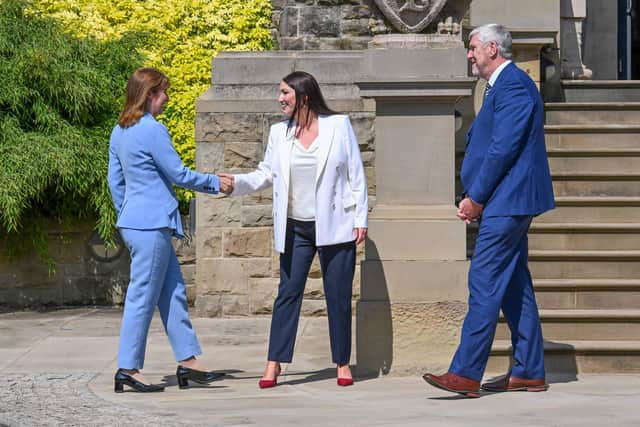

The visit of Rachel Reeves came days before the 80th anniversary of the end of World War Two, a conflict in which the strategic importance of Northern Ireland to the UK was underlined.
Unionists, at this time of uncertainty for the Union and of political weakness towards Scottish and Irish nationalists, should take comfort from Ms Reeves’ remarks.
Her visit also coincided with the US vice-president, a man of Scots Irish (ie Ulster) origins, being on holiday in England and Scotland. He talked about the importance of the ‘special relationship’. This term is much mocked by rivals of the UK, who say that only Britain thinks in such terms, not America, yet it is clear that both the current president and his number two are anglophiles.
We report today on how Mr Vance’s criticism earlier this year of the severe restrictions around protest outside abortion clinics has had undermined those exclusion zones. We know that President Trump’s scathing criticisms on Europeans for not spending enough on defence had an immediate impact too.
It is a reminder of the great value of being part of a UK that has been a close ally of the US for more than 100 years, and that was already spending more on defence than some other European members of Nato.
Ms Reeves said: “Northern Ireland is brimming with talent and ambition, from cutting-edge film studios to world-class defence manufacturing.”
She said that the investments she announced were a “turning point”, adding: “Every pound we invest here supports good jobs, strengthens our economy, and boosts the United Kingdom’s standing on the world stage, with Northern Ireland at its heart.”
On the one hand such comments are not particularly unusual – leading UK politicians will always praise the regions that they visit. On the other, they are hugely significant. Less than a decade ago, Jeremy Corbyn came within a whisker of Downing Street when he had one of the best recent Labour votes shares in a UK general election (40% in 2017). He was a man who is not merely weak on defence but sometimes positively warm about groups or countries that are hostile to Britain. He is also a politician who has previously espoused an all-Ireland and is a long-time friend of Sinn Fein.
Now there is a Labour government which has made clear that a border poll is not on the agenda, and which has dismissed even the republican grievance that the criteria for the calling of such a referendum must be clarified (in fact, as Hilary Benn has said, the position is clear in the Belfast Agreement). And a government that is increasing defence spending.
Last year, the influential centre-right think tank, Policy Exchange which is based in Westminster, issue a report that said that Northern Ireland is key to addressing the UK’s security concerns. The document called for the UK government to expand its naval and air presence in NI for “maritime patrol missions against Russian intrusion”. It also urged the UK and its regional partners to unite and “up the ante” in pressing Dublin to do its “fair share for collective security”.
The then prime minister Rishi Sunak said that he would be “delighted” to examine the report and added: “I have seen, with my own visits, the vital role that Northern Ireland is playing through the location of firms like Thales and Harland and Wolff.”
I am not saying that the current Labour government is on the same page as Policy Exchange – all Keir Starmer does about the Republic of Ireland is gush rather than apply pressure over its defence freeloading, even as Ireland has the audacity to sue the UK over its handling of the legacy of the Troubles.
But even so the Labour leadership is clearly inclined to dismiss complaints by the SF First Minister Michelle O’Neill, who said this year that she was “incredulous” that the government was spending money to help Ukraine’s military when it could instead fund public services. Ms O’Neill did not meet the chancellor on Tuesday – her deputy first minister Emma Little-Pengelly did with the finance minister John O’Dowd.
Ulster gave large manpower to the Great War, a terrible conflict that led on to World War II, when NI played a vital geographic role against the Nazis. Still many people from here join the wider UK security world, from the army to the intelligence agencies.
Now we remember all those from here who served and died in two global conflicts that finally ended 80 years yesterday.
Ben Lowry (@Benlowry2) is News Letter editor