
Ben Lowry: The new Ulster Unionist Party leader cannot be faulted for never having been elected
Jon Burrows, the next leader of the Ulster Unionist Party, has come into politics very recently, but has done so from a successful career in policing.
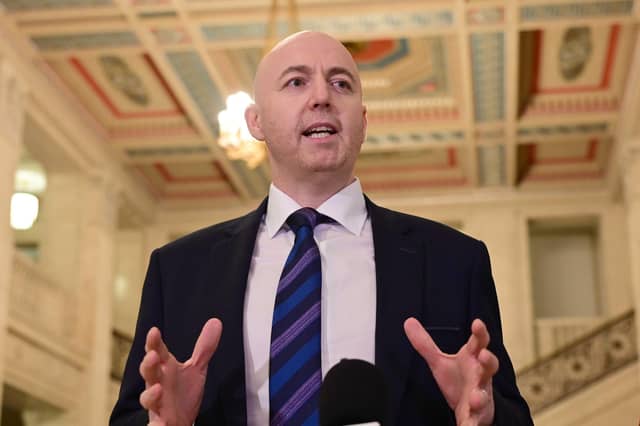

Stormont does not have a great track record in attracting talent, but it has done with Mr Burrows.
The Ulster Unionist Party in fact has one of the best portfolios of politicians who had a notable career prior to politics, including the outgoing leader Mike Nesbitt, who was a successful broadcaster, the MLA Steve Aiken, who commanded a nuclear submarine, and Doug Beattie, who was a captain in the Royal Irish Regiment. Andy Allen is a veteran who lost his legs in service to his country.
The man who did not stand for the leadership, the outgoing UUP deputy leader, Robbie Butler MLA, was an experienced firefighter.
The Ulster Unionist Party faces challenges, but it cannot be faulted on public service.
Much has been made of the fact that Mr Burrows has not been elected, neither to elected office nor to the leadership of the UUP. I don’t think he can be criticised for that.
As I have written many times over the last decade, it is a huge struggle to get good people into politics and it is a further struggle to get those who enter Stormont then to agree to be the leader of a party. We are a country of two million people with at least five major political parties, and a divided society in which people do not want to admit their political views, let alone actually go into the public arena fighting for those views. America has 300+ million people yet struggles to find good leaders, so it is all the harder for us.
The brightest and best in society can be selfish and money-orientated, and turn up their noses at jobs that pay two or even three times the £53,000 that an MLA is paid.
Furthermore, the foolish double jobbing ban (why on earth can someone not be both a councillor and an MLA?) has not improved our politics but has merely reduced the pool of good people to fill important political positions.
So, in the circumstances, the Ulster Unionist Party has done well.
Regrettably Mr Butler did not stand, which means that once again the UUP has had to crown its leader without a contest. The Lagan Valley MLA put out a statement announcing that he was not running for the top job, in which he simultaneously implied that he was popular across the party but that he would not have enough support to win the leadership. He said that the party wanted a different style of leadership and focus to his.
In his statement, which did not mention Mr Burrows at all, he said that he would continue to serve the community, adding: “I will continue to engage honestly and with good conscience in the coming days and weeks to better understand the direction and focus of any new leadership team, whilst remembering and demonstrating the credo: Country first, Party second.”
That he did not offer any warm words to Mr Burrows, who had been warm about Mr Butler, and instead said he wanted to see the new direction of the party before saying that party was not as important as country, could make it seem that he was saying he might not always continue as an Ulster Unionist politician.
In the previous sentence his remark that he remained “loyal to the cause of enlarging the pro-Union voting block” appears to dismiss any idea that he would be more comfortable in a party like Alliance.
I emphasise that this is how Mr Butler’s statement might have appeared but we will of course be pleased to run a platform from him that outlines more of his thinking. He said in the statement that he is not saying more at this time.
I think that it is correct that the party wants a new focus because even moderate unionists are frustrated by an emboldened nationalism – and I mean nationalists on both sides of the border, not just republicans.
It is more than a decade since I called for a liberal unionist party, even though my own politics would now be more firm than that. I also have written about liberal unionism at times falling into confusion, and failing to challenge nationalism on core issues.
But, not least based on the admirable essays that Mr Burrows has written for this paper, the incoming leader seems to offer a mix of robust unionism that is moderate in style. His instincts are not naturally DUP, yet I doubt he will find unionist co-operation at times unpalatable.A last thought: our story on pages 1 and 14 shows unionist frustration with three parties. It is unsustainable. But a single unionist party will lose votes to the centre that unionism cannot afford to lose. The path forward is not an easy one.