
Ben Lowry: The Ulster Unionist Party has defied its obituarists but really does face a crisis if Jon Burrows is ousted
On the last day of January, a Saturday, I was at the Stormont Hotel for the election of the latest leader of the Ulster Unionist Party.
(To read Ben Lowry on lectures about Ulster and early America, click on this link here)
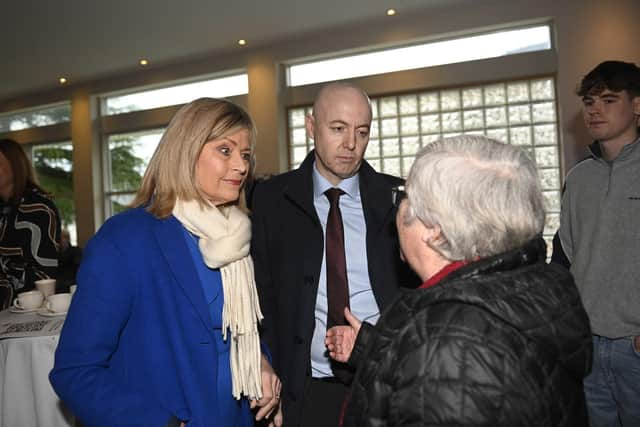

A striking aspect of that day, as our political editor David Thompson reported, was the fact that all the Ulster Unionist Party MLAs turned up for the installation.
Mr Burrows was new to politics, having been co-opted as Stormont MLA for North Antrim after the incumbent Robin Swann was elected Westminster MP for neighbouring South Antrim.
All nine UUP MLAs were at the hotel that grey winter morning, which was telling because there had been a whiff of tensions within sections of the party at Mr Burrows taking over from Mike Nesbitt, given that Burrows was so new to politics. If one or more of the small assembly team had been absent, it would have been seen as a snub.
That Saturday was a ratification of the new leader, not an unveiling – he was certain of the post because there had been no contest. Robbie Butler, then UUP deputy leader and Lagan Valley MLA, had been expected to run for the position but did not. There was no candidate other than Mr Burrows, and no election. This was the fifth such leadership change in which there was no contest and it meant nobody – in the Ulster Unionists or outside it – could assess what members wanted.
In 2012 Mike Nesbitt defeated John McCallister for the leadership, but in 2017 Robin Swann was unopposed for the post. In 2019 Steve Aiken was also unopposed, in 2021 Doug Beattie likewise, and Mike Nesbitt was unopposed on his return as leader in 2024.
The 2022 assembly election was OK for the UUP, then under Mr Beattie. While the nine seat tally was its lowest ever number of MLAs, this was partly because it was only the second Stormont election in which the number of MLAs had fallen from 108 to 90, meaning less seats for all parties. The UUP in 2022 got 96,390 first preference votes, 11.2% of the overall total. While this would have been a disastrous result 20 or so years previously, when the Ulster Unionist Party could hope to secure almost a quarter of all votes cast in NI and on a good day the better part of 200,000 votes, the 2022 outcome nonetheless showed that it was wrong to dismiss the UUP.
I have written before about how the demise of the UUP and SDLP is routinely predicted, yet both parties between them always poll more than Alliance do. On their own, they get more votes than Alliance did for years after the 1998 Belfast Agreement. If Alliance was seen as being on the march when it got 51,000 votes in 2007, why was the UUP seen to be almost extinct on twice that amount in 2022?
Having said all that, if the Ulster Unionists were to flirt with extinction then the saga of the last two weeks would be a good way to go about it.
This week it was reported that three of the now eight UUP MLAs (after Doug Beattie quit) were strongly opposed to Mr Burrows as leader. He was accused of creating a toxic environment in the party. Well if that is so why did none of them challenge him for leader? And why did they not put their name to this criticism, as Mr Beattie did?
The collapse of the relationship between Mr Beattie and Mr Burrows is very sad – they are the sort of Northern Ireland needs in politics, having had a distinguished career prior to Stormont. The assembly can seem badly devoid of talent of experience, yet those two men were successful in the security forces. The UUP has a good record in attracting external talent, including the former nuclear submarine commander Steve Aiken and the experienced broadcaster Mike Nesbitt.
The struggle in attracting good people into politics is due to factors including the selfishness of the brightest and best in society, who will typically not contemplate becoming an MLA even on the controversial new higher salary of £67,000, let alone the current income of £53,000. High court judges are paid several times that, £234,000, yet the legal world can find it hard to get suitable keen judicial candidates.
Stormont’s talent deficit is also due to the hypocrisy of a public that is scathing about politicians and often abusive about them online, yet will not itself come forward to serve their country in elected office. Immense societal problems need fixed yet the collective political class will not take tough decisions.
Mr Burrows is impressive, yet has much to learn about politics, being so new to it. But he is popular with unionist voters and UUP grassroots. If his MLAs force him out, who is going to do a better job for the UUP?
• On Monday, Owen Polley in his column will challenge the idea that the UUP has become hardline
• Ben Lowry (@Benlowry2) is News Letter editor