
Ben Lowry: We were not the first newspaper to report the US declaration of independence in 1776, but our coverage of early America is even better than that charming myth
It is two hundred and fifty years to the day since the signing of the American Declaration of Independence.
Next month it will be 250 years since the publication, pictured right, of that momentous declaration in a famous edition of this newspaper, which was then styled the ‘Belfast News Letter’ (a title no longer in formal use but one that I use informally to describe this paper if I am speaking to someone who is from outside Northern Ireland).
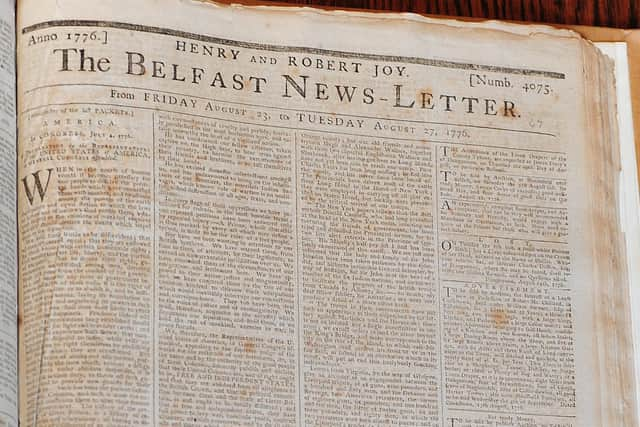

That declaration of July 4th 1776, which created the United States of America, was as you can see reported at the top of our front page – newspapers then were only a few sides of paper.
You can also see the large capital W which denotes the start of the text, which continues:
“When in the Course of human events, it becomes necessary for one people to dissolve the political bands which have connected them with another, and to assume among the powers of the earth, the separate and equal station to which the Laws of Nature and of Nature's God entitle them, a decent respect to the opinions of mankind requires that they should declare the causes which impel them to the separation.”
The readers of the News Letter here in Ulster understood the massive significance of the declaration because they knew so many people who had left for America. It was the formal launch of a war that they had read about, from the first skirmishes near Boston more than a year earlier.
That was in Massachusetts, an area that had large numbers of people who tended to have sailed west from England, whereas the many immigrants from Ulster were more likely to be found living in the colonies to the south, such as Pennsylvania. The earliest surviving News Letters of late 1738 and early 1739 (we were founded in 1737, almost 40 years prior to the declaration of independence) have an advert for a boat called the Snow Charming Molly, that was due to sail “from Belfast for New Castle or Pennsylvania in America, against the first Day of May next”.
The date of the edition pictured on this page is August 23 to 27 1776, spanning a weekend. It had taken news of the declaration seven weeks to cross the Atlantic and then reach Ulster.
We are one of a handful of newspapers around the world that reported the declaration and are still in publication, most of them weekly papers. The Times of London, for example, is a unusually old title but was not founded until 1785, almost half a century after us, so it has no such 1776 report in its archives. Even the oldest surviving paper in America, the Hartford Courant, was not founded until 1764. The News Letter was launched decades before even that Connecticut-based title.
As our readers well know, we are the oldest English language daily newspaper in the world (there are two German language papers and one Italian that are older). We were were not in fact a daily at the start – we were published twice a week in the 1700s – so the most precise description of our historical record is this: of the daily newspapers published anywhere today in English, we are the oldest.
Which brings me to a charming myth about the News Letter – that we were the first newspaper in Europe to report the US declaration. The story, of unknown origin, took on a force of its own over the decades – for example that the news was being carried to England but a storm led to the ship berthing in Londonderry and the declaration being taken by horseback to Belfast.
I wish it was true!
In a history for our 275th birthday in 2012, the historian CDC Armstrong disproved the story. The declaration was in fact published in papers in London in mid August, and then was reported here a week later.
You might wonder why I choose this date to correct the record (again). I do so because multiple times in the last few months alone I have heard this story circulating at events to mark the 250th anniversary, including a reception I was at in Washington DC. We have tried to correct the record many times, removing stories from our website that repeated it and so on. I have informed tour guides and broadcasters and indeed libraries, but it is very hard to keep it down. My heart sank when I talked to visitors to Belfast recently who had just been told it by a guide.
Yet while I am slightly embarrassed by the myth, this is only because it is a distraction from our magnificent real history. I am proud to edit a paper that is one of the most important in the world when it comes to early reports on America.
This is because the population movement from Ulster to America in the late 1600s and 1700s was one of the most significant migrations ever. The exact numbers are unknown but it was up to 200,000 people into a society that was, at the time of independence, a little more than two million people.
Talk of American presidents with Ulster origins can be exaggerated by claims that the list includes late 20th century leaders US leaders such as Richard Nixon and Bill Clinton, whose link to here is distant. But it is not exaggerated at all when it comes to early presidents.
My rule of thumb is that a president has serious Ulster links if he had a parent, grandparent, great grandparent or great great born here – which is about a quarter of the men who have occupied the White House (11 out of 45). Those who did are led by Andrew Jackson, who – incredibly – had two parents born here in 1765 shortly before heading west (he was born in America in 1767). As recently as a century ago, the US was led by Woodrow Wilson, who had a grandparent born in Ulster. The other presidents with close ancestral links are:
James Knox Polk, James Buchanan, Andrew Johnson, Ulysses S. Grant, Chester Alan Arthur, Grover Cleveland, Benjamin Harrison, William McKinley, Theodore Roosevelt.
There is no room here to give examples of the vast archive of News Letter reports on these men, the ships that took them out and on the other Ulster men who helped build the pre and post revolutionary America. Suffice to say that the News Letter is essential to major historical research on that Ulster-America history, which persists up to this day, with a US vice-president, JD Vance, who has written of his Scots Irish roots in Kentucky.
The distinguished historian Professor Lord (Paul) Bew once called the later 1790s News Letter the most interesting newspaper in the world. “Because,” he wrote, “it covers the French Revolution in great detail, but more importantly it deals with the impact on Britain and Ireland. As Ireland is caught up in the clash between enlightenment ideals, national security and sectarianism there is no better guide than The Belfast News-Letter.”
Something similar can be said about our extensive archive of 1770s reports on America.
Ben Lowry (@Benlowry2) is News Letter editor