
Doug Beattie: I hope MoD challenge to Clonoe ruling is start of a pro-active approach that will see IRA leaders held to account
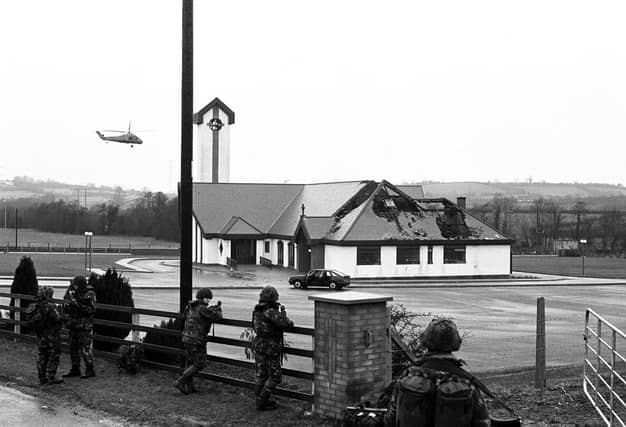
The news that the Ministry of Defence (MoD) is to challenge the coroner’s ruling that a specialist military unit was not justified in the killing of four heavily armed terrorists at Clonoe may come as a surprise to many.

Surprise to those who are apologists for the terrorists because, having had a free run promoting the narrative that the terrorists are the victims, they are suddenly seeing it challenged.
Surprise from the veterans community because they have stood by while the Ministry of Defence and the UK government have been silent in defence of veterans, instead relying on legal support to the former soldiers without getting directly involved.
This has changed and it has changed for good reason. The ruling that the killings were unlawful puts in question the rules of engagement the UK forces used when deployed on Operation Banner – rules that were continuously scrutinised by legal advisors and rules that lay the basis for ‘judgmental training’ of military personnel before they were deployed.
As an instructor at the Northern Ireland Training Advisory Team (NITAT) I saw first-hand how all training was designed. Training, tactics and procedures (TTPs) were based around civil law, the law of armed conflict and most importantly the rules of engagement - the yellow card.
If now, after operation Banner has ended, the yellow card is found to be flawed then it is not the soldiers who should be held to account but those who sent them there with flawed legal direction.
The Operation Banner rules of engagement are explicit. A challenge must be given before opening fire unless ‘to do so would increase the risk of death or grave injury to you or any other person’.
Therefore, the argument must be, did the commander on the ground at the time, at night, with reduced visibility, poor cover and faced with a heavily armed terrorist group of up to 10 individuals, believe there was an increased risk of death or grave injury.
To argue “no, he didn’t” is both naïve and fails to accept the lethality of the East Tyrone Brigade of the Provisional IRA.
It also fails to understand the reality of military interventions in such circumstances and how training, tactics and procedures would have driven their response once the decision to use lethal force was taken.
The Sinn Fein MP for Mid Ulster can complain all he wants but the use of judicial review is a mechanism of the law.
His party is never shy in supporting its use if it is to support terrorists.
It must also be remembered that he is part of a political party that supported these young men in their murderous actions.
To that end Sinn Fein, siting in the warm offices feeding their bank accounts, should take some responsibility for the death of these four terrorists.
In the end, the Ministry of Defence and the UK government must do more to challenge the narrative of the Troubles.
I hope this is the start of a pro-active approach that will eventually see the UK government holding previous leaders of the Provisional IRA and Sinn Fein to account.
l Doug Beattie is a politician and former member of the British Army, who was leader of the Ulster Unionist Party between May 2021 and September 2024. He has been a Member of the Northern Ireland Assembly since 2016 and is currently MLA for Upper Bann.