
James Dingley: Republicans have provoked sectarian row over pointless Irish signs
It is ages since republicans last manufactured a divisive issue to stir up sectarian division, without which they are redundant.
And this is a clever one, who would have thought of turning the new, gleaming Grand Central Station into a sectarian issue?
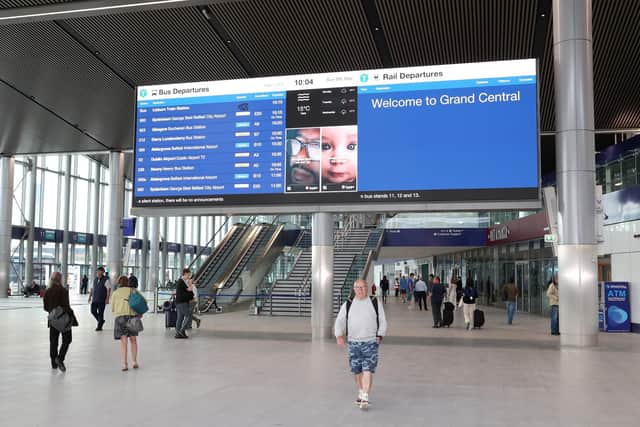

After all, station signs have always been in English – the language of inclusion, providing a shared belonging and means of communication in shared spaces with equal opportunities.
The perfect republican ground for manufacturing sectarianism in workplace and community relations in general and all in the name of diversity, inclusion and parity – the sectarian bigot’s charter.
If we seek inclusion, why not have all the UK’s languages, e.g. Welsh, Cornish, Manx, Scots Gaelic, just to show how inclusive the UK really is?
And then, of course, what about all the other languages spoken in the UK (far greater than Gaelic), e.g. Polish, Portuguese, Spanish, French, German, Russian, Chinese, Urdu, Hindu, Kurdish, Arabic etc?
We could make Grand Central Station truly international.
But republicans don’t want that, they seek a narrow sectarian agenda that only recognises themselves (Sinn Fein, ‘ourselves’). In a recent sojourn in hospital (the Royal Victoria Hospital, RVH) I was excellently cared for by Spaniards, Portuguese, Indians, Lebanese, Chinese, native Ulster folk and probably others: we all conversed in English, were treated in English, and got well in English.
We bonded in English and I recovered very well without any recourse to my native tongue (Welsh).
If we want inclusivity and equality the moral is simple – a single language bonds people from all walks of life.
So, why the need for Gaelic signs, which exceptionally few people can read and no one needs, especially international visitors, when it is such a sensitive issue? The answer is simple: it is guaranteed to sow sectarian division and keep communities divided.
Everyone here knows Gaelic signs are a sectarian marker, a claim over territory and belonging, just like painting kerbstones ‘red, white and blue’ or flying flags. It tells the ‘other’ to keep out because ‘we control this area’.
In Belfast it only requires 15% of a streets’ house-holders to seek a poll on Gaelic signs, allowing a small minority to initiate sectarian division and alter the entire character of a neighbourhood. This was how small groups of republicans turned non-contentious parades, e.g. Garvaghy Road, Portadown and Twaddell Avenue, Belfast, into sectarian issues. It only took a small minority of republicans to turn ‘mixed areas’ into sectarian ghettoes.
Further, republican tactics divide many Catholics. Many Gaelic language enthusiasts and the SDLP dislike republicans’ ‘weaponising’ the language because it forces them to either support a sectarian move or to divide their community by opposing it.
It is even worse for the Alliance, forcing them to stop sitting on the fence and make a real commitment to the common good as a against a sectarian ‘parity of esteem’. Very clever republican politics.
Meanwhile, unionists flounder in their usual disarray because they have never really thought about it or developed a coherent policy.
Their knee-jerk reaction is the predictable one of cost: true, but miniscule in the great scheme of things (including the government doing anything just to shut the whingeing republicans up).
Unionists must develop a carefully thought out, long-term strategy on language that spells out clearly the short and long-term consequences of letting republicans get away with manufactured grievances. Also, the limits to diversity, inclusion and parity if the government genuinely seeks stability, peace and reconciliation.
Westminster must stop playing ‘Pontius Pilate’ and actively stamp on overtly sectarian moves, which are not difficult to recognise, and promote genuine inclusion, e.g. one language for all in public spaces.
• Dr James Dingley is a former university lecturer and Nato NATO instructor on terrorism