
Jonny McCambridge: Marathon memories. Can I put myself through that again? I'm not so sure
There is a large crowd and their energy is sustaining the suffering runners as they complete the gruelling final yards. I am here to lend support to my brother who is running his third marathon.
My impression is that it is all great fun. I see the exhausted but smiling athletes, feel the warmth of the crowd. It is a bit intoxicating. I don't want to be watching, I want to be taking part, soaking in some of that adulation, getting the congratulatory hugs as I finish the race.
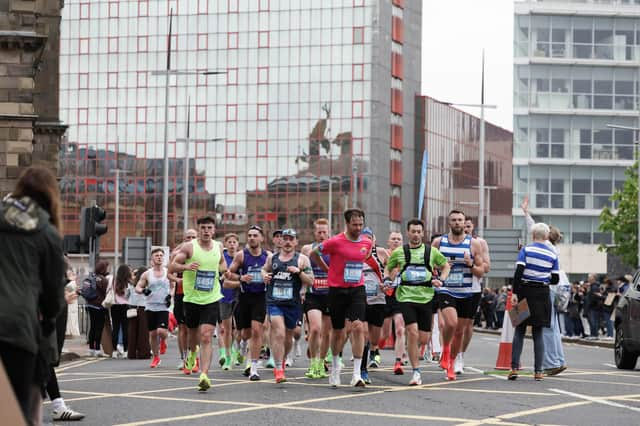

I have completed one marathon in my life, a decade ago. Once more, I begin to get the itch. Wouldn't it be great if I got myself ready for the daunting 26.2188 miles next year? I feel a certainty flooding through my limbs. I will prepare my mind and body once again for the ordeal. I will do it. I will.
Later, I am driving home and still tingling with a little bit of anticipation. I have warm memories of my last marathon. I raised money for a mental health charity, I had family and friends waiting for me at the end, there was the sense that I had fulfilled a lifelong ambition. It is all positive.
However, as the car inches along roads, which are still partially closed to facilitate the runners, some of the deeper memories of 2016 begin to resurface.
During my preparation for that race, my obsessive personality traits took over. In the dark, bitter days of that distant January, I embarked on my own tailored four-month marathon training plan (it's at this point that I start hearing the music from the Rocky films in my head). Short fast runs for pace. Medium steady runs. Long slow runs for endurance. Interval training. Running up steep hills. Pilates for flexibility. ViPR (Vitality. Performance. Reconditioning) training to strengthen leg muscles.
Very slowly my ability to run long distances began to improve, but the challenges kept coming. Then, as now, I worked long hours. At the time my son was a demanding toddler son who took up almost all of my attention. As the training became more intensive, I found myself struggling to fit it all in.
The only solution was to invent new time (bear with me). I started setting my alarm earlier in the morning to squeeze in the training runs before my son woke up. First to 6am. But as I got closer to the race, the runs got longer. The alarm went back to 5.30am, then 5am. Eventually, I was getting up at 4.30am for two-hour jogs.
The training in those black early mornings went on right through the long winter in horrendous conditions - snow, ice, gale force winds and driving rain were all encountered. I ran straight into the teeth of multiple named storms while most sensible people were still asleep.
You can't run 40-50 miles every week without it having an impact on your body. I watched my arms, legs and stomach dramatically change shape. I lost a lot of weight and was later informed that a rumour had existed in the office where I worked that I was ill.
I battled aching knees, hips and calves, blisters on my feet and cracked and broken toenails. I'm not even going to talk about nipple chafing.
The everyday process of eating and drinking became more complicated. The body is not equipped with enough fuel to run distances more than 20 miles. I had to ensure that I ate enough carbohydrates, so that my muscles did not exhaust their supplies of glycogen during the long training runs. That's a lot of pasta, rice, nuts, seeds and grains. This was topped up during exercise using an assortment of foul-tasting energy gels.
I drank water constantly (at least three litres a day) to keep my hydration levels stable. That resulted in me running to the toilet enough times to convince those that I worked with that I had a problem with my bladder.
The run itself became a punishing journey into the unknown. I was advised several times that for a man in my 40s with no previous long-distance running experience, four hours would be an impressive debut marathon time. I set off at a pace which would have enabled me to run a three-hour marathon. Close to 20 miles into the race, I was still on course to complete the distance in three hours 15 minutes.
Then my pace slowed dramatically. At the 21-mile mark I suffered cramps in my left calf so severely that I could not straighten my leg and hobbled on, determined I would not stop. The last three miles seemed to be interminable as I limped along the Ravenhill Road, suffering physically and mentally and praying for the finish line. I ran the marathon in three hours, 35 minutes and four seconds.
Even after I had concluded the race, the ordeal was not over. Within half an hour my body went into shock. I was freezing and shook uncontrollably for some minutes and was only restored to equilibrium when I gulped down several chocolate bars.
The physical scars of the 2016 marathon healed over time, but I'm not sure the mental ones will ever entirely go away.
I have left Belfast now and am driving towards home. Some of the infectious energy that I felt just an hour ago as I watched the runners has now dissipated and I see the situation in a different way. I am 10 years older, with less energy and more weight to shed. The pinnacle is much further away than it was before.
However, my obsessive personality is as it was. If I were to undertake this challenge, I would want to do it better than before and would punish myself accordingly. I pull into my driveway. I ask myself do I really want to run the Belfast Marathon in 2027? I'm not so sure.