
Owen Polley: Activist quangos - all funded by the tax payer - have debased human rights and equality in Northern Ireland
Last week, the unionist parties at Stormont slammed the NI Human Rights Commission (NIHRC) and the Equality Commission (ECNI), following a Supreme Court ruling that limited how EU rights laws are imposed here through the Windsor Framework.
The UUP’s justice spokesman, Doug Beattie, said the quangos had effectively “joined the lobby” for Northern Ireland’s annexation by the Republic, and the TUV called for resignations.
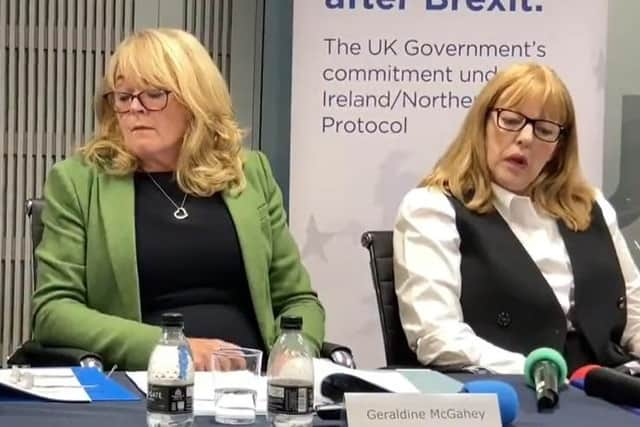

The DUP MLA, Phillip Brett, said the court’s judgment showed, “They (the NIHRC and ECNI) are wrong. They have wasted public money and it is now time for each and every one of them to consider their position.”
In Northern Ireland in particular, human rights and equality had already become two of the most abused concepts in politics. The two public bodies in question have undoubtedly played a role in degrading the ideas they are supposed to uphold.
The NIHRC was established as part of the Belfast Agreement to “consult and advise on the scope for defining, in Westminster legislation, rights supplementary to the European Convention on Human Rights, to reflect the particular circumstances of Northern Ireland”.
Right from the start, it seemed unable to stick to this remit and it was inclined to stray into activism.
The rights it proposed for Northern Ireland were either protected already, by the European Convention and the UK Human Rights Act, or they amounted to debatable political demands.
The Labour government under Gordon Brown, hardly a flinty, right-wing administration, decided that the quango’s work was of limited use. “Over half the rights proposed by the NIHRC’s advice are equally as relevant to the people of England, Scotland and Wales,” it said.
Despite failing to perform the task assigned to it, the organisation continued to lobby for a Bill of Rights.
In 2020, the NIHRC also supported the campaign to change British citizenship law, so that people in Northern Ireland would be treated differently to those in the rest of the UK. Its report claimed this would avoid, “the negative connotations of forcing British citizenship on persons on the island of Ireland…. (which) are the story of the struggle for independence of Ireland”.
This statement of Irish nationalist ideology was published by a body that was supposed to serve all communities in Northern Ireland, rather than pursue partial political objectives.
The NIHRC, along with the ECNI, more recently demanded that the government and executive should, “ensure North-South equivalence of rights, by aligning with changes to EU equality and human rights law, even where not required to by the Windsor Framework”.
The Supreme Court has now thankfully rejected claims that the framework should be used to strike down UK immigration laws and other Westminster laws in Northern Ireland.
The chief problem with the NIHRC is that human rights have gradually become an almost meaningless concept. They no longer cover only things like our entitlements to life, freedom of conscience and a fair trial, which they were invented to protect.
Instead, almost any political demand can now be described as a human right, in an attempt to exempt it from criticism.
Equality is a similarly debased idea, particularly in Northern Ireland.
It no longer means simply that people should not be prevented from getting on in life, because of their religion, gender, race or sexuality. Instead, it has come to imply that certain groups get privileges over others, determined, usually, by how vehemently they claim victimhood.
Take, for example, the demands of trans activists to access female-only spaces, despite the distress and discomfort this causes to many women.
Meanwhile, for Irish nationalists, ‘equality’ consistently means that their aspirations for an all-Ireland state should be treated as if they were just as important and should have just as much effect as the democratic will of a majority to be part of the UK.
Against this backdrop, it is not even a question of whether the NIHRC and the ECNI are partial on Northern Ireland’s constitutional position. No doubt they would deny that they are.
By definition, they are part of an industry that supports expanding the scope of these ideas. It is so-called progressives, in Northern Ireland nationalists and the Alliance party, who have co-opted this language and this way of framing political arguments.
It is admittedly a clever tactic, because human rights and equality sound like principles that no reasonable person could oppose. But they are consistently used to defend otherwise indefensible positions, like preventing people from voicing legitimate political opinions, or blocking the deportation of foreign criminals, or imposing controversial theories, like trans ideology, in public life.
In Northern Ireland, we have an enormous array of commissions, ombudspeople and quangos, all funded by taxpayers. These bodies need to justify their existence, which means they are inclined to expand their remits.
It was therefore always likely that the NIHRC and the ECNI would become activist organisations, working to an agenda that troubled unionists. The things they were supposed to protect, after all, were already well protected by law.
That does not mean that their recent interventions are excusable, nor does it invalidate the criticisms they received from pro-Union parties last week.
Indeed, it seems unlikely that bodies like these can ever operate in a way that commands confidence across the political spectrum. If that is the case, we must ask, not just whether the NIHRC and ECNI leaders should resign, but whether their organisations serve any useful purpose in the first place.