
Owen Polley: Another ‘crisis’ is inevitable if immigration fears not tackled, given the sense that voters are not being listened to
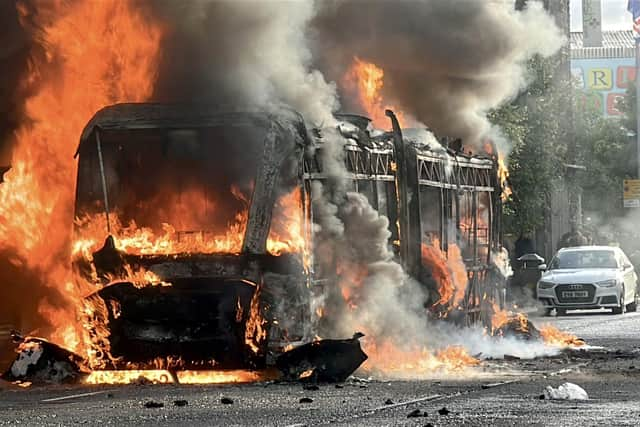
The sickening knife attack in Belfast, in which the suspect is a Sudanese asylum seeker, and the subsequent racist violence, were squarely the fault of the perpetrators.
The debate they created, though, highlighted some of the ways in which Westminster and Stormont have let Northern Ireland down; as well as exposing again the Dublin government’s hypocrisy.

Hadi Alodid, the migrant who was charged with attempted murder and a threat to kill, arrived in Belfast on a bus from Dublin.
During the Brexit negotiations, of course, the Republic’s government and northern nationalists defended the idea of an open border in hysterical terms. They implied that, if checks on trade were introduced or a single camera was installed, it would cause civil disobedience and even terrorist violence.
Despite the vicious anti-British abuse directed at the UK by nationalists during that time, successive prime ministers effectively accepted their demands. This eventually resulted in a border in the Irish Sea, which cut Northern Ireland off from the mainstream British economy.
There have been many attempts since to defend this policy as a necessity or talk down its consequences. But, effectively, the government decided that it was more important and less dangerous to indulge nationalists’ fantasies that there was no Irish border, than to protect the rights of British citizens here to play a full role in their own country.
It quickly turned out, as it happened, that the principle of an open frontier was not as precious or inviolable as it had been portrayed by Dublin during negotiations.
In 2024, ministers there, keen to blame the Brits for their problems, claimed that 80% of migrants were arriving in the Republic via Northern Ireland. This, they said, was due to the Conservative government’s plans to process asylum seekers in Rwanda.
The Taoiseach, Micheal Martin, admitted this figure was not ‘statistical’ or worked out from an ‘evidence base’. But his administration stepped up checks on cross border journeys and drafted legislation to stop abuse of the Common Travel Area, which for over a century has allowed free movement between the UK and the Republic.
The British authorities, predictably, did not treat immigrants moving from Dublin to Northern Ireland in the same way. The News Letter’s political editor, David Thompson, wrote last week that, “checks only happen in one direction”.
The Republic has returned ‘dozens’ of illegal migrants to the UK under an inter-government deal. The UK has reportedly sent back just one asylum seeker to the Republic.
This pitiful record reflects our government’s desperation to avoid offending Dublin and Irish nationalists by actually enforcing the border.
Equally pathetically, during the violence last week, ministers at Stormont were quick to accuse ‘bad faith actors’ elsewhere of stirring up problems here.
They should look closer to home.
The scale of the trouble quickly led to suggestions that paramilitaries, who still dominate some areas decades after the Troubles ended, were involved.
It is not clear yet that the trouble was orchestrated directly by these groups and their sources have denied involvement. At the same time, there is certainly a culture of disorder and violence, that, at moments of high tension or crisis, can give rioting here an edge and an appearance of organisation that are not usually seen elsewhere in the UK.
This is a consequence of decisions taken during the ‘peace process’.
The blame for a lot of last week’s violence inevitably fell on loyalists, because it took place mainly in areas where they are dominant. Politicians from Sinn Fein, ironically, were particularly keen to make these accusations.
The culture of lawlessness, though, is certainly not confined to one community.
In fact, its most flagrant expression is at Stormont, where the biggest party is linked inseparably to the IRA.
The influence of loyalist paramilitaries is a problem in the areas where they are still prominent, but unionists have never voted for their political proxies in any numbers, and by extension given their thuggery a veneer of acceptability.
When the implied lesson of the peace process is that illegal violence, or threats of violence, can lead to power and influence, there will always be an incentive to resort to these tactics.
The other way that Stormont contributes to the combustible situation on the streets is its complete failure to facilitate a realistic debate about immigration, or its possible disadvantages. Westminster is responsible for our borders policy, but local politicians have added to the sense that voters are not being listened to, and that their views are irrelevant.
Even over the past week, nationalists and so-called progressives have tried to close down the discussion. They are incapable of acknowledging either that an influx of people could create added pressures on housing and services, or that bringing in newcomers from war-torn parts of the world, sometimes with beliefs that are hostile to our way of life, could create specific problems that we are poorly equipped to deal with.
This leads to moments that would almost be funny, if they were not so serious. Like the Alliance MLA, Nuala McAllister, telling a national TV news station that the trouble on Belfast’s streets was not triggered by immigration.
The current disorder will pass, if it has not already done so.
Unfortunately, there is no sign that either Westminster’s weakness on the Irish border, or ‘progressives’ failure to listen to people on immigration, will change before the next, inevitable crisis.