
Owen Polley: Jim Allister's mutual enforcement has unfortunately been shelved
Last year, the North Antrim MP, Jim Allister, introduced a Private Member’s Bill to the House of Commons, which attempted to replace the Irish Sea border with a system of ‘mutual enforcement’.
If the legislation had been enacted, the UK would have applied Brussels’ laws to goods destined for the EU market and punished companies that did not abide by them. Every Northern Irish unionist in the Commons supported Mr Allister’s proposal, alongside a small but high-profile coalition of MPs from the Conservatives, Reform and Labour.

Unfortunately, the bill was ‘talked out’ of parliament. Private Member’s Bills are subjected to strict time limits and some MPs spoke for so long that no vote could be taken.
This meant that the draft legislation could not progress to the next stage at Westminster. On the other hand, it was not defeated, so the idea remains alive.
The House of Commons will be required to consider Mr Allister’s bill again in the coming months. And all the unionist parties, with varying degrees of commitment, continue to advocate it as a potential solution.
The survival of an alternative to the Irish Sea border, in the form of a bill for parliament’s consideration, seems to have irked and perhaps rattled the government.
At prime minister’s questions a few weeks ago, Sir Keir Starmer attacked mutual enforcement, claiming that it would result in a hard border between Northern Ireland and the Republic. And, last week, during a speech about the anniversary of the restoration of Stormont, the Secretary of State, Hilary Benn, described it as ‘magical thinking’, echoing language previously used by the former EU negotiator, Michel Barnier.
These interventions were at best insensitive. Indeed, they would have seemed almost inflammatory if so many unionists did not already seem defeated by the Windsor Framework.
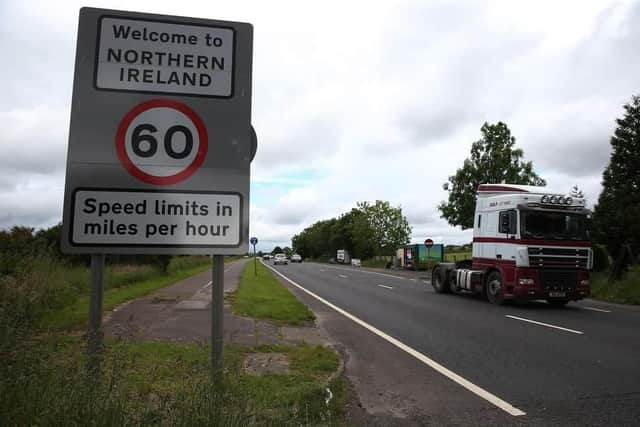
Of course, there already is an established hard border in the Irish Sea and Northern Ireland has been cut off from the UK economy, on which it overwhelmingly relies, in order to satisfy the demands of nationalists and the EU. Yet, Starmer had the gall to lecture unionists on the threat of trade barriers with the Republic.
Meanwhile, Benn rehashed Brussels’ attack lines from 2017, which were successfully and dishonestly employed to force the UK to divide up its own territory, without a trace of regret.
If you have a clear memory of those tortured Brexit negotiations, you probably weren’t surprised by the secretary of state’s provocative language.
Back in 2019, Benn introduced his own Private Member’s Bill to parliament, which effectively prevented the government from leaving the EU without a deal. At a stroke, he undermined any leverage that British negotiators had over Brussels.
The then prime minister, Boris Johnson, reacted with genuine fury, describing the legislation as the ‘surrender act’ and an ‘abject capitulation’. His supporters argued later that the law forced Mr Johnson to agree to the Northern Ireland Protocol, so that he could deliver some form of Brexit and avoid Jeremy Corbyn becoming PM.
There are many people on the British side who share blame for the disastrous Irish Sea border, from Theresa May, who first endorsed the concept, to the DUP, who signed off on a regulatory barrier, to Johnson, who eventually pushed it through. However, europhiles like Benn, who undermined their country’s position, subverted the referendum and assisted Brussels, deserve a place on the roll-call of infamy.
The secretary of state, it is fair to say, played a significant part in getting us where we are today. Is it any wonder, then, that he defends our demotion to a kind of hybrid state between the EU and the UK, and denies all the chaos that his actions helped to cause?
The EU always claimed that the Irish Sea border was needed to protect against the ‘risk’ of goods that did not meet its regulations from entering the single market.
The idea of ‘mutual enforcement’ kept resurfacing precisely because it tried to address those concerns, in a way that did not require Northern Ireland to be cut off from the rest of the UK economy.
It was attacked so vehemently because, for many Irish nationalists, the Dublin government and pro-EU liberals, protecting the single market was never really the point of the backstop, the protocol or the Windsor Framework, no matter how strongly they protested otherwise.
The point of a sea border for them was always to retain as much of the EU in Northern Ireland as possible, including its authority, its market and its laws, irrespective of the practical problems that caused. Mutual enforcement had to be rejected and mocked because it exposed as nonsense all the talk about ‘risk’ to the single market. It was based on practicalities rather than ideology.
Irish nationalists didn’t like it because it would have scuppered their plans for an all-Ireland economy. The EU didn’t like it because it would have prevented the bloc from using Northern Ireland to exert control over the UK. And europhiles like Benn didn’t like it because it meant we couldn’t be used as an excuse to realign the whole country with Brussels.
In the rest of his remarks last week, the secretary of state made good points about the Stormont executive and lack of delivery. The irony is that many unionists, rather than focusing on his sea border remarks, joined nationalists in lambasting Benn for his justified message on funding and public sector reform.