
Owen Polley: Northern Ireland a warning against more devolution
If, as expected, Andy Burnham becomes prime minister, he plans to give away powers to regional and local politicians.
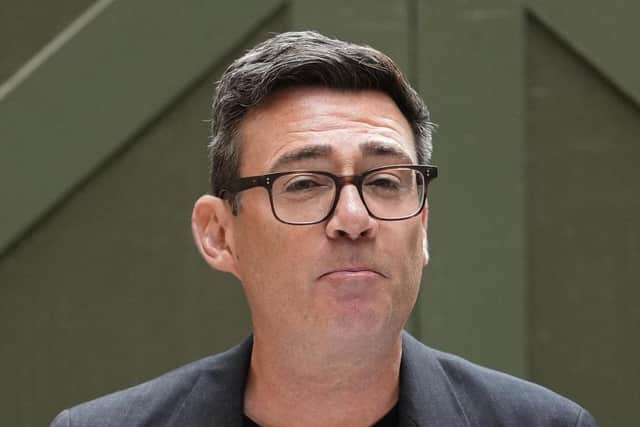
That was the thrust of his first major speech since winning the Makerfield by-election, delivered at the People’s History Museum in Manchester. The likely new Labour leader claimed this approach would deliver economic growth, right across the UK.

The idea of emphasising a prospective government’s commitment to devolution and decentralisation is not remotely new.
The Conservatives under David Cameron promised to “push power out to the people” and “turn Britain’s pyramid of power on its head”. Boris Johnson’s plans to extend devolution in England and put government funds at local leaders’ disposal were described as ‘levelling up’.
Keir Starmer effectively rebadged similar policies as his ‘Pride in Place’ scheme.
While these initiatives generated discussion papers, opinion columns and speeches, they were difficult to put into practice.
The principle of giving local people more power over decisions and funds is difficult to rebut. The experience of devolution in Northern Ireland, Scotland and Wales, though, suggests a more complicated picture.
There have been suggestions previously that Stormont should be given more powers, particularly over taxation.
The Independent Fiscal Commission was established by the former finance minister, Conor Murphy, to “review the case for increasing the fiscal powers (granted) to the NI Assembly”.
The body eventually reported that Stormont could in theory take on more of these responsibilities, but should do so gradually.
Even then, its report was full of qualifications.
The commission admitted that, “almost everyone we spoke to raised the political capacity of the Northern Ireland Executive”. In other words, they doubted its ability to act sensibly or even make decisions at all, should it gain new powers.
The latest set of ministers at Stormont can only have caused that scepticism to deepen. It is not just that they remain incapable of tackling decades old issues, like health-care reform, the size and inefficiency of the public sector or crumbling water infrastructure.
They have also repeatedly failed to agree on a budget. Indeed, it is not just other parties that disagree with the budget drafted by Sinn Fein Finance Minister John O’Dowd. Some of his party colleagues in the executive have refused to endorse it as well.
Last week, in talks at Hillsborough Castle, our parties engaged in their latest undignified attempt to shake-down the secretary of state for yet more money, to bail them out.
Many people will argue that these issues are due to Northern Ireland’s system of power sharing, and safeguards that mean unionists or nationalists can generally veto policies they do not like.
At Holyrood, though, the Scottish government has established a similar pattern of promising gimmicks, failing to take responsibility for serious issues and blaming its problems on Westminster.
The SNP has discredited Scotland’s once highly-esteemed education system and presided over the worst record of drug deaths in Europe, all while burnishing its ‘progressive’ credentials on woke causes like ‘trans’ activism, unchecked immigration and Palestine.
This probably sounds very familiar and it is almost exactly the opposite of what a programme dedicated to economic growth might entail.
In Wales, the devolved Labour administration adopted something like a soft nationalist position that involved posturing against Tory governments in London, but it failed to tackle the region’s problems with poverty. Now, genuine separatists, in the form of Plaid Cymru, have a chance to do even more damage.
The idea that, to achieve growth, Westminster just has to further empower these administrations, each of them under considerable influence from nationalists who want to destroy the UK and progressives aching to conform to the latest fashionable policies, is fanciful.
Andy Burnham will quickly discover that what the devolved governments demand, more than anything else, is unfeasible quantities of Westminster’s money. That, they will claim, is the solution to all their difficulties.
The problem he’s actually facing is a government that has become too large, expensive and overbearing. Reallocating resources (or powers) will not solve that.
Indeed, it is overwhelmingly likely that a Burnham government will spend more as part of its commitment to devolution. I predict that this makes the UK’s national debt worse, while doing little to achieve lasting economic growth and deepening the devolved regions’ unsustainable addiction to ever greater quantities of public money.
As this newspaper pointed out in a recent editorial, though, Burnham at least implied that devolution should ‘run deeper’ than Stormont, Holyrood or Cardiff. That could mean pushing powers currently exercised by the assembly to local councils.
This, again, sounds attractive in theory. Our local councils, though, have many of the same problems that we see at Stormont and suffer from an even shallower pool of talent.
The qualification to all of this is that, although many governments express their commitment to decentralisation, they often fail to deliver much more than policy announcements. The outcome of previous projects has effectively been a few extra government offices in the regions and new labels for some funding.
The impact of Burnham’s scheme may be felt most keenly in the north of England. That is where his proposed ‘No10 North’ office will operate and it is where he claims his time as Manchester mayor established a template.
In Northern Ireland, as in Scotland and Wales, there is little evidence that extra devolved powers are wanted or needed, still less that they would bring about growth.