
Owen Polley: Steve Baker's contemptible attack on unionists and his hypocrisy does not mean that Labour is a better government
In the run up to last year’s election, some unionists argued that a Labour government would be good for Northern Ireland.
Gavin Robinson praised Hilary Benn, the then shadow secretary of state, for his attempts to ‘cement stability’ here. And the DUP leader rejected the idea that Labour would be, “in some way … pro Irish nationalism”.

Doug Beattie, who was in charge of the UUP, hoped a new government would repair damage inflicted on the Union.
It was not surprising to hear these views. Many unionists in Northern Ireland felt terribly let down by 14 years of Conservative prime ministers. Every Tory leader had expressed vocal support for our constitutional position. David Cameron introduced the line that Conservatives would ‘never be neutral’ on the Union and it was repeated by his successors.
The party’s actions, though, completely undermined this sentiment.
It was a Tory government that cut Northern Ireland off politically, legally and economically from the rest of the UK (after both Theresa May and Boris Johnson promised they would never accept a border in the Irish Sea).
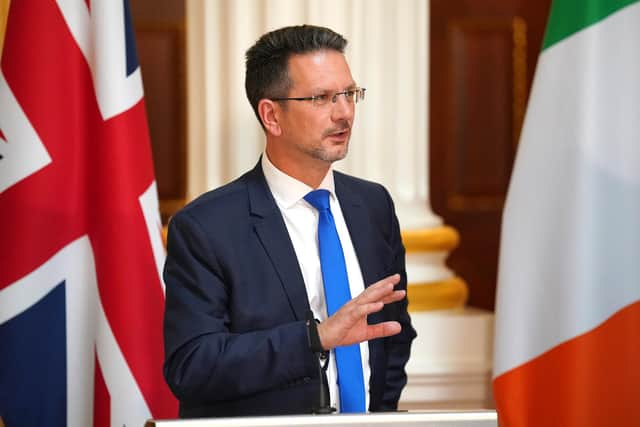
There can be few figures who embodied this betrayal more than the hard-line Brexiteer come pliant NIO minister, Steve Baker.
His appointment by Liz Truss in 2022, alongside secretary of state, Chris Heaton-Harris, was greeted with horror by nationalists. SDLP MP, Claire Hanna, described their recruitment as ‘obnoxious’ and a ‘red flag’.
In office, though, Baker chided unionists for refusing to accept the sea border and apologised to Dublin for his conduct during Brexit. Last week, he was at it again. In a Twitter thread that accused Labour of unpicking Brexit, Baker urged “Northern Irish unionists, in their zeal for the Union,” to avoid supporting, “a sell-out of the whole country”.
In a reply to this post, the TUV’s press officer, Sammy Morrison, with understandable anger, described the former minister as a ‘disgusting hypocrite’.
Baker’s attitude, that Northern Ireland should accept a relationship with the EU that he would never support for the rest of the UK, was galling and indefensible. That’s before we consider the implication that prioritising the Union, rather than independence from Brussels, amounts to zealotry.
But it was just a particularly flagrant example of the contortions that pro-Brexit Tories performed, to justify the protocol and subsequent deals with the EU.
Unfortunately, though, the idea that Labour is a more reliable friend to Northern Ireland, or that its negotiations with the EU will make the sea border disappear by default, already look misplaced.
In opposition, both Benn and Keir Starmer sounded almost pro-Union. They dismissed the prospects of a border poll and Starmer claimed he would support our place in the UK, if a referendum took place.
In power, those mildly unionist messages soon disappeared. Instead, the government stopped the Conservatives’ attempts to address the legacy scandal of British servicemen being pursued by the courts, while IRA murderers received an effective amnesty. It also quickly announced an inquiry into the murder of Pat Finucane.
The questionable policies have continued from there.
Recently, the NIO minister, Fleur Anderson, made confused remarks about the criteria for holding a border poll. She told Agenda NI that opinion poll results, rather than an all-encompassing assessment by the secretary of state, would be the decisive factor.
Meanwhile, Hilary Benn’s unbalanced comments on the Irish language, showing no understanding of its politically charged history, were criticised even by Mike Nesbitt, the UUP leader.
Against this backdrop, some unionists still argue that Labour’s ‘reset’ with the EU will make the Windsor Framework irrelevant and effectively dissolve the sea border.
The government wants to strike a veterinary (SPS) agreement with the EU, which would amount to signing up to Brussels’ food standards regime. This could ease some red tape for GB companies sending food or animals here, but it is an exaggeration to claim it would remove much of the sea border.
For that to happen, the EU would have to loosen its grip on Northern Ireland voluntarily, which is as unlikely as ever. While it was claimed that the framework applied only to trade in goods, its legal effects have actually been felt in everything from immigration to the gender debate.
In addition, Brussels initially said it could never compromise on food and agriculture, or its market would be at risk. Ironically, the most onerous parts of the framework eventually applied to other goods and materials.
The government plans to opt into some regulations in these areas too, by passing legislation allowing ministers to align with EU laws without acts of parliament. The Product Regulation and Metrology Bill could prevent some new divisions from arising, but it comes nowhere close to removing the sea border.
The astonishing thing is that Labour’s masterplan seems to be to voluntarily conform with all sorts of aspects of the EU, without asking for any guarantees or anything in return. It is an astonishingly naive strategy. And, after so many years of broken promises, you would expect unionists to be sceptical about its chances of success.
Baker’s point was that it would be wrong for unionists to support a solution for NI, if it reversed Brexit for the rest of the UK. This argument was contemptible from someone with his backstory. At the same time, there are few reasons to believe that Labour’s groveling attitude to the EU is actually going to repair our place in the Union.