
Owen Polley: The Conservatives will not be convincing on Northern Ireland until they reject the Irish Sea border
When the Conservatives were beaten at the last general election, many unionists believed that a Labour government could do no worse.
In the summer of 2024, it was a sentiment they shared with voters across the UK.

Since then, the mood has changed completely.
From a Northern Ireland point of view, just weeks ago, Sir Keir Starmer and his ministers reached a deal with Dublin on the legacy of the Troubles that resembled a capitulation.
Similarly, while the Conservatives introduced the Irish Sea border, Labour has allowed it to become much worse, enforcing trade barriers enthusiastically and dismantling schemes that helped move goods between Great Britain and Northern Ireland.
Starmer and Hilary Benn claimed that a ‘reset’ of relationships with the EU would help. Now, it has emerged that Brussels is demanding that the sea border becomes even more rigorous, before it agrees to an agriculture deal. Who realistically expects Starmer to stand up to them?
It is not unfair to say that, rather than tackling our difficulties effectively, Labour has allowed almost every serious problem that the country faced to become worse.
The Conservative government allowed public spending to rise dangerously. Unfortunately, under the chancellor Rachel Reeves, this issue has deteriorated. At the coming budget, she faces a £50 billion ‘black hole’ in the country’s finances.
The current wave of immigration started under the Tories too, but Labour is less equipped to tackle this influx of people. It started its time in office by stopping the Rwanda scheme, which was one of the few potential disincentives for new arrivals.
At Labour’s conference, the new home secretary, Shabana Mahmood, introduced new plans aimed at curbing migration. There are doubts, though, that she can persuade her backbench colleagues that action to secure our borders is even necessary.
Anyway, she implied that concern about immigration is caused by small minded nationalism, rather than genuine worries about the UK’s resources and society. That attitude does not inspire any confidence that she is serious about cutting numbers.
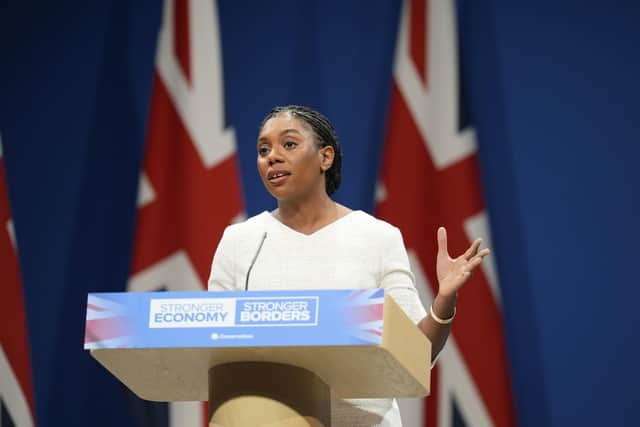
It was against this backdrop that the Conservatives held their annual conference last week, in Manchester. Labour’s troubles should have provided the opposition with hope, but its own circumstances are not encouraging.
The party is behind Reform in most opinion polls, putting it in third place overall, while some surveys suggest it may be fourth.
As Conservative activists are keen to point out, though, in the UK, elections rather than polls determine political influence. The country certainly needs a strong, credible opposition.
Did the Tories sound like one last week?
On the Northern Ireland issues, there were signs of hope.
The party defended its legacy policies robustly. The shadow defence secretary, James Cartlidge, pledged to ‘restore full legal protection for our veterans’, if Labour goes ahead with its agreement with Dublin. The ability to ‘stop our veterans being harassed through the courts’ was also one of party leader Kemi Badenoch’s ‘five tests’ for whether the UK could be described as a sovereign state.
The Tories’ attitude to the Windsor Framework, which is even more directly related to sovereignty, is more complicated. At the Northern Ireland Conservatives’ reception, the local Tory chair, Paul Leeman, attacked Labour for “allowing the Irish Sea border to become harder”.
He urged the government to use safeguards against diversion of trade, help unionists to pull the Stormont brake (which could prevent certain new EU laws from being imposed here) and demand a change to the definition of goods that pose a risk to Brussels’ market.
As this paper reported, the Conservatives also claimed they would make “whatever changes are necessary” to ensure that the whole United Kingdom, including Northern Ireland, can pull out of the European Convention of Human Rights. That could, in theory, include scrapping or changing the framework.
It is encouraging that these kinds of ideas are at least being discussed, but Kemi Badenoch has never admitted that the Tories got the sea border badly wrong originally. And she told the News Letter earlier this year that she would not look to ‘unpick’ the Windsor Framework. That implies that, if the Conservatives’ are edging toward a coherent policy on the sea border, they have certainly not yet reached the destination.
The national themes explored last week may not be enough to change the Tories’ fortunes either. On immigration, the Conservatives promised to leave the ECHR, but that simply puts them on the same ground as Reform.
Their best ideas, arguably, related to reforming the welfare system. The proposal that only British citizens should be able to claim benefits is overdue. If foreign nationals are not here to work and support themselves, then why on earth are they here?
Likewise, the Tories pledged to stop all kinds of over-diagnosed mental health issues, like depression, anxiety and ADHD, from entitling claimants to disability payments. That was the Conservatives at their best.
The party’s emphasis on cutting spending and the exploding cost of welfare is the kind of thinking that can help recover its credibility, while distinguishing it from Farage and Reform.
It is still far from clear that Kemi Badenoch is the right leader to oversee a Conservative revival, of course. But, last week, the Tories at least showed signs of life.
Unfortunately, while Northern Ireland badly needs a strong centre-right government, from our perspective the Conservatives cannot be convincing until they renounce their previous failures on the Irish Sea border.