
Owen Polley: The implication that Jon Burrows is hardline, and that the UUP has abandoned moderate unionism by picking him as leader, is based on nothing concrete
Before last week, Jon Burrows was generally thought to have made a decent start as leader of the Ulster Unionist Party, despite his political inexperience.
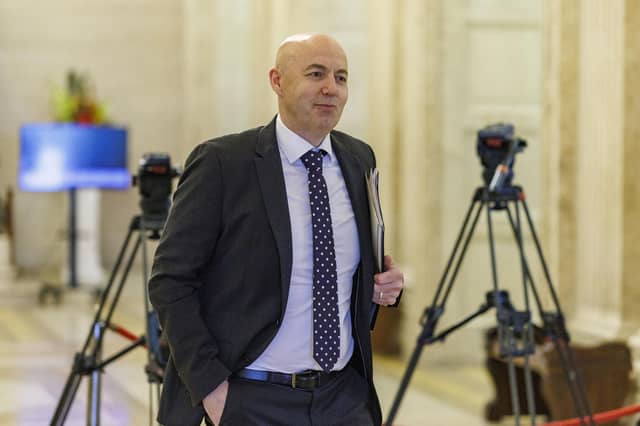

Polling suggested he was the second most popular party leader in Northern Ireland, and there had been a small increase in support for the UUP since he took over.
That could now be undermined, as Ben Lowry wrote in Saturday’s paper, by infighting among the party’s MLAs at Stormont. none of whom challenged Mr Burrows’ during the leadership contest.
The latest episode of this melodrama began when Doug Beattie, the UUP’s former leader, resigned from the party, claiming his membership was no longer ‘tenable’ under Burrows.
As an outsider, it is not easy to know whether the atmosphere really is ‘toxic’ thanks to the new leader, as his critics claim.
The toxicity could easily be coming from another direction, as miffed MLAs refuse to accept Mr Burrows and try to undermine his leadership.
We can safely dismiss, though, the widespread notion that the UUP has become ‘hardline’ over the past few months, or that its representatives have radically incompatible views.
The kinds of differences that have been cited, so far, as the pretext for this disagreement, are trifling.
The party previously backed puberty blocking drugs for children with gender confusion. That was a problem for Mr Beattie, but it was also a hangover from Mike Nesbitt’s leadership.
The position was relatively quickly reversed by Mr Burrows.
The age of criminal responsibility has also been mentioned. Mr Burrows favours keeping it at 10 years, the same as England and Wales, to help police deal with difficult situations.
The nationalist parties at Stormont, in league with Alliance, want it raised to 14.
Was Mr Beattie’s preference for splitting the difference, at 12, really an argument that should divide a party?
In reality, the implication that Burrows is hardline, and that the UUP has abandoned moderate unionism by picking him as leader, is based on nothing concrete.
The perception comes from his straight-talking style, and his relative lack of interest in using mushy buzzwords.
Mr Beattie had many merits as UUP leader and, while he was not significantly more successful than other recent leaders in elections, he had a loyal following, including members who were previously not involved in unionist politics.
The wisdom on social media is that the UUP was previously committed to a ‘Union of People’ under Beattie and Nesbitt, but that Burrows ditched this ethos.
While ‘Union of People’ was a good slogan, though, as a statement of beliefs it was vague enough to mean anything.
The test of a unionist party will always be how effectively it defends the Union.
The greatest threat to Northern Ireland’s place in the UK, during Mr Beattie’s time as UUP leader and Nesbitt’s more recent tenure, was the Irish Sea border. Rather than focusing on this, they tended to talk down its importance.
Instead of emphasising the constitution, trade and other practical links to Westminster, Mr Beattie liked to philosophise about the strength of his personal feelings of Britishness.
The former UUP leader fought for his country, so his firm British identity was never in doubt, but it was also largely irrelevant to Northern Ireland’s ability to play a full role in the economy, culture and politics of the UK.
His successor, Mike Nesbitt, has in the past articulated more troubling views on important issues.
Some of his previous positions effectively endorsed nationalists’ attempts to dilute the Union. He supported the De Souza campaign to end automatic British citizenship in Northern Ireland and sponsored an event demanding votes for Irish passport holders in EU elections.
He even told The Australian newspaper, in the aftermath of Brexit, that we would not be ‘worse off’ in an all-Ireland republic.
I previously compared Mr Nesbitt’s unionism to the christianity of a vicar who does not believe in god, which I think, in light of this record, was not unfairly harsh.
In contrast, Mr Burrows has so far seemed a firm, clear pro-Union leader, who likes to challenge other parties, rather than simply acting as a junior partner in the executive.
He would make a particularly effective leader of the opposition, if the UUP ever decided to go down that road.
If his style has made rival parties uncomfortable, that is hardly grounds for criticism.
Any Ulster Unionist leader should be aiming to show that the current set-up at Stormont is failing, and arguing that the UUP is different. The alternative is to become a kind of progressive-cliche bingo caller, spouting words like ‘constructive’, ‘confident’ and ‘inclusive’, without much content or context.
If that is what ‘moderate unionism’ had really become, would it even be worth saving?
Putting across a political message, admittedly, is just one aspect of a leader’s job. He or she must also manage a party, which can involve soothing the egos of difficult, opinionated, argumentative people.
We don’t know yet how skilled Mr Burrows is in this art.
As an editorial pointed out last week, though, the News Letter has consistently argued that the UUP is a vital part of unionism, even while other media wrote obituaries for the party.
Northern Ireland, given the current set-up at Stormont, is badly in need of assertive, persuasive unionist leadership. The UUP should be aiming to provide that, rather than getting caught up in internal fighting.