
William Matchett: RUC pair murdered before Bloody Sunday aren't mentioned now
The recent acquittal of Soldier F for murders and attempted murders on Bloody Sunday 53 years ago sparked anger among Irish nationalists.
On the BBC, Foyle MP Colum Eastwood criticised the Royal Ulster Constabulary for denying justice for the families of those killed. However, he did not know the names of two of its officers murdered just 72 hours earlier beside the protest route. Ulster Unionist MLA Doug Beattie who raised the issue, did.
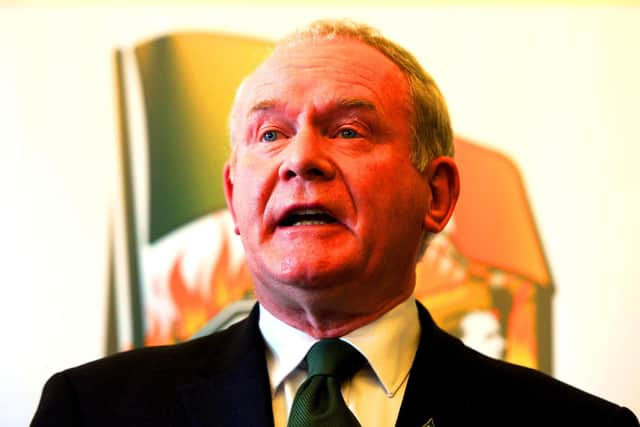

On January 27 1972, a police car was ambushed with two Thompson submachine guns (Thompsons were bought off US mobsters and shipped into the Republic), leaving sergeant Peter Gilgunn and constable David Montgomery dead and two others injured. It is widely believed that Martin McGuinness – who later became a senior Sinn Féin politician and Deputy First Minister – carried out the attack. Many accounts also have him firing the first shots from a ‘Tommy gun’ on Bloody Sunday, hoping to provoke a strong reaction from the British Army, which sadly happened. McGuinness was a prominent Provisional IRA leader, known for recruiting schoolboys into Derry City PIRA.
The killing of police officers on Thursday heightened the danger for soldiers on Sunday. These were the first police officers killed in the city for 32-years, which in most cities would be a big deal. Despite Mr Eastwood casually dismissing the issue as “whataboutery” the events were firmly related. Also, it is worth asking why wasn’t the protest postponed out of respect for the grieving families?
After Peter’s Requiem Mass and David’s Methodist service, their colleagues returned to a city full of menace. Up to that day, there had been 242 killings during the ‘Troubles’ with almost 30 in Londonderry, a third of them soldiers. Most deaths were attributed to the Provisional IRA, whose ‘Brits Out’ war saw the Protestant population on the west bank reduce by as much as 90%. Fear and intimidation triggered a steady exodus of up to 10,000 Protestants, sharpest after Bloody Sunday up to 1974. A west bank dominated by nationalists made things less risky for McGuinness and his gang.
Soldiers were often attacked multiple times on patrol, with gunmen and bombers using civilians as shields. Robin Alers-Hankey was the first army officer lost in those years. Again, one would think this memorable! He was shot during rioting at the end of 1971 in the city and died on 30 January 1972 – Bloody Sunday. Most murders of security forces, such as Robin, Peter and David were never punished. The Provisional IRA, especially its leaders, surpassed everyone else in evading justice. Getting evidence to prove guilt beyond a reasonable doubt in a murder prosecution, irrespective of who was the defendant, was extremely tough in the fast-moving high threat environment. Many politicians struggle with the justice precept of innocent until proven guilty, and what constitutes evidence and murder, never mind framing an accurate context.
Republican terrorists caused more deaths among security forces, particularly soldiers, than the security forces caused among them. The British Army showed remarkable restraint. Bloody Sunday was not typical of its ‘Troubles’ CV. In January 1972 the RUC faced around 30 terrorist related incidents, including murder, every day. After Bloody Sunday, the number doubled and by July it doubled again, veering towards civil war had it not been for the men and women in British uniform.
In 1972 the RUC had roughly 4,500 officers. Now, nationalist politicians complain that some 6,500 are too few to keep everyone safe, even when things are peaceful. They suggest that policing in the early 1970s was easy, as if Bloody Sunday was the only incident in the in-tray. The Foyle MP used ‘colonial conspiracy theory’ to accuse the army and RUC between 1970-74 (police regained primacy in 1975) of protecting soldiers, but in those years, at least 16 soldiers were charged with serious crimes, including one for murder. Policing was far from perfect, but in the circumstances was as good as possible. The only way we think that things could have been different is to ignore the huge threat from the Provisional IRA – which is what often occurs when people look back at these events.
If anyone should have stood trial for murders in the Maiden City, it was Martin McGuinness.
• William Matchett was an officer in RUC Special Branch and is author of Secret Victory: The Intelligence War that Beat the IRA