
Jonny McCambridge: Stationary gibbons and an invisible stick insect … a day out at Belfast Zoo
I am staring into a glass box. My son is doing the same. This goes on for some minutes. Eventually, I crack.
“Can you see anything?”
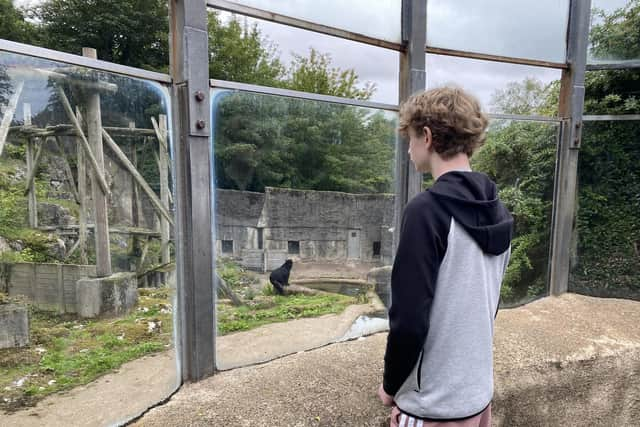

“No, daddy.”
According to the sign positioned to the side, there is a stick insect inside. However, it also contains a number of twigs and branches. I am in that awkward position of not knowing whether it is worth spending time trying to spot the phasmid which has blended into the environment, or whether I am making a fool out of myself by examining an empty box.
"Let's look at something else,” I suggest.
My son nods.
For the first time in several years, I am visiting Belfast Zoo. These are the last few days of the school holiday and I have a familiar pang of parental guilt.
Yes, we have had the family trip abroad, but aside from that, have I made enough of an effort to do things with my boy? I feel low when I think about how many times during the last eight weeks he has asked me if I'm busy and I have had to reply in the affirmative because of work.
So, I have secured a couple of prized days off and pledged all of this time will be for him.
When I offered options of day-trips, I was mildly surprised when he asked to go to the zoo.
However, this leads to one form of guilt being replaced by another. In my attempts to be a responsible father, I am forced to wrestle with the conundrum of whether it is ethical to visit such an establishment. This is far from my area of expertise, but I am conflicted by opposing arguments over the merit of strategic conservation of endangered species against concerns over the display of animals in enclosed spaces.
In the end I reach an uneasy accommodation by deciding that I will use the visit to combine fun and education. We will take the time to read all the information boards, to learn a little about the challenges that the animals we see are facing in their natural environments.
My son is delighted by the brightly-coloured feathers of a macaw from South America, but slightly chastened when the accompanying sign informs that there are less than 250 of this particular species remaining in the wild. He nods slowly when I say that this is about a third of the total number of pupils that go to his school.
We strain our eyes to see a sea eagle which is high above us on a wooden perch. My first instinct is to be troubled that such a large and majestic bird is in a confined space. However, the sign informs that the eagle, which was once plentiful on this island, went extinct in the wild here in 1916. The breeding programme at the zoo has allowed a chick to be sent to Israel as part of an international wildlife reintroduction programme.
My son is excited to see elephants, but there are none. A quick Google search informs that the last elephants left this zoo in 2024.
We walk up the hill to view the cheetah, but that enclosure is empty. The website tells us that she is currently in another zoo as part of a breeding programme.
There are, however, plenty of monkeys and apes. The spider monkeys delight children with their manic energy and sense of mischief, while the gibbons are more serious and stationary.
At one point while I am taking a photograph of the chimpanzees, one of the primates puts her face against the glass and is only inches away, staring directly into my mobile. I put the phone away.
As we walk higher up the hill, we see a bear stretching, three lions lounging on a wooden platform and a silverback gorilla sitting on the floor while a group of children bang on the glass in an effort to encourage him to move.
The penguins are standing tall but seem not to be tempted to swim today. The sealions, so ungainly out of the water move effortlessly and elegantly within it. I notice that there is a plastic bottle floating in their pool.
Our trek brings us to the top of the zoo, under the shadow of Napolean's Nose at Cavehill. The setting is impressively green and the views of Belfast from here are stunning.
We stop for ice creams and sit on a bench licking them in the sun while I tell my boy about the occasion I visited this zoo on a school trip when I was much younger than he is now. I also tell him that there used to be a safari park in north Antrim and he looks at me dubiously.
We walk back down the hill and go inside the steamy tropical house. There we see two sloths who make the tortoises in the same pen seem energetic.
On the way to the exit, we take a moment to read notices which tell of the history of the site.
One story is about Daisy, the zoo's first elephant, who was brought to Belfast in 1934 and was walked from the docks to the Antrim Road, stealing a turnip from a greengrocer's shop on the way.
Our last stop is at the Floral Hall, the old art deco ballroom which has been closed to the public for longer than I have been alive. I have a vague notion that there are efforts to stabilise and restore the structure ongoing. There is scaffolding on one side of the building, but it is hard to view it without being startled by the sense of decay. The feeling is that the glory days are gone and the future remains uncertain.
As we leave, I check the time and am surprised at the number of hours we passed at the zoo and how it held my son's attention. We pass a sign warning of danger from a wasp's nest as we begin to drive home.