
Letter: A lesson in minding your language - from Irish to English to Ulster-Scots
A letter from Anne Smyth:
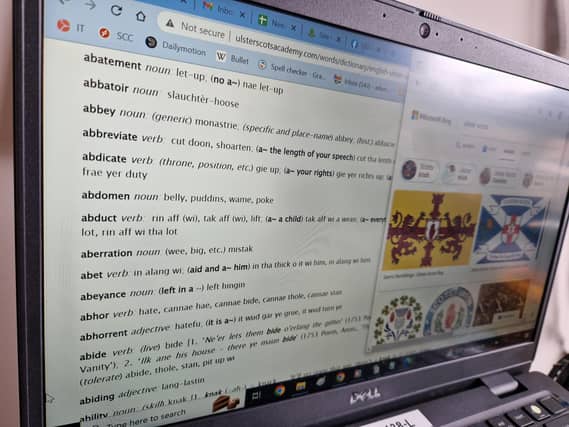

On your article ‘Popular Northern Ireland phrase has been included in a British Council list that sheds light on the evolution of English’ (April 24), there are couple of problems with its content.
Firstly, the Northern Ireland phrase in question is given as 'Haud yer wheesht'.
Because Ulster-Scots has developed in close proximity to Northern Hiberno-English, the Ulster-Scots form of English 'hold' that is now most common is houl rather than haud.
The latter remains the form used in Scottish Scots.
Secondly, regarding the other main element, wheesht, your article states: 'The word “wheesht” is derived from the Irish Gaelic word "faoistin", which means to whisper or to be quiet and has recently gained renewed attention thanks to popular TV shows like Derry Girls and Line of Duty.'
This is not supported by any of the main sources of information on Ulster dialect.
The etymology of the form wheesht as given in the Concise Ulster Dictionary, on which I worked as editorial assistant, under the headword whish reads as follows: 'Scots also whush, wheest, wheesht; onomatopoeic'.
As confirmation, the Scottish National Dictionary (post-1700), which also included limited coverage of Ulster, under the headword 'whisht... Also wheesht' gives the following etymology: [The forms whish, whisht, whist, are found in most of the above senses in liter. Eng. till the 17th c.].
The problem with any dogmatic assertion about an Irish origin is that there is not yet a full historical dictionary of Irish Gaelic with citations.
This would by its nature show the first instance of a particular headword in the literature, enabling the reader to assess whether it appeared first in English or Irish. It could well be that it is a borrowing into Irish.
Two other examples of this come to mind: the English and then Scots and Ulster-Scots word ‘crack’ has been borrowed into Irish as ‘craic’ and the Scots and Ulster-Scots ‘sheugh’ has been adopted as ‘seoch’.
On the other hand, it has perhaps simply become fashionable to assign an Irish origin to English and Scots words.
Anne Smyth, chairman of the Ulster-Scots Language Society and Consultant on Ulster dialect to OED