
'A story that is not really told': Memorial stone recognises Irish policemen who fought with the British Army during WWI
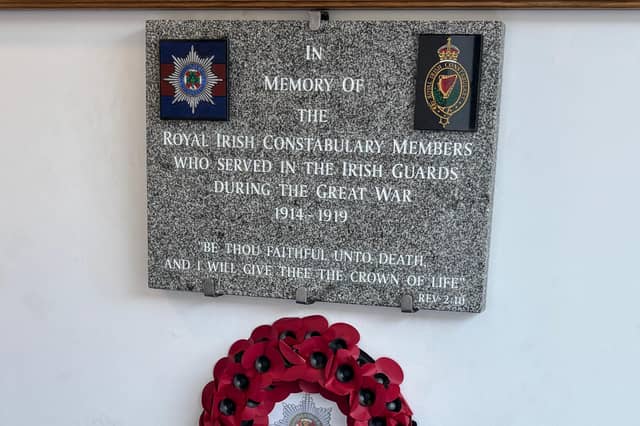

A memorial stone has been set in place to remember the members of Ireland’s police force who signed up to fight with Britain in World War One.
The stone, which was sourced from the townland of Altnaveigh near Newry, now forms part of a memorial wall in the headquarters of the 1st Battalion Irish Guards in Mons Barracks, Aldershot, Hampshire.
It is the work of Ulsterman Gareth Chambers, company sergeant major with Number 1 Company of the 1st Battalion Irish Guards, who is not aware of another tribute just like it.
"Those men didn’t really have anything to remember them by,” he told the News Letter.
"Clearly when they came back after WWI, Ireland was different for them.
"The Irish Guards had the highest number of Royal Irish Constabulary (RIC) volunteers across the British Army.
"There was 179 [RIC men] killed across WW1, and 109 of them were serving with the Irish Guards.
"The Irish Guards had a linkage with the RIC when they were first formed.”
As to why he had arranged the tribute, he said: “I’ve always been interested in Irish history, Irish military history, so that was my reason why, and the fact that they were in [my regiment] the Irish Guards.
"I think it’s a story that’s not really told.
"We’ve come through the decade of centenary events and it’s opened up a lot of windows, and I think it’s a nice thing to do now, that people can actually honour these men.”
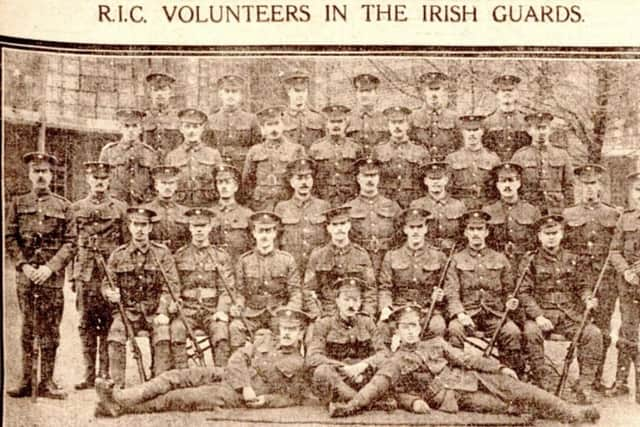
As part of his research, he had unearthed a clipping from The Larne Times, dated November 13, 1915, about a troop of RIC volunteers departing for the army:
“Close on 80 members of the RIC from various stations in Ireland received an enthusiastic send-off from Dublin on Wednesday.
"The men left for London as volunteers to fill vacancies in the Irish Guards.
"The detachment was played from the Depot to the North Wall by the RIC and DMP bands, and that of the 10th Cavalry Regiment.
"An RIC guard of honour was also provided, and the volunteers were cheered by a vast crowd of admirers.
"Addressing the volunteers before their departure from the Depot, the Inspector-General said this detachment was the sixth to leave the force for the army.
"The total number of RIC who had joined the army was, in round numbers, 500, including 98 reservists.
"It had been most encouraging to him to hear nothing but good of those who had joined the army from the force."
WO2 Chambers expressed gratitude to those who had assisted him.
The RIC was disbanded in 1922 after the Anglo-Irish Treaty partitioned the island, with An Garda Siochana becoming its successor force in the Free State and the RUC being formed in Northern Ireland (with the latter more-or-less keeping the crest of its predecessor).
The Imperial War Museum hosts a list of the names of 166 RIC fatalities in WWI. It can be found at this link: livesofthefirstworldwar.iwm.org.uk/community/8022