
Bernard Montgomery built his WWII successes on a rapport with the troops he commanded
In August 1942, Winston Churchill appointed Montgomery commander of the 8th Army.
Montgomery was originally Alan Brooke’s choice rather than Churchill’s. Churchill’s preferred candidate, Lieutenant General W H E Gott, was killed in an air crash so Brooke got his way.

Montgomery was the type of commander Churchill normally deplored. Auchinleck had been sacked because he refused to be prodded into a premature offensive. Montgomery refused to be hurried into mounting his own offensive and proved to be even slower than Auchinleck.
Montgomery was a cautious, thorough strategist. He refused to move until he had all the resources he demanded. He even proclaimed that he would never undertake an operation unless he was certain that it would succeed.
By mid-October 1942 the 8th Army had 230,000 men and 1,230 gun-armed tanks ready for action, while the German-Italian forces numbered only 80,000 men, with only 210 tanks of comparable quality ready; and in air support the British enjoyed a superiority of 1,500 to 350.
Montgomery enjoyed other advantages too. Since September 23 Rommel had been on sick leave in Austria. Although ‘the Desert Fox’ returned to North Africa on October 25 at Hitler’s request, he was absent from the war zone when battle commenced.
The German-Italian forces were critically short of fuel, largely the result of British submarines and torpedo bombers operating out of Malta. Finally, Montgomery had insight into what the Germans were thinking, courtesy ULTRA intelligence.
Montgomery began the second Battle of El Alamein with a giant artillery barrage and a diversionary attack in the south to draw Axis forces into the area so that the main attack in the north could create a gap for the British armoured divisions to pass through German minefields.
Progress was slow however and Montgomery changed tactics, constantly switching the main emphasis of his attack to wear down Rommel's front line. The decisive phase of the battle came with an Australian attack along the coastal road on October 26 which diverted Axis forces while Montgomery launched a fresh attack further south which developed into a major tank battle.
By November 3 Rommel had only 30 serviceable tanks in action and on the following day he began organising his withdrawal. By November 6 Montgomery had driven the Germans from Egypt back into Libya and inflicted a crushing blow to the Axis powers in North Africa.
Although born in London on November 17 1887, Bernard Law Montgomery was of Ulster stock. The energetic Hugh Montgomery, laird of Braidstane in Ayrshire, who acquired a third of Con O’Neill’s Clandeboye estate in 1605, was probably the earliest member of the family to settle in Ulster.
The future field marshal’s branch of the family settled at Killaghtee, near Dunkineely, Co Donegal, in 1628. Samuel Montgomery, an 18th-century ancestor, made a fortune in the wine trade in Londonderry and purchased New Park, a large estate near Moville on the Inishowen peninsula.
Montgomery’s father, who became Bishop of Tasmania shortly after his birth, inherited the property. Bishop Montgomery was one of the seven Anglican bishops to sign the Ulster Covenant in September 1912.
While Montgomery was evicting Rommel from North Africa his widowed mother lived in the family home at Moville across the Foyle from Londonderry.
Montgomery was educated at St Paul’s School, London, and the Royal Military Academy, Sandhurst. His choice of a career as a soldier came as a complete surprise to his parents. He distinguished himself during the Great War, winning the DSO and almost dying of his wounds at Meteren, near Ypres, in October 1914. The slaughter on the Somme and at Passchendaele made a profound impact on his mind. Montgomery was highly critical of Douglas Haig’s lack of imagination, which produced such carnage.
Montgomery served under Plumer, one of the outstanding commanders of the Great War, a meticulous planner, the architect of the victory at Messines in June 1917 and a man determined not to squander the lives of his troops, as his GSO 2 (Training). Plumer’s three autumn attacks of 1917 were models of preparation, training and execution. In a letter, dated November 8 1917, two days before the final assault on Passchendaele, Montgomery wrote to his mother, ‘… the whole art of war is gain your objective with as little loss of life as possible’.
Between the wars he attended the Staff College, Camberley, became an instructor there within five years, and was appointed chief instructor at the Staff College, Quetta.
Though not a stickler for drill, he was a fanatic for efficiency and training. He wrote a manual of infantry tactics, wholly disregarding the criticisms of his supervising committee. His mantra was ‘Poor planning means the unnecessary deaths of brave men’, a lesson taught by his experiences of the Great War.
Early in the Second World War Montgomery commanded the 3rd Division in France and succeeded in impressing Alan Brooke, the future chief of the Imperial General Staff, with his fighting retreat to Dunkirk, which contributed much to the salvation of the BEF.
After Dunkirk Montgomery was given command of S E England in anticipation of a German invasion. He galvanised the forces under his command by rigorous professional training, by realistic rehearsals and by winning the confidence of the men.
As commander of the 8th Army, Montgomery believed Rommel’s success in the western desert was due to his rapport with his troops. Hitherto, for most British troops generals were remote beings whom they would never encounter. Determined to see, hear from, and be seen and heard by ordinary soldiers, he embarked on a gruelling tour of the units under his command.
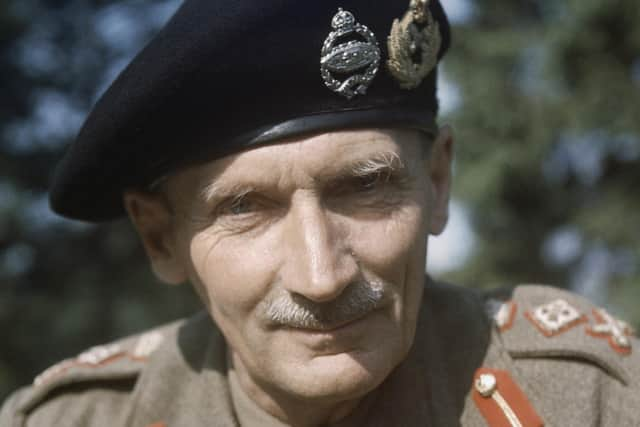
In August 1942 he acquired an Australian bush hat on which he affixed the badges of all the units he visited. During the latter stages of El Alamein the bush hat was displaced by the black beret of the Royal Tank Regiment, which Montgomery wore with his general’s insignia alongside the badge of the RTR. This unorthodox headgear became his hallmark.
Montgomery’s headgear incurred the wrath of King George VI who was obsessional about the minutiae of military dress. In a private audience with the King Montgomery pre-empted the monarch with a lecture on the importance of an army’s morale and how his black beret created a bond between him and his troops.
Montgomery told the King that his beret was worth at least an army corps and that it was vital that he should continue to wear it to the end of the war. The subject of Montgomery’s iconic beret was never raised again.
Montgomery died almost 50 years ago on March 24, 1976.