
Disputed origins, but the Lambeg drum is the heartbeat of Orange Order and the Twelfth
The Lambeg drum rivals the flute as the most traditional of Orange instruments, but its exact origin is open to debate.
Folklore has it that the Lambeg drum was brought to Ireland from Holland by the troops of Duke Schomberg, King William's celebrated second in-command at the Battle of the Boyne.

Another theory is that the first Lambeg drum was made for the Battle of the Diamond in September 1795, after which the Orange Order was formed.
Respected Sandy Row drum-maker William Hewitt claimed his grandfather made the first Lambeg drum in 1870 and it had its first appearance at a Twelfth demonstration in Lambeg the following year.
This drum measured 86 centimetres in diameter and 61 centimetres in width, and is still in the possession of a Moira, Co Down lodge.
However, there are drums which pre-date the 1870 version – one in Belfast is marked with the name Walsh the drum-maker and dated 1849, the year of the famed Battle of Dolly's Brae in Co Down. It measures 72 centimetres in diameter and 61 centimetres in width and resembles present-day Lambeg drums, with a construction of two oak boards.
King William did stop with his army at Lambeg outside Lisburn, after arriving in Carrickfergus, on his way to the Boyne in June-July 1690, and this could explain the name given to the large drums which have become such a dominant feature of Orange parades over the centuries.
Various animal skins have been used for the drum heads, but today goatskin is the most popular. The shell is mostly of wood, but brass has been used. Drum sticks are of wooden cane.
The beating of drums has been associated with Orange processions since the formation of the Order in September 1795. A drum was carried at a Twelfth demonstration in Co Armagh in 1796. Lord Gosford, of Markethill, confirmed this in a letter to the Lord Lieutenant, Lord Camden in Dublin Castle: “I have the honour to acquaint your excellency that the meeting of Orangemen took place in different parts of this county. One party, consisting of 30 companies with banners etc, after parading through Portadown, Loughgall and Richhill came towards this place. The party had one drum and each company had a fife.”
The 1796 version was probably the first of the fife and drum combinations that were to become an iconic part of traditional Orange culture.
Before the dramatic increase in 'blood and thunder' flute bands by the mid-20th century, the accompaniment of Orange lodges by drummers and fifers was a regular feature of parades.
Lambeg drummers beat to a set rhythm or roll whether it be with the tune or another drum or a fife. The sound of the drum travels horizontally and with the shrill tones of the fife moving in a vertical direction the two blend in quite a unique way. Locally, drumming tunes can be described as the ‘Tandragee Time' or the 'Ballymena Roll'. However, each drummer has his own distinct rhythm and roll.
Co Armagh, not surprisingly where the Orange Order was formed, has the strongest tradition of Lambeg drumming of any county in Northern Ireland. Travel the rural roads of Tandragee, Lurgan or Loughgall any evening leading up to the Twelfth and you will hear the staccato beat sounding out from a fully tightened drum over the warm summer night air. Drummers come in all ages, from Orange veterans to teenage brethren.
Even prominent Unionist politicians like the late Jack Maginnis and the late Harold McCusker, both Westminster Ulster Unionist MPs for Co Armagh, loved a crack with the cane on the goatskins that made up the head of a Lambeg drum.
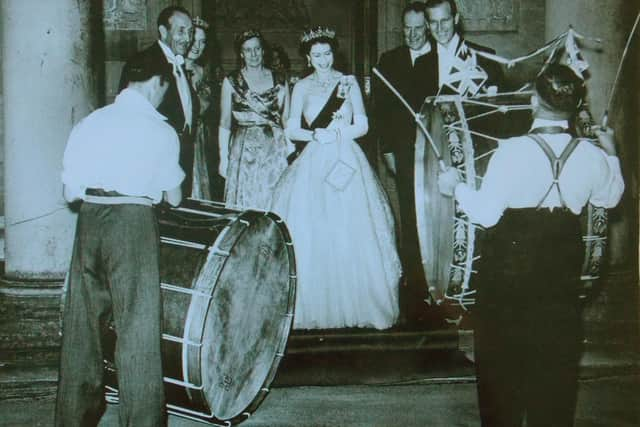
Memorably, the late Queen Elizabeth II and her husband the late Duke of Edinburgh were entertained to the sound of Lambeg drums on their official visit to Hillsborough Castle during the coronation year of 1953.
But the advent of more bands, flute and accordion, on the scene has meant a reduction in the number of drums being carried at Twelfth parades. Even traditionalists in Co Armagh will admit that the place for Lambeg drums in the Twelfth walk is narrowing.
The weather is a major factor in the appearance of Lambeg drums on parade. On a wet evening drum enthusiasts will not parade their drums, as was evidenced at the recent Portadown District mini-Twelfth when only bands made an appearance with lodges after a dismal day of rain.
On a dry day Lambeg drummers are in their element. The weather is a factor in getting the best out of a drum and a summer heatwave is considered to be ideal. The warmer and drier it is the sweeter the tune. Wet weather spoils a good drum.
In the heyday of drumming – back in the 1930s/1950s – the 22 lodges of Tandragee Orange district usually had about 60 drums out on a Twelfth parade. Loughgall, Portadown and Lurgan districts were the same and it was commonplace for 200 drums to be carried at the county demonstration with many of the drums being accompanied by a fifer.
Now the quota of drums taking part has been reduced to about 50 overall, most taken only by Tandragee, Loughgall, Lurgan and Portadown Orangemen.
Getting drummers is another problem for lodges and sometimes it is left to a few enthusiasts in the lodge to look after the drums for the day. Many of the Co Armagh drums, as elsewhere in the province, are owned by individual members of a lodge and this allows greater freedom to participate in the many drumming matches held throughout Ulster from February to November each year.
A new drum can be expensive, ranging to £1,000-plus with appropriate loyal decor added. There are drum-makers in Belfast, Tandragee, Markethill, south Derry and south Antrim and drumming matches are organised by different associations.
Only a few traditional fifers remain – in the South Down/South Antrim areas. Unlike the drummers their fifing is a dying art. But for Orangemen and their legions of supporters, the Twelfth would not be the same without a rattle or two on the sweet sound of an auld Lambeg drum.
l Billy Kennedy was editor of 'A Celebration: 1690-1990, The Orange Institution' (published 1990) and 'Steadfast for Faith and Freedom – 200 Years of Orangeism' (published 1995).