
Dream of a ‘perfect union’ between England and Scotland proved unattainable for James
During the 16th century there were occasional calls for union between England and Scotland. Some believed that the marriage of Margaret Tudor, daughter of Henry VII, and James IV of Scots in August 1503, ‘the marriage of the Thistle and the Rose’, following the Treaty of Perpetual Peace of 1502, would facilitate such an outcome but, realistically, it was, at best, a remote possibility.
The Battles of Flodden in 1513, of Solway Moss in 1542 and of Pinkie in 1547 demonstrate that Anglo-Scottish relations could still be fraught. While the English could inflict crushing defeats on the Scots they lacked either the resources or the will to embark upon the conquest of their northern neighbour.
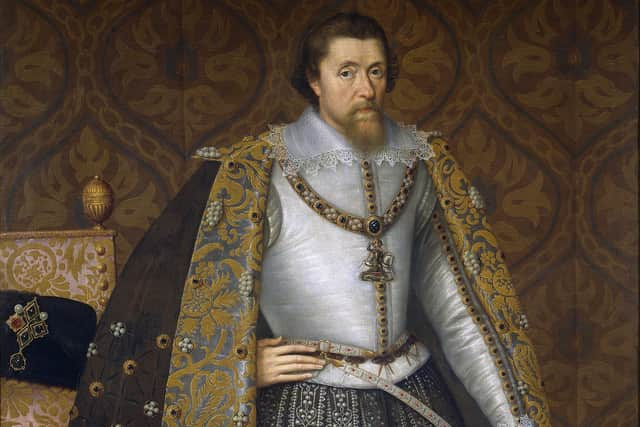

There was no inevitability to the Union of the Crowns. It came about essentially as the result of a dynastic accident: the inability of the Tudors, more specifically the offspring of Henry VIII, to reproduce themselves.
Edward VI died young and unmarried. Mary married Philip II of Spain but was too old to bear children. Elizabeth I, ‘the Virgin Queen’, had never married. Thus, it was that Henry VII’s great-great grandson, James I and VI, succeeded Elizabeth I, his granddaughter. There was one further element of chance: if James had not been a Protestant he would probably have been unacceptable to English opinion.
On April 5 1603 James left Edinburgh for Westminster. James’s progress south was warmly welcomed: ‘If ever there was an act in which the nation [England] was unanimous it was the welcome with which the new sovereign was greeted.’
English men and women had worried about the succession, a recurring theme in many of Shakespeare’s Histories, and feared a return to the Wars of the Roses, the civil wars which also feature prominently in the Bard’s work. A peaceful succession and the avoidance of civil war were much appreciated and greatly valued.
James, for his part, looked forward to getting his hands on his new kingdom’s wealth. Compared to Scotland, England was immensely rich, a point underscored by the fact that Scotland would account for only two per cent of Royal revenue. However, James little realised how parsimonious the English Parliament could be.
James, who was 37, told his English Parliament that he was ‘an old and experienced king’. He had become King of Scots when he was 13 months old and had begun to play an active role in government at the age of 11. By the age of 19 he was the effective ruler of Scotland.
Objectively, he was the most experienced monarch to accede to the English throne since William the Conqueror as well as one of the greatest of all Scottish kings. James was also a philosopher prince, writing political treatises like The Trew Law of a Free Monarchy (1598) and Basilikon Doron (‘The Prince’s Gift’, advice for his son on the conduct of kingship, written in 1598 but published in 1599), debating theology with learned divines, and reflecting continually on the art of statecraft. However, differences between the political culture of England and Scotland did place him at something of a disadvantage in England.
James wanted more than a Union of the Crowns; he wanted ‘a perfect union’. Contemporaries viewed a Union of the Crowns as ‘an imperfect union’: a union of sovereign states under a common authority, without a union of laws. ‘A perfect union’, such as that achieved between England and Wales in 1536, would involve full integration.
A tract in 1604, advocating perfect union, observed that the Union of Crowns was like the union of Portugal and Spain, ‘wherein there can be no great assurance of continuance’. In other words, imperfect unions were viewed as impermanent. The union of Portugal and Spain did not endure nor did the Union of Kalmar (the union of Poland and Lithuania). James sought permanence.
James’ desire to create a unified monarchy, a single parliament, a congruous church, a unified legal code, an interdependent economy, an integrated elite, and in due course, a British people could only be achieved with the support of the English and Scottish Parliaments. Debates on legislative union in the English Parliament were to reveal the full depth of English prejudice against the Scots.
James was able to take several steps unilaterally. First, he declared that the Anglo-Scottish Borders should be known as ‘the Middle Shires’. Secondly, in October 1604 he issued a decree pronouncing himself ‘King of Great Britain, France and Ireland’. Thirdly, in November he created a common Anglo-Scottish currency, including a 20-shilling piece called a ‘Unite’.
However, this all fell significantly far short of his aspirations. The immediate impact of the Union of the Crowns was not as far-reaching as might have been expected. Scotland no longer needed a separate foreign policy. The Anglo-Scottish Borders or ‘the Middle Shires’ could be more readily pacified than hitherto. And the Union of the Crowns would have implications for Ireland, more especially Ulster.
Despite James I’s wishes, England and Scotland remained independent states until 1707 (except for a brief period of legislative union during the Interregnum when the entire British Isles came under the rule of the Parliament at Westminster). Great Britain came into existence in May 1707 – a full century after James’ dream of a union of his kingdoms. However, James’ vision of ‘one King, one Flock, one Law’ was unobtainable.
The Anglo-Scottish Act of Union of 1707 cannot be described as ‘a perfect union’, to borrow the terminology of the early 17th century, or be equated with full integration because it was a union that accommodated diversity. The House of Stuart’s efforts to impose uniformity, especially at the end of the 1630s, had ended in disaster. The Scots retained their own legal system based on Roman law rather than the English common law, although the House of Lords became the highest court of appeal from the Scottish courts. Presbyterianism remained the established church in Scotland, recognition that Scottish Presbyterians could never be reconciled to Anglicanism.