
George Orwell is the most influential post-war British author, and his prescient writing remains part of our language
George Orwell was the most influential British writer since 1945. Many of his neologisms – such as ‘Big Brother’, ‘Thought Police’, ‘Room 101’, ‘Newspeak’, ‘memory hole’, ‘doublethink’ and ‘thoughtcrime’ – have a permanent and enduring place in the English language. (Well, for the moment at any rate.)
When in November 2024 Essex police visited the journalist Allison Pearson following a complaint about a social media post a year earlier it prompted the front-page headline in one newspaper, “Thought police in Starmer’s Britain ‘like Soviet Union’ warns Boris”.
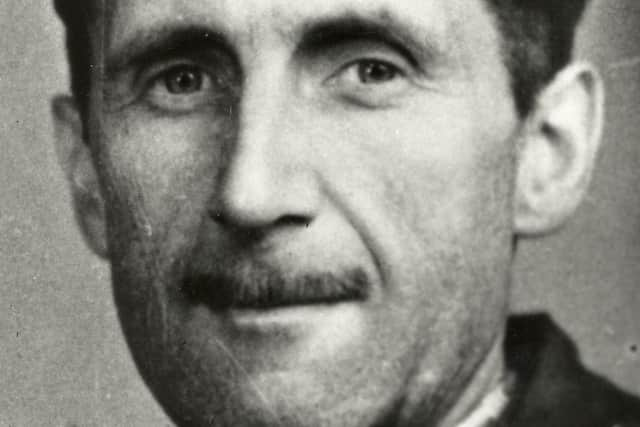

Orwell was born Eric Arthur Blair on June 25 1903 in eastern India, the son of a British colonial civil servant. He was educated in England and, after he left Eton, joined the Indian Imperial Police in Burma. He resigned in 1927 and decided to become a writer.
In 1928, he moved to Paris where lack of success as a writer forced him into a series of menial jobs. He described his experiences in his first book, 'Down and Out in Paris and London', published in 1933. He took the name George Orwell, shortly before its publication. This was followed by his first novel, 'Burmese Days', in 1934.
An anarchist in the late 1920s, by the mid to late 1930s he had begun to consider himself a socialist. In 1936, he was commissioned to write an account of poverty among unemployed miners in the north of England, which resulted in 'The Road to Wigan Pier' (1937).
The defining political experience of his life was the six months he spent in Spain as a Republican volunteer against Franco in 1937.
He was wounded in the throat – the bullet passing within a few millimetres of his carotid artery – and was present in Barcelona when Soviet-sponsored hit-squads attempted to suppress the Trotskyist POUM militia, of which he had been a member, and all other socialist dissent.
Although not a Trotskyite, Orwell had to flee from Spain in fear of his life. The experience instilled in him an enduring hatred of totalitarianism and turned him into a lifelong anti-Stalinist.
In his essay ‘Looking Back on the Spanish War’ (1943) Orwell wrote: ‘I am willing to believe that history is for the most part inaccurate and biased, but what is peculiar to our own age is the abandonment of the idea that history could be truthfully written.’
He had already demonstrated this in his memoir ‘Homage to Catalonia’ (1938): ‘Early in life I have noticed that no event is ever correctly reported in a newspaper, but in Spain, for the first time, I saw newspaper reports which did not bear any relation to the facts, not even the relationship which is implied in an ordinary lie. I saw great battles reported where there had been no fighting, and complete silence where hundreds of men had been killed. I saw troops who had fought bravely denounced as cowards and traitors, and others who had never seen a shot fired hailed as heroes of imaginary victories; and I saw newspapers in London retailing these lies and eager intellectuals building emotional superstructures over events that never happened. I saw, in fact, history being written not in terms of what happened but of what ought to have happened according to various “party lines”.’
In ‘Why I write’ (1946), Orwell set out his convictions: ‘Every line of serious work that I have written since 1936 has been written, directly or indirectly, against totalitarianism and for democratic socialism, as I understand it’.
Between 1941 and 1943, Orwell worked for the BBC. In 1943, he became literary editor of Tribune, the left-wing weekly. By now he was a prolific journalist, writing articles, reviews and books.
As early as July 1943, he anticipated in his war-time diary the difficulties he would encounter in highlighting and exposing the evils of Stalinism: ‘One could not have a better example of the moral and emotional shallowness of our time, than the fact that we are now all more or less pro-Stalin. This disgusting murderer is temporarily on our side, and so the purges, etc, are suddenly forgotten.’
Orwell wrote ‘Animal Farm’ between November 1943 and February 1944 and by April 1944 it was ready for publication.
Gollancz, who had previously published some of Orwell’s books, refused it, viewing it an attack on the Soviet Union and a crucial ally in the war. A similar fate was met from other publishers, including T S Eliot at Faber & Faber, until Jonathan Cape agreed to run with it.
Even in the United States, according to Peter Viereck, writing in 1952 (in a journal edited by Henry Kissinger), there was a concerted effort to prevent publication.
Published on August 17 1945, it is a political fable set in a farmyard, mirroring the course of Russian history between the Bolshevik Revolution and the establishment and consolidation of the Stalin dictatorship.
The book made Orwell's name and ensured he was financially comfortable for the first time in his life.
When ‘Animal Farm’ was published, ‘Nineteen Eighty-Four’ was already a work in progress. It was beginning to take shape in his mind, if not on paper, in 1943 or 1944. Again, his purpose was to warn the world of the dangers of Stalinism and its onward march.
The title was probably simply an inversion of 1948, the year he completed the book. Written in a remote and inaccessible farmhouse without running water and electricity on the island of Jura, 'Nineteen Eighty-Four' was an exhausting race against time because Orwell’s health was deteriorating rapidly. It was published in the UK on June 8 1949.
He died of tuberculosis on January 21 1950.
And its core messages:
First: ‘One does not establish a dictatorship in order to safeguard a revolution; one makes the revolution in order to establish the dictatorship. The object of persecution is persecution. The object of torture is torture. The object of power is power’.
Secondly: ‘If you want a picture of the future, imagine a boot stamping on a human face, forever. The moral to be drawn from this dangerous nightmare situation is a simple one: don’t let it happen. It depends on you.’