
Historical sites to get accessibility boost for blind visitors
New training is being undertaken at historical sites across Northern Ireland, such as Carrickfergus Castle, to help make them more accessible to those with visual impairments.
Communities Minister Gordon Lyons visited the castle on Friday and was taken through a number of initiatives provided by Guide Dogs NI to help blind people appreciate the site.
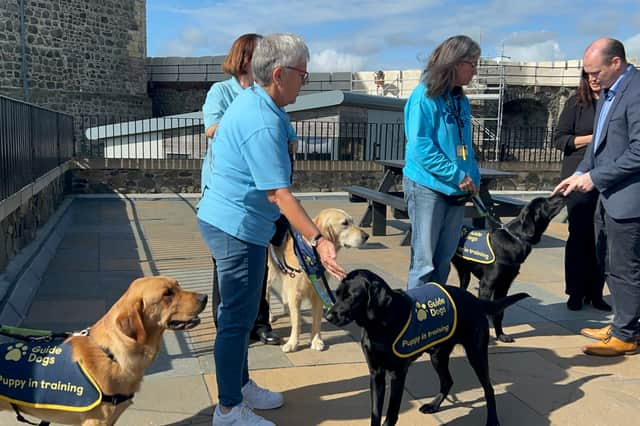

These include guiding advice for staff to help them direct blind people around the castle, by offering their arm to allow them to safely navigate the castle while remaining in control.
People can also be helped to touch different surfaces around historical sites, or some exhibitions such as suits of armour, to give a sense of the artefacts.
The minister was also given a demonstration of Meta glasses, which can be used by visually impaired people to ask for descriptions of the room around them, or to read writing on an object a person is holding, for example, the label on a tin.
Guide Dogs NI have carried out similar training at Dunluce castle and hope to expand further.
Mr Lyons said he wanted Northern Ireland’s historical sites to be “enjoyed by everybody” and that is “not always the case because of issues to do with access and inclusion”.
He said: “We’re investing more money to make it more open to give people the opportunity, whatever the challenges they have, to enjoy these fantastic monuments and sites right across Northern Ireland.
“So it was brilliant to work with Guide Dogs to be able to see the things that we can do to make things easier, and so that people can enjoy what we have here to offer.”
He added: “We’ve been working across all of our historic sites to make sure that we do what we can to make them more accessible, so that it’s not shut off to anybody, but that everybody can come and enjoy – and what’s really stood out to me today are the small things that we can do to help those who are blind or partially sighted to make it easier for them.”
Torie Tennant, who has been blind since birth, attended the event with her guide dog Vivvy.
She urged people to be proactive in offering assistance to blind people in public, by “offering your arm” and allowing them to hold the arm just above the elbow, enabling them to be guided without being pulled along.
“I would always say if you see someone and you think they might need help, offer that help,” she said.
“Now, if someone refuses, that’s OK, but someone might say, ‘Yes, that’s grand, I need a bit of help getting around these roadworks’ or whatever it may be.
“But something as simple as just introducing yourself and offering your arm is such a beneficial skill because a lot of people want to help but they don’t want to patronise, but then you have other people where you’re just grabbed and that’s never OK.
“Because nobody would want to be grabbed, I don’t know what your intentions are, whereas if you introduce yourself and offer your arm, it’s much more safer, I feel much more in control, and it just works far better.”
Mark Quinn from Guide Dogs NI said the training at historical sites highlights that accessibility comes in a range of forms, not just guide dogs.
“We have long-cane training, we have a children and young people’s service, and all of that adds together to create a really independent, active life for people with a vision impairment,” he said.
“That’s so important that the dogs are available, but they may not be suitable for everybody.
“So we have a wide range of offers for people who are blind or partially sighted that they can avail of to just live as actively and independently as they wish.”