
Joseph R Fisher was a vital influence for unionism as Boundary Commission determined the border between Northern Ireland and Irish Free State
The Irish Boundary Commission was established under the terms of Article 12 of the Anglo-Irish treaty of 6 December 1921 to determine the border between the Irish Free State and Northern Ireland ‘in accordance with the wishes of the inhabitants, so far as may be compatible with economic and geographic conditions’.
The body consisted of three commissioners: Eoin MacNeill, appointed by the Free State government; Joseph R Fisher, appointed as the Northern Ireland representative by the British government (the Northern Ireland government had refused to recognise the Boundary Commission because it was not a party to the Anglo-Irish treaty); and the chairman, Justice Richard Feetham, a British-born South African-based judge who was also appointed by the British government.
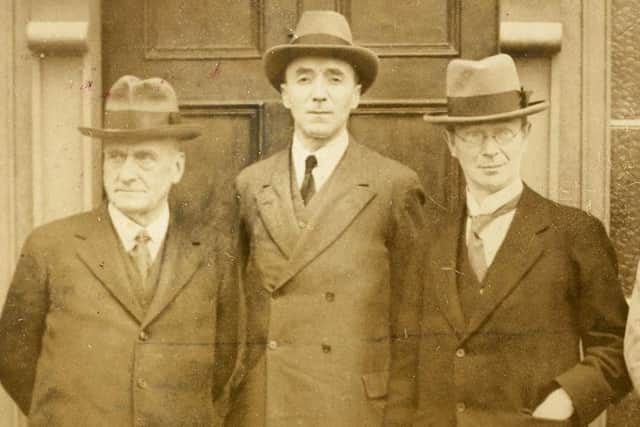

Here we examine the role of J R Fisher.
Fisher was born in 1855 in Raffrey, Co Down, youngest among three sons and one daughter of the Rev Ringland Fisher, the local Presbyterian minister, and his wife Sarah (née English). He was educated at Inst and Queen’s College, Belfast, the precursor of QUB, graduating with a BA in 1876. After studying in Germany and France, he was called to the English bar.
However, he was more interested in journalism and political history than law and embarked upon a successful career in London as a journalist. Briefly foreign editor of the Daily Chronicle (1881-83), he served as assistant editor of the Standard (1883-91). He also wrote widely on foreign affairs.
His historical works included ‘Finland and the czars’ (1901) and ‘The End of the Irish Parliament’ (1911). Fisher and J A Strahan jointly produced ‘The Law of the Press’ in 1891.
Politically, he was a Liberal Unionist and in 1891 he became editor of the Northern Whig, the News Letter’s liberal unionist counterpart, a position he relinquished because of ill-health in 1913.
In 1914 the Ulster Reform Club published ‘The Ulster Liberal Unionist Association; a sketch of its history’ with Fisher contributing the introduction in which he paid handsome tribute to the work of the association and Thomas Sinclair, the author of the Ulster Covenant.
At the Craigavon demonstration of September 1911, Sir Edward Carson told his audience: ‘We must be prepared ... the morning Home Rule passes, ourselves to become responsible for the government of the Protestant Province of Ulster.’
Carson believed that Home Rule was not economically viable without Ulster’s – and more specifically Belfast’s – heavy industry and that John Redmond, the Nationalist leader, and Irish nationalist opinion would never accept Home Rule with Ulster exclusion. Carson was convinced that if he could demonstrate that Ulster Unionists were resolute in their determination to oppose Home Rule, Home Rule would be ‘dead as a stone’.
But whereas Carson viewed the threat of partition as a stratagem to frustrate Home Rule, Ulster was Fisher’s focus and he favoured partition as a desirable outcome in itself. Liberal Unionists in Ulster tended not to be overly sentimental about the rest of Ireland.
During the Great War Fisher resumed his career in journalism in London and represented The Times in Ireland between 1919 and 1921.
Although Sir James Craig refused to recognise the boundary commission, Fisher was appointed to the commission by the British government to represent the government of Northern Ireland in October 1924.
As Fisher was a longstanding friend and political ally of Craig, Craig was probably very happy with the appointment.
Fisher believed Northern Ireland would benefit from adjustments to the border (and had told Craig so as early as 1922). For example, he was keen to trade south Armagh in return for predominantly unionist parts of north Monaghan and east Donegal, and believed that nationalist areas in Northern Ireland could be safely controlled behind ‘a solid ethnographic and strategic frontier to the south’.
Although at the outset, Feetham, MacNeill and Fisher agreed to keep the work and proceedings of the commission confidential, because the commission potentially represented an existential threat to the future of Northern Ireland this commitment did not weigh heavily with Fisher.
In October 1924 he advised Wilfrid Spender, the Cabinet secretary, to set up a back channel of communication so that the Unionist government could provide ‘the necessary statistical, economic and topographical information’ to refute Dublin’s claims.
In November and December he was writing to Robert Lynn, the editor of the Northern Whig and an MP at both Westminster and in Belfast, about the work of the commission. He wrote a great many letters to Florence Reid, wife of the Ulster Unionist leader at Westminster, who effectively acted as a conduit to the Unionist leadership.
For example, on October 18 1925 David Reid informed James Craig, on the basis of his wife’s correspondence that ‘Newry and the whole of Co. Down is safe’. On the same day Fisher assured Carson that ‘no centre of even secondary importance goes over, and with Derry, Strabane, Enniskillen, Newtownbutler, Keady and Newry in safe keeping, your handiwork will survive’. He concluded by observing, ‘if anybody suggested 12 months ago that we could have kept so much I would have laughed at him’.
In November 1925 the recommendations of the boundary commission were leaked to the Morning Post. The Post, a paper since absorbed by the Daily Telegraph, published a largely accurate map of the commission’s award with an accompanying commentary which noted that ‘no important territory will go to the Free State. The changes proposed will consist of adjustments only. Ulster will lose neither Enniskillen or Newry’.
Fisher’s correspondence with Lynn, Spender and Florence Reid makes him the prime suspect but he never admitted to being the culprit and he may not have been.
The leak precipitated a crisis which resulted in the abandonment of the commission and the burying of its report in favour of a tripartite agreement confirming the existing border while releasing both the Free State and Northern Ireland from financial obligations arising out of the Anglo-Irish Treaty.
Fisher’s admirers credit him with playing an important role in preventing the commission from weakening the Northern Ireland state by assisting Unionists to shape their representations in ways that would carry weight with Feetham.
After the commission Fisher returned to London to write articles in London dailies or learned periodicals. He died there on October 27 1939.