
Robert Todd Lincoln was destined to live in his father Abraham’s shadow
Robert Todd Lincoln was the eldest son of President Abraham Lincoln and Mary Todd Lincoln and the only one of their four children to survive to adulthood.
During the last weeks of the Civil War, Robert served on U S Grant's staff and was ‘exceedingly popular’ with the rest of the staff because he ‘was always ready to perform his share of hard work’ and ‘never expected to be treated differently from any other officer’ because he was the president's son. Robert was present at Appomattox when Robert E Lee surrendered (and was the last-surviving witness of this event).
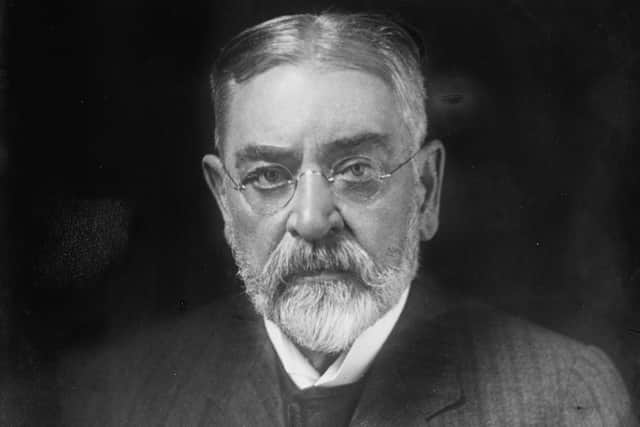

After Harvard and legal studies in Chicago, he built a successful law practice representing corporate clients and was general counsel of the Pullman Company. When George Lincoln Pullman, the company founder, died in 1897, Robert succeeded him as president of the company. After retiring from this position in 1911, Robert served as board chairman until 1924.
Between 1884 and 1912, Robert was often in the frame for the Republican presidential or vice-presidential nomination but he repeatedly indicated that he would not accept nomination for either position.
In 1877 he rejected President Rutherford Hayes’ offer to appoint him Assistant Secretary of State but he served as Secretary of War in the administration of James Garfield, continuing under Chester Arthur. In 1889, President Benjamin Harrison nominated Robert, without his knowledge, as US minister to Great Britain, an appointment the Senate approved. Robert accepted and served as ambassador from 1889 to 1893.
Coincidentally (incredibly might be a better word), Robert had either been present or near the assassination of the first three American presidents to meet that fate. Although he did not go to Ford’s Theatre the night his father was shot, he attended his father’s death bed.
In 1881 he was at Washington train station when President Garfield was shot by Charles J Guiteau, a disappointed and delusional office-seeker.
In 1901 he was just outside the building where President McKinley was fatally wounded by Leon Czolgosz, an anarchist, at the Pan-American Exposition at Buffalo.
Robert became convinced that he was a bad omen for presidents and made a point of declining presidential invitations, pointing out that ‘there is a certain fatality about presidential functions when I am present’.
He made an exception for the dedication of the Lincoln Memorial in May 1922 and happily nothing untoward occurred to either Chief Justice William Howard Taft (who had previously been the 27th president) or President Warren Harding who were both present on that occasion.
Robert is at the centre of yet another remarkable story. In either late 1863 or early 1864 Edwin Booth, brother of his father’s future assassin, saved Robert from serious injury or death on a train platform in Jersey City, New Jersey.
Robert provided an account of this episode in a letter to the editor of ‘The Century Magazine’ in 1909:
‘The incident occurred while a group of passengers were late at night purchasing their sleeping car places from the conductor who stood on the station platform at the entrance of the car. The platform was about the height of the car floor, and there was of course a narrow space between the platform and the car body. There was some crowding, and I happened to be pressed by it against the car body while waiting my turn. In this situation the train began to move, and by the motion I was twisted off my feet, and had dropped somewhat, with feet downward, into the open space, and was personally helpless, when my coat collar was vigorously seized and I was quickly pulled up and out to a secure footing on the platform. Upon turning to thank my rescuer I saw it was Edwin Booth, whose face was of course well known to me [because he was the most celebrated actor in the United States at the time], and I expressed my gratitude to him, and in doing so, called him by name’.
At the time Booth did not know that the man he had assisted was the president’s son but the incident was said to have been of some comfort to Edwin Booth following his brother's assassination of President Lincoln.
Michael Burlingame, the author or editor of 20 scholarly books about Abraham Lincoln, considers Robert Todd Lincoln to be ‘a particularly unfortunate, even tragic figure’.
Quite apart from the tragedy surrounding his father’s assassination, Robert had a distant relationship with his father, in part because, during Robert's formative years, Abraham Lincoln spent months away on the judicial circuit. Robert recalled, ‘During my childhood and early youth he was almost constantly away from home, attending court or making political speeches.’
His relationship with his mother was no easier. She had serious mental health issues – depression or possibly bipolar disorder. After all, she had to cope with the death of three of her four sons as well as that of her husband.
Fearing that she was a danger to herself, he arranged to have her committed to a psychiatric hospital in 1875. The director of the institution, who at Mary Todd Lincoln’s commitment trial assured the court she would benefit from treatment at his facility, then declared her well enough to go to Springfield to live with her sister. These events comprehensively alienated Robert from his mother.
In 1890, during Robert’s term as ambassador to London, his 16-year-old son, Abraham II ‘Jack’, died of blood poisoning after a minor operation. Robert wrote: ‘Jack was to us all that any father and mother could wish and beyond that, he seemed to realise that he had special duties before him... I did not realise until he was gone how deeply my thoughts of the future were in him.’ To another friend, Robert admitted simply, ‘the loss is very hard to bear’.
Robert, while completely loyal and protective of his father’s memory and legacy, lived in his father’s shadow. He once observed, ‘No one wanted me for Secretary of War... For minister to England... For president of the Pullman Company; they wanted Abraham Lincoln's son.’ Sadly, he may well have been right.
Opinions differ as to his ability but Fanny Seward, daughter of W H Seward, the US Secretary of State from 1861 to 1869, described him as ‘ready and easy in conversation having, I fancy, considerable humor in his disposition… agreeable, good-natured, and intelligent’. A serious amateur astronomer, he built his own observatory.
Robert died, just days before his 83rd birthday, on July 26 1926.