
Business bodies write joint letter to Sinn Fein minister warning that her Good Jobs Bill could damage the local economy
Over twenty business groups have written a joint letter to Stormont’s economy minister warning her not to rush through major changes to employment laws as businesses struggle with inflation and soaring costs.
They say that given the economic picture, changes to business regulation and workers rights can’t be fully scrutinised by the end of this Assembly term – and have implied that the Sinn Fein minister’s plans could jeopardise jobs and economic recovery.
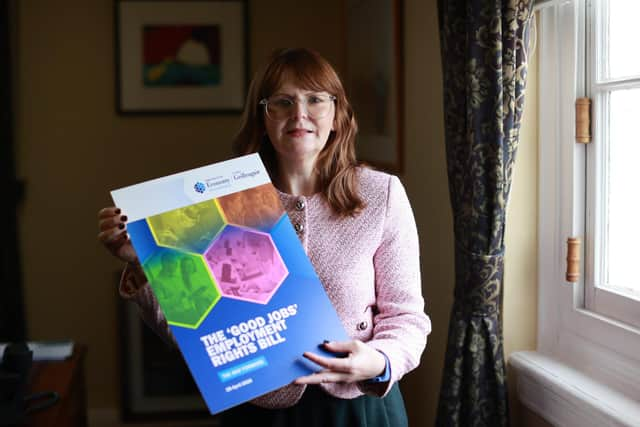

Caoimhe Archibald is pushing ahead with her Good Jobs bill, which would include around 50 new measures – including day one employment rights, increased recognition of trade unions in small businesses and replacing zero hours contracts.
Trade unions have broadly backed the Sinn Fein plans, with Nipsa previously claiming business sounded like a “broken record” and warning of a “prolonged propaganda offensive” by industry.
However, a coalition of business groups says that the legislation should not be “rushed” through in the short time left in this Assembly mandate. The bodies, representing manufacturing, retail, logistics, farming, agri-food, construction, hospitality and professional services, have warned the minister that the “scope, pace and timing of the legislation” comes at a time of unprecedented pressures for all businesses across Northern Ireland.
Among their concerns is a proposal to lower the threshold for union recognition from 21 to 10 employees – alongside new union access measures. The groups say this will add administrative and cost burdens for small businesses and family owned firms.
Whilst acknowledging that the Sinn Fein minister has listened to some of their concerns, the business coalition says the economic environment “is extremely challenging” – citing cumulative UK inflation rising by more than 20% since the outbreak of war in Ukraine in 2022, sustained energy price pressures and heightened global instability.
“With no end in sight, economic shocks continue to erode business resilience, along with significant added costs of doing business and employing skilled workers”, the groups – including FSB Northern Ireland, Hospitality Ulster and Manufacturing NI – said in a joint statement.
In their letter to the minister, the business lobby groups said: “We are increasingly concerned that we are running out of time to ensure that full and proper scrutiny can be given to the Bill, or indeed, any potential amendments. The risk of unintended consequences is now so significant that all consideration should be given to deferring the Bill to the next mandate. The stakes for workers, employers, and the wider economic recovery are simply too high.”
The group added: “We share the Minister and Executive’s ambition for a globally competitive and sustainable economy. At a time when youth unemployment remains stubbornly high, job creation is stalling, and business confidence is at record lows, the Executive must do better in responding to employers' concerns if it hopes to reverse any of those trends”.
The DUP says that Sinn Fein’s flagship employment rights legislation is unravelling as a result of a “backlash” from business groups.
The unionist party says the Good Jobs bill is “now in serious difficulty” following “an unprecedented intervention” from trade bodies representing Northern Ireland’s business community.
Reacting to the news, the DUP said: “For the first time, a broad coalition of representative organisations has collectively raised fundamental concerns about both the content and handling of the Bill, rejecting key elements of the Minister’s approach, making clear they oppose the progression of this legalisation”.
The party’s economy spokesman Phillip Brett, who chairs Stormont’s economy committee, said: “Sinn Fein have spent over two years cheerleading this Bill, yet it now appears to have fallen at the first hurdle.
“This situation was entirely avoidable. The Minister promised partnership with business and delivery of legislation before Christmas. Neither has been achieved.
“At a time when businesses are already under intense pressure from rising costs and constrained public finances, this approach is deeply irresponsible.
“For business to take such an unprecedented move, means this intervention cannot be ignored. The Minister must now take responsibility for this situation. She was warned repeatedly.
“Securing the support of the business community was her responsibility, and she has clearly failed to do so. This failing goes beyond a single Bill. It is yet another example of sustained weakness at the Department for the Economy under Sinn Fein leadership.”
Public sector trade union Nipsa – the largest union in NI – has previously dismissed business concerns. In response to the minister’s consultation on her plans, it said “We all… need to be spared the ‘we can’t cope’ noises from employers who have had an employment world created in their image for decades”.